
Let’s be totally real for a second. Butter is basically the soul of the culinary world. It is the reason that restaurant steak tastes so much better than the one you make at home. It is the secret to that perfect, flaky pastry. It is the gold standard of flavor.
But if you are living with Gastroesophageal Reflux Disease (GERD) or even just frequent acid reflux, butter can feel like a direct betrayal. You are sitting there in your early twenties, trying to enjoy a normal brunch with your friends, and suddenly your chest is on fire because the chef decided to bathe your eggs in a half stick of butter.
It is frustrating. It is annoying. And it makes you feel like you are eighty years old when you have to ask the waiter if something is cooked in oil or butter.
I get it. I have been the person at the table awkwardly questioning the ingredients while everyone else is face deep in eggs benedict. It feels like your body is glitching out on one of the most basic ingredients in the world.
The big question we are tackling today is pretty straightforward: is butter actually bad for GERD? And if it is, do you have to live a sad, dry-toast life forever?
The short answer is that butter is a major trigger for most people. But the long answer is a bit more nuanced. It is about how much you use, what you pair it with, and how your specific “internal plumbing” handles fat. Let’s break it down so you can stop the burn without losing all the flavor in your life.
The Science of the “Spicy Burp”
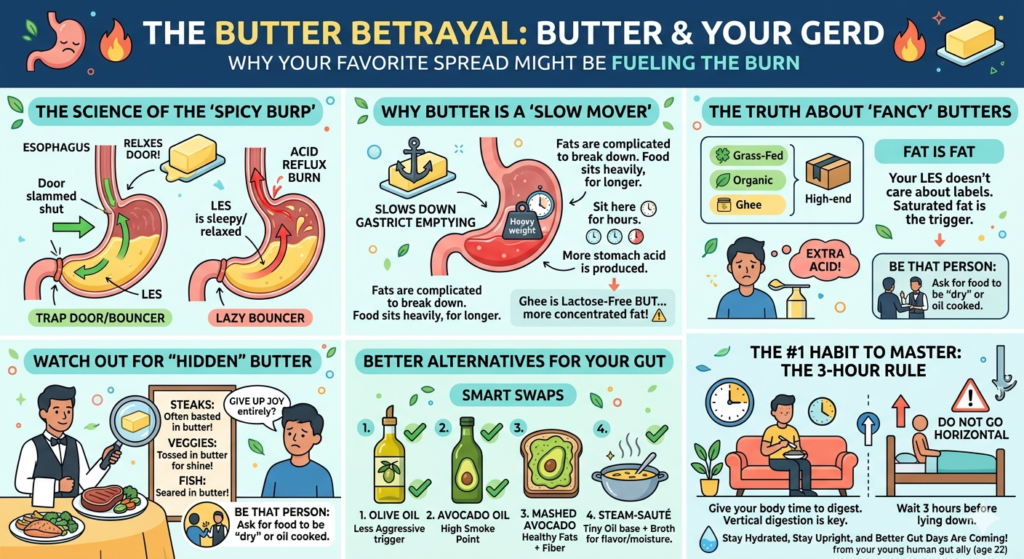
To understand why butter is such a problem, we have to look at the mechanics of your esophagus. Everyone has a little ring of muscle at the bottom of their throat called the Lower Esophageal Sphincter, or the LES.
Think of the LES as a “trap door” or a bouncer. Its only job is to open when you swallow food and then slam shut immediately to keep stomach acid down in the “acid pit” where it belongs.
When you have GERD, that bouncer is basically falling asleep on the job. The trap door stays slightly ajar, or it opens when it should not, allowing that spicy stomach acid to splash back up into your throat. That is the “burn” you feel.
So, where does butter fit into this? Butter is almost 100% fat. And fat is the ultimate “relaxant” for your LES. When you consume high-fat foods, your body releases a hormone called cholecystokinin. This hormone tells your stomach to slow down digestion so it can process the fat properly, but it also tells that trap door at the bottom of your throat to relax.
When the trap door relaxes, and the food stays in your stomach longer because fat takes forever to digest, you have the perfect recipe for a reflux disaster. You have a full stomach and an open door. It is not a good combo.
Why Butter is a “Slow Mover”
One of the biggest reasons butter triggers GERD is that it slows down your “gastric emptying.” This is just a fancy way of saying how fast food leaves your stomach.
Your stomach handles simple carbs like white rice or crackers pretty quickly. They are in and out. But fat is complicated. Your body has to work really hard to break down those fat molecules.
When you eat something loaded with butter, it sits in your stomach like a heavy weight. The longer food sits there, the more acid your stomach produces to try and break it down.
More acid plus more time in the stomach plus a relaxed trap door equals a bad night for your esophagus. This is why you might feel fine right after eating a buttery meal, but then two hours later, you are reaching for the antacids.
Is “Fancy” Butter Any Better?
In the age of social media, we see a lot of talk about grass-fed butter, cultured butter, and clarified butter (ghee). People love to claim that these “higher quality” fats are somehow magic and will not trigger the same issues.
Let’s keep it 100% real: your LES does not care if your butter came from a cow that listened to Mozart and ate organic clover. To your esophagus, fat is fat.
Saturated fat, which is what butter is primarily made of, is the biggest trigger for reflux. While grass-fed butter might have more vitamins or omega-3s, the fat content that causes the LES to relax is still there.
Ghee is an interesting one, though. Ghee is clarified butter, meaning the milk solids and water have been removed. Some people with dairy sensitivities find it easier on their stomach because the lactose is gone. However, it is even more concentrated in fat than regular butter. So, if your GERD is triggered by fat volume rather than dairy itself, ghee might actually be harder on you than regular butter.
Hidden Butter in the Wild
The hardest part about managing GERD when you are young and social is that butter is literally everywhere. It is the “invisible” ingredient.
You go to a steakhouse? They probably “baste” the steak in butter before it hits your plate. You get steamed veggies at a cafe? They are likely tossed in butter to make them look shiny and taste better. Even that “healthy” salmon you ordered was probably seared in a pan with a generous pat of butter.
This is why “eating out” can be such a minefield. You think you are making a safe choice, but the hidden fat load is way higher than you realize.
The best way to handle this is to be that person who asks for their food to be “dry” or cooked in a little olive oil. It feels awkward at first, but it beats the alternative of spending the rest of the night in pain.
The Mental Game: “Food Fear” is Real
When you start realizing that butter and other fats trigger your pain, it is easy to develop what I call “food fear.” You start looking at every meal like a potential enemy. You stop going out to eat because you do not want to deal with the stress of it.
That is not a way to live, especially in your twenties. The goal is not to live a “zero butter” life. It is to understand your threshold.
Maybe you can handle a tiny bit of butter on a piece of sourdough toast, but a buttery croissant sends you over the edge. Maybe you can handle butter at lunch when you are upright and moving, but having it for dinner is a disaster.
Finding your personal “tolerance level” is the key to managing GERD without losing your sanity.
Better Alternatives for Your Gut
If you want to keep the “vibe” of butter without the “burn” of butter, you have to get a little creative.
Olive oil is a great alternative. While it is still a fat, it is a monounsaturated fat. For some reason, many people find that high-quality olive oil does not trigger that immediate LES relaxation quite as aggressively as saturated fats like butter or lard. Plus, it is great for your heart.
Avocado oil is another winner. It has a very high smoke point, so you can sear things with it just like you would with butter, but it has a much “cleaner” profile for your digestive system.
If you are a fan of that creamy spread on your toast, try mashed avocado with a little salt and lemon juice. It gives you that rich, fatty mouthfeel but with fiber and healthy fats that your gut handles differently.
For cooking, try “steam-sautéing.” Use a tiny bit of olive oil and then add a splash of chicken or veggie broth to the pan. You get the flavor and the moisture without needing a mountain of butter to keep things from sticking.
The 3-Hour Rule and Butter
If you are going to indulge in something buttery, you absolutely have to follow the 3-hour rule.
Digestion is a vertical game. Gravity is your best friend. When you eat a high-fat meal, your stomach is full and the door is open. If you lie down on the couch or go to bed shortly after eating, you are literally inviting that acid to flow straight out of your stomach and into your throat.
If you are having a meal that involves butter, make sure you have at least three hours of “upright time” before you hit the hay. Go for a walk, do some laundry, or just sit up and watch a movie. Just do not go horizontal. This one habit can be the difference between a fine night and a night of “lava throat.”
Small Changes, Big Relief
You do not have to overhaul your entire life overnight. Start by swapping butter for olive oil in one meal a day. See how you feel.
If you notice a difference, keep going. If you do not, then you know that maybe butter is not your primary trigger, or you need to look at other parts of your diet.
The goal is progress, not perfection. Your gut is unique, and it might take some trial and error to find what works for you.
Do not be afraid to advocate for yourself at restaurants or at family dinners. Your health is more important than being a “polite” guest who suffers in silence later.
Final Thoughts
Is butter bad for GERD? For most of us, yeah, it is a major player in the reflux game. Its high fat content and its ability to slow down your stomach make it a perfect trigger.
But it does not have to be the end of the world. By choosing lower-fat alternatives like olive oil, being mindful of hidden butter when eating out, and respecting the “upright rule,” you can still enjoy your life.
Your gut is sensitive right now, and that is okay. Be patient with your body. Listen to the signals it is sending you. If you have a flare-up, do not beat yourself up. Just take note, pivot, and try a different approach next time.
You are more than your diagnosis. You can still be a foodie and a social butterfly; you just have to be a slightly more strategic one. Stay hydrated, stay upright, and remember that better gut days are coming!