
I feel like honeydew gets a really bad reputation for being the “filler” fruit in those grocery store fruit bowls.
You know the ones I mean.
It’s usually like three grapes, two pieces of pineapple, and then a literal mountain of green honeydew.
But honestly? I’ve always kind of liked it.
It’s refreshing, it’s sweet, and when it’s actually ripe, it’s lowkey elite.
However, there is a dark side to this melon that nobody really talks about until they’re sitting on their couch three hours later feeling like they swallowed a literal basketball.
We’re talking about the bloat. The rumbling. The gas.
If you’ve ever wondered “does honeydew cause gas,” you are definitely in the right place.
I’ve done the deep dive (and suffered the stomach aches) so you don’t have to.
Let’s get into why this innocent looking melon might be the reason your jeans feel three sizes too small today.
The Sugar Culprit: Fructose is the Main Character
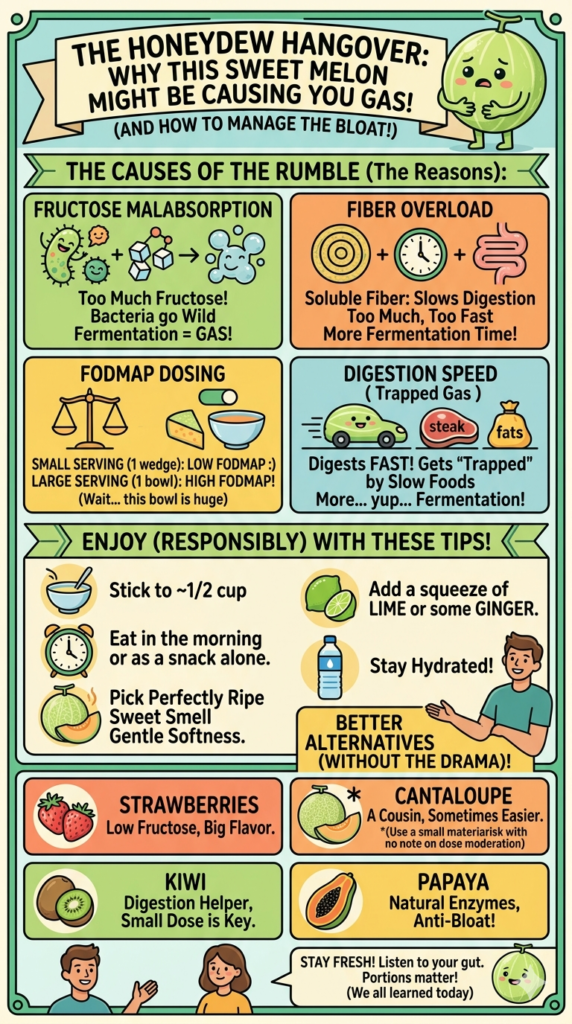
The biggest reason honeydew can cause gas boils down to one word: fructose.
Fructose is the natural sugar found in fruit.
Most people handle it just fine, but your body has a limit on how much it can process at one time.
Think of your small intestine like a tiny, busy highway.
When you dump a whole lot of honeydew in there, you’re basically creating a massive traffic jam of sugar.
If the sugar doesn’t get absorbed quickly enough in the small intestine, it moves down into the large intestine.
This is where the trouble starts.
The bacteria in your large intestine are basically like college kids at a free pizza party when they see that sugar.
They start fermenting it immediately.
And what is the byproduct of fermentation?
Gas.
Lots and lots of gas.
So, if you’re eating a massive bowl of honeydew on an empty stomach, you’re essentially giving those bacteria a massive sugar rush.
The result is that bubbly, uncomfortable feeling that makes you want to cancel your plans and hide under a blanket.
The Fiber Factor: Too Much of a Good Thing
We’re always told that fiber is the holy grail of health.
Eat more fiber, they say. It’ll be great, they say.
And for the most part, that is true.
But honeydew contains a decent amount of soluble fiber.
Soluble fiber absorbs water and turns into a sort of gel during digestion.
This is great for keeping things moving, but if your body isn’t used to it, or if you eat a lot of it at once, it can slow down your digestion.
When food sits in your system longer than it should, it has more time to sit there and… well, ferment.
It’s a bit of a theme here, isn’t it?
Everything leads back to fermentation.
If you aren’t a regular fruit eater and you suddenly decide to smash half a melon, your digestive system is going to be very confused.
It’s like trying to run a marathon when you haven’t even walked to the mailbox in three weeks.
Your gut needs time to adjust to that extra fiber load.
The FODMAP Situation
If you’ve ever looked into gut health or IBS, you’ve probably heard of FODMAPs.
It stands for Fermentable Oligosaccharides, Disaccharides, Monosaccharides, and Polyols.
Basically, it’s a fancy list of short-chain carbs that are notoriously hard for some people to digest.
Honeydew is actually a bit of a “yellow light” in the world of FODMAPs.
According to the experts (and the Monash University app, which is basically the Bible for this stuff), honeydew is low FODMAP in small servings.
Usually, that means about half a cup or a single wedge.
But once you cross over into that second or third cup?
It becomes a high FODMAP food because of the excess fructose.
This is why you might feel totally fine after a few bites but absolutely miserable after a whole bowl.
It’s all about the dose.
Most of us don’t stop at one wedge because honeydew is like 90% water and feels light.
But your gut knows exactly how much sugar is in there, and it will let you know if you’ve overstepped the boundary.
The “Melon Alone” Myth (Or is it?)
There’s this old school piece of advice in the wellness world that says “eat melon alone or leave it alone.”
I used to think this was just some weird “almond mom” pseudo-science.
But there is actually a little bit of logic behind it when it comes to gas and bloating.
Melons, including honeydew, digest incredibly fast compared to things like protein, fats, or even complex grains.
If you eat a big steak dinner and then have honeydew for dessert, the melon is ready to leave the stomach way before the steak is.
It gets “trapped” behind the slower-digesting food.
While it’s stuck there waiting for the exit to clear, it starts to break down and ferment.
That trapped gas has nowhere to go but up or… well, you know.
So, if you’re prone to bloating, eating honeydew as a standalone snack might actually be the move.
Give it its own lane so it can zip through your system without getting stuck in traffic.
Ripeness Matters More Than You Think
Have you ever bitten into a piece of honeydew that was kind of crunchy and tasted like a cucumber’s sad cousin?
That’s an underripe melon.
Underripe fruits contain more complex starches that haven’t fully converted into simpler sugars yet.
These starches are even harder for your enzymes to break down.
When you eat “hard” honeydew, you’re basically giving your stomach extra work that it didn’t sign up for.
On the flip side, overripe honeydew is basically a sugar bomb.
The perfect middle ground is a melon that is slightly soft to the touch and smells sweet at the “button” end.
If you’re eating fruit that isn’t ready, don’t be surprised when your stomach starts protesting.
It’s literally trying to tell you that it can’t handle the raw materials you just sent down there.
Is it a Food Allergy or Just Sensitivity?
Sometimes the gas isn’t just “gas.”
There is a thing called Oral Allergy Syndrome (OAS).
If you find that your throat gets a little itchy or your stomach gets extremely cramped right after eating honeydew, you might actually be reacting to the pollen.
Honeydew is often linked to ragweed pollen.
Your body sees the proteins in the melon and thinks, “Wait, is this ragweed?”
It triggers a mild allergic reaction that can manifest as digestive distress.
It’s not super common, but it’s worth keeping in mind if you feel genuinely sick rather than just a bit gassy.
Most of the time, though, it’s just the fructose doing its thing.
How to Enjoy Honeydew Without the Drama
I’m not here to tell you to stop eating fruit.
That would be terrible advice.
Honeydew is packed with Vitamin C, potassium, and hydration.
It’s basically a natural Gatorade.
If you love it but hate the gas, here are a few ways to play it smart:
1. Watch the Portion Size
Stick to about half a cup. I know it’s hard when it’s sitting there looking all juicy, but your small intestine will thank you.
2. Eat it on an Empty Stomach
Try having your melon in the morning or as a mid-afternoon snack by itself. Avoid the “melon for dessert” trap.
3. Check the Ripeness
Only eat it when it’s perfectly ripe. If it’s hard and flavorless, it’s not worth the bloat.
4. Pair it with Digestion Helpers
Some people find that a little squeeze of lime juice or a tiny pinch of ginger on the melon helps kickstart the enzymes needed to break it down. Plus, it tastes amazing.
5. Stay Hydrated
It sounds counterintuitive since melon is mostly water, but staying hydrated in general helps your fiber move through your system more smoothly.
Better Alternatives if You’re Done with the Bloat
If you’ve tried everything and honeydew still makes you feel like a human parade float, you might just be extra sensitive to fructose.
It happens to the best of us.
You can try switching to fruits that are lower in fructose and easier on the gut:
Strawberries and Raspberries: These are the GOATs of low-bloat fruit.
Cantaloupe: Interestingly, some people find cantaloupe slightly easier to digest than honeydew, though they are cousins.
Kiwi: Great for digestion and usually very low-gas.
Papaya: Contains papain, an enzyme that actually helps you digest food. It’s like the anti-honeydew.
The Bottom Line
So, does honeydew cause gas?
The short answer is: yes, it definitely can.
Between the fructose overload, the fiber, and the way it interacts with other foods, it’s basically a recipe for a bubbly stomach if you aren’t careful.
But it’s not a “bad” food.
It’s just a misunderstood one.
We’re all out here just trying to live our best lives and eat some fruit without feeling like we need to unbutton our pants.
If you pay attention to your portions and timing, you can probably keep honeydew in your rotation.
But if your gut is constantly screaming at you?
It might be time to pick a new favorite melon.
There are plenty of other fruits in the sea (or the produce aisle).
Listen to your body, keep the portions small, and maybe keep some ginger tea on standby just in case.
How does your stomach usually feel after a fruit salad?
Are you a “melon alone” believer or do you think it’s all a myth?