I’m just going to say it: blue cheese is polarizing.
You either think it’s the greatest culinary invention on the planet, or you think it smells like a locker room after a double overtime game.
Personally? I’m in the “love it” camp. Or at least, I was.
Until my stomach decided to start a literal uprising.
If you’ve ever finished a plate of wings with extra dipping sauce or a wedge of Gorgonzola only to feel like you swallowed a handful of hot coals twenty minutes later, you’re not alone.
We need to talk about why blue cheese and acid reflux are basically the toxic couple of the food world.
They’re obsessed with each other, but they’re absolutely ruining your life.
The Reality of the “Burn”
Before we dive into the cheese of it all, let’s get real about what acid reflux actually is.
It’s not just a “little burp.”
It’s Gastroesophageal Reflux Disease (GERD) or just standard reflux, and it feels like your internal organs are trying to exit through your throat.
Basically, there’s a little muscle at the bottom of your esophagus called the Lower Esophageal Sphincter (LES).
Think of it as the bouncer of your stomach.
Its only job is to let food in and keep acid down.
When you eat certain things—spoiler: blue cheese is a big one—that bouncer basically falls asleep on the job.
The door stays open, and stomach acid starts wandering back up where it doesn’t belong.
It’s gross, it’s painful, and honestly? It’s a total vibe killer.
Why Blue Cheese is the “Final Boss” of Reflux Triggers
So, why is blue cheese specifically so bad for people with sensitive stomachs?
It’s not just “cheese” in general.
While most dairy can be a bit tricky, blue cheese is like the final boss of reflux triggers.
It has a specific combination of traits that make it a nightmare for your LES.
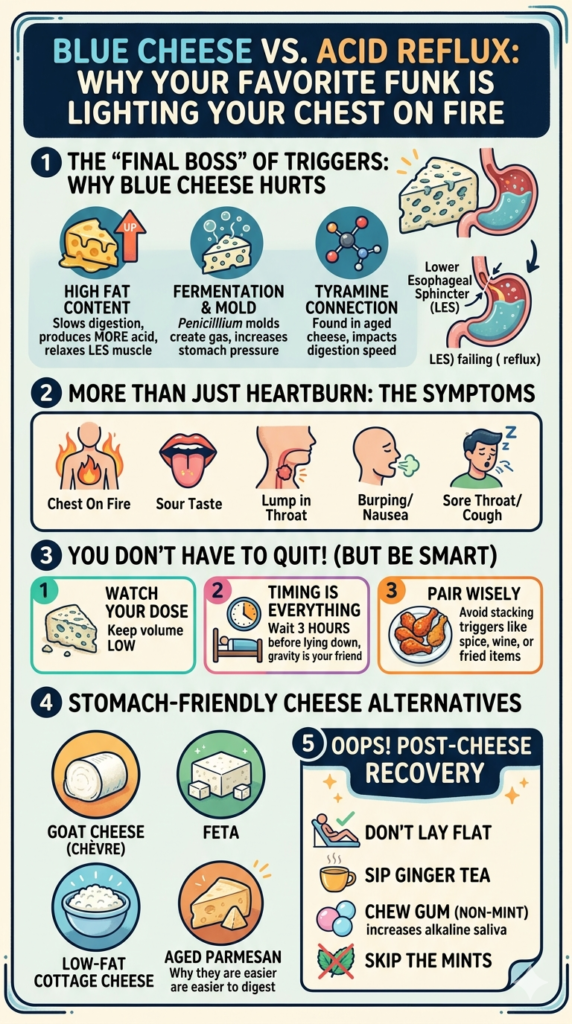
1. The High-Fat Content (The Heavy Hitter)
Blue cheese is notoriously high in fat.
I know, that’s why it tastes so good. It’s creamy, rich, and decadent.
But fat is the #1 enemy of anyone with acid reflux.
Fatty foods take forever to digest.
When food sits in your stomach for a long time, your body has to produce more acid to break it down.
Plus, high-fat foods actually signal that “bouncer” muscle (the LES) to relax.
So you’ve got a stomach full of extra acid and a door that won’t shut.
That is the perfect recipe for a night spent sitting upright in bed wondering why you didn’t just order a salad.
2. The Fermentation and Mold Factor
Blue cheese is, by definition, moldy.
It’s Penicillium roqueforti or Penicillium glaucum that gives it those iconic blue veins.
While these molds are safe to eat, they contribute to the cheese being highly fermented.
Fermented foods can be great for gut health for some people, but for others, they produce gases during digestion that increase pressure in the stomach.
More pressure means more acid being pushed upward.
It’s like shaking a soda bottle and then cracking the lid just a tiny bit.
3. The Tyramine Connection
Here’s a deep cut for the science nerds: aged cheeses like Roquefort, Stilton, and Gorgonzola contain something called tyramine.
Tyramine is an amino acid that can trigger headaches (hello, cheese migraines) and also impact how your digestive system moves.
When your digestion gets wonky or slows down, your reflux symptoms are going to flare up.
It’s a chain reaction that usually ends with you reaching for the Tums.
The Symptoms: More Than Just Heartburn
Most people think acid reflux is just that burning sensation in your chest.
I wish it were that simple.
When blue cheese hits your system and triggers a flare-up, you might experience a whole “greatest hits” album of symptoms:
The classic “chest on fire” feeling.
That metallic or sour taste in the back of your throat (that’s literally the acid saying hello).
Feeling like there’s a literal lump in your throat that won’t go away.
Excessive burping or feeling like you’re about to be sick.
Waking up with a sore throat or a dry cough because the acid traveled up while you were sleeping.
Does This Mean No More Blue Cheese?
I’m 22, I’m not your doctor, and I’m definitely not your mom.
I’m not going to tell you to never eat blue cheese again because I know that’s an unrealistic boundary.
But if you’re struggling with GERD, you have to be smart about it.
The “All or Nothing” approach usually fails.
Instead, you need a strategy.
The “Dose” Makes the Poison
If you dump half a cup of blue cheese dressing on a salad, you’re asking for trouble.
But a tiny crumble of high-quality Stilton on a steak?
You might get away with it.
The goal is to keep the fat volume low enough that your stomach doesn’t go into panic mode.
Timing is Everything
If you’re going to indulge in the funk, do not do it at 10:00 PM while watching Netflix.
Eating blue cheese (or any high-fat trigger) right before bed is basically a guarantee that you’ll have a bad time.
Give your body at least three hours to digest before you lay down.
Gravity is your best friend when it comes to keeping acid where it belongs.
Pair it Wisely
Don’t pair your blue cheese with other triggers.
If you’re having blue cheese, maybe skip the spicy buffalo sauce, the glass of red wine, and the fried onions.
When you stack triggers on top of each other, you’re creating a “perfect storm” in your esophagus.
Try pairing a tiny bit of cheese with something alkaline, like cucumbers or whole-grain crackers, to help balance things out.
Better Alternatives for Cheese Lovers
If your reflux is at a point where blue cheese is just a non-negotiable “no,” don’t worry.
You don’t have to live a cheese-free life.
There are plenty of options that satisfy that salty, creamy craving without the 2:00 AM chest pains.
Goat Cheese (Chèvre): It’s tangy, creamy, and much easier on the digestive system. It’s usually lower in fat and has a different protein structure that doesn’t relax the LES as much.
Feta: If you want that salty kick, feta is a great substitute. It’s lower in fat than blue cheese and usually doesn’t cause the same level of drama.
Low-Fat Cottage Cheese: Okay, it’s not “fancy,” but if you blend it with some herbs, it makes a killer dip that won’t leave you miserable.
Aged Parmesan: Believe it or not, because it’s a hard cheese, you tend to eat less of it. A little shave of Parm gives you a ton of flavor with way less fat volume than a big scoop of blue cheese dressing.
How to Recover After a Blue Cheese Incident
Let’s say you ignored all this advice.
The wings looked too good. The Gorgonzola gnocchi called your name.
Now you’re sitting on the couch feeling the burn. What do you do?
Don’t lay flat. Prop yourself up with pillows. Elevating your torso is the only way to let gravity help you out.
Sip ginger tea. Ginger is a natural anti-inflammatory and can help speed up gastric emptying (getting that fat out of your stomach faster).
Chew gum. It sounds weird, but chewing gum (non-mint) stimulates saliva, which is alkaline and helps neutralize the acid in your esophagus.
Skip the mints. People always reach for a peppermint after a meal, but mint actually relaxes the LES even more. It’s like adding fuel to the fire.
The Bottom Line
Look, life is too short to eat boring food.
But life is also too short to be in constant pain because of a salad dressing.
Blue cheese and acid reflux are a tough match, but once you understand why it’s happening, you can make better choices.
You don’t have to delete blue cheese from your life forever, but you do need to treat it with a little bit of respect.
Listen to your gut—literally.
If it’s telling you that the Roquefort isn’t worth the three days of heartburn, it might be time to find a new favorite cheese.
Your esophagus will thank you.
And honestly? You’ll probably sleep a lot better too.
Stay cheesy, but stay safe.
How’s your stomach holding up today? Under control or a total disaster?