We have all heard the legend. You are sitting at the dinner table, eyes definitely bigger than your stomach, staring down a third slice of pizza.
Just as you reach for it, someone (usually an aunt or a very intense fitness influencer on TikTok) drops the “knowledge bomb.”
“You know, your stomach is only the size of your fist. You shouldn’t be eating more than that in one sitting!”
You look at your hand. You look at the pizza. You look back at your hand.
It feels fake. It feels like a conspiracy designed to keep you away from the things you love. But at the same time, it sounds just “sciencey” enough to be true.
So, what is the actual vibe? Is your stomach really just a tiny little clenched hand living in your torso, or have we been ghosted by the truth this whole time?
If you are 22 and trying to figure out your relationship with food, hunger, and your own body, it is time we set the record straight.
Let’s get into the straight facts about your internal plumbing.
The Origins of the Myth
Where did this fist thing even come from?
It probably started as a way to help people visualize “portion control.” Most people have no idea what a cup of pasta or four ounces of chicken looks like, but everyone knows how big their hand is.
In that sense, it was a well intentioned lie. If you eat a “fist sized” portion, you are probably getting a decent amount of calories for a standard meal.
But as a literal anatomical fact? It’s pretty much a scam.
Your stomach is way more interesting (and way more flexible) than a static little fist.
Anatomy 101: The Stretchy Reality
Here is the thing. Your stomach is not a hard, fixed object like a bone or a rock.
It is a muscular, J shaped organ that is designed for one specific job: being a temporary storage unit.
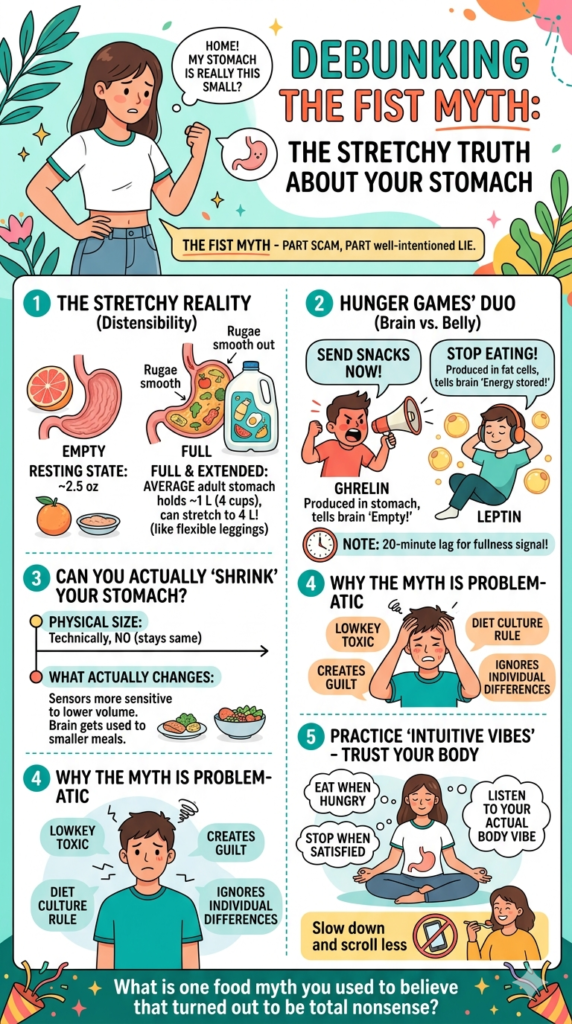
When your stomach is completely empty, yes, it is pretty small. It might be roughly the size of a fist or a small grapefruit. In its resting state, it holds about 2.5 ounces of fluid.
But the magic of the stomach is its “distensibility.” That is just a fancy word for saying it is basically the world’s most elite pair of leggings.
It is built to stretch.
Inside your stomach, there are these crazy folds called “rugae.” When your stomach is empty, these folds are all bunched up. But as soon as you start eating, those folds smooth out, allowing the stomach to expand significantly.
How Big Can It Actually Get?
If the empty stomach is a tiny fist, the full stomach is a literal gallon jug.
The average adult stomach can expand to hold about one liter of food and liquid. That is roughly four standard measuring cups.
For some people, especially those who are used to eating larger meals, it can expand even further, sometimes holding up to four liters.
That is the equivalent of a giant party sized bottle of soda.
So, when someone tells you that you are “overstuffing” your fist sized organ, you can tell them that your “gallon jug” is doing just fine.
Your body was literally evolved to handle feast or famine. Back in the day, we didn’t have refrigerators. If we found food, we had to eat as much as possible because we didn’t know when the next meal was coming.
Your stomach’s ability to stretch is an ancient survival hack.
The Brain vs. The Belly
Now, just because your stomach can hold a gallon of mac and cheese doesn’t mean it should.
This is where things get complicated.
Your stomach size doesn’t actually dictate how hungry you feel. That is handled by your brain and a very dramatic group of hormones.
Meet the “Hunger Games” duo: Ghrelin and Leptin.
Ghrelin is the loud, annoying roommate. It is produced in your stomach and tells your brain, “Hey, we are empty! Send snacks immediately!”
Leptin is the chill roommate. It is produced by your fat cells and tells your brain, “We have plenty of energy stored up, you can stop eating now.”
The problem is that it takes about 20 minutes for your stomach to communicate with your brain.
By the time your brain gets the “I’m full” text, you might have already eaten way past the point of comfort. That is why you feel like a human balloon after a Thanksgiving dinner. Your stomach did its job and stretched, but your brain was late to the party.
Can You Actually “Shrink” Your Stomach?
We have all heard people say, “I’ve been eating less, so my stomach has shrunk.”
Technically, this is a myth.
Your stomach doesn’t physically shrink in size unless you have actual surgery (like a gastric sleeve). If you are a grown adult, your stomach is the size it is.
However, what does change is your “fullness threshold.”
When you consistently eat smaller portions, your stomach’s distension sensors become more sensitive. You start to feel “full” earlier because your brain gets used to a lower volume of food.
Similarly, if you are a competitive eater or just someone who loves a massive “one meal a day” vibe, you can train your stomach to feel comfortable while stretched to its limit.
It isn’t about the physical size of the organ. It is about how your nerves and brain interpret the stretch.
Why the “Fist” Myth Is Lowkey Toxic
The reason this myth keeps me up at night is that it is often used to make people feel guilty.
Diet culture loves a “rule.” And “only eat what fits in your hand” is a very easy rule to market.
But here is the reality. Every body is different. A 6 foot 4 athlete is going to have a different caloric need than a 5 foot 2 student. Their “fist” sizes might not be that different, but their energy requirements are worlds apart.
If you try to force yourself to eat only a “fist” of food when your body is screaming for more fuel, you are going to end up in a cycle of restriction and bingeing.
It’s much better to listen to your actual “body vibe” than to try and measure your lunch against your knuckles.
The Water Factor and Bloating
Another thing people forget when talking about stomach size is liquid.
If you drink a big glass of water before a meal, your stomach is already partially stretched. This is a common “hack” for weight loss, but it can also lead to that weird, sloshy, bloated feeling.
Bloating isn’t usually about your stomach being “too small.” It is usually about gas, slow digestion, or the specific types of food you are eating (shoutout to my fellow lactose intolerant girlies).
When your stomach expands from gas, it can feel tight and painful. This has nothing to do with the “fist” rule and everything to do with how your gut bacteria are reacting to your lunch.
The “Dessert Stomach” Phenomenon
Have you ever been so full of dinner that you literally couldn’t take another bite, but then someone mentions lava cake and suddenly you have room?
There is actually a scientific reason for this! It’s called “sensory specific satiety.”
Your brain gets bored of the same flavor profile. If you have been eating salty, savory food, those specific “fullness” signals get really strong.
But when a new flavor (sweet) is introduced, your brain’s reward system overrides the “stretch” signals from your stomach.
It isn’t that you have a second stomach for dessert (I wish). It’s just that your brain is a sucker for variety.
How to Actually Listen to Your Gut
Forget the fist. If you want to feel good after eating, you need to practice “intuitive vibes.”
Eat when you are hungry. Stop when you are satisfied, not when you are “Thanksgiving full.”
Try to eat slowly enough that your brain and stomach can actually stay in the same group chat. If you scroll TikTok while you eat, you are completely ignoring the signals your rugae are sending to your head.
Drink water, but don’t drown your food in it. Give your digestive enzymes space to do their thing.
And most importantly, stop comparing your plate to your hand.
Final Thoughts
The “stomach is the size of your fist” thing is a classic piece of “bro science” that has overstayed its welcome.
Your stomach is a flexible, adaptable, incredible organ that knows how to do its job. It can be a tiny fist when it needs to be, and it can be a massive storage tank when the pizza is just too good to pass up.
The next time someone tries to tell you that you are eating “more than your stomach can hold,” just smile, take another bite, and remember that your anatomy is way more badass than they think.
You are 22. Your body is doing its best. Feed it, trust it, and let the myths go.
What is one food myth you used to believe that turned out to be total nonsense?