We have all been there. You are sitting at a dimly lit Italian spot, the air smells like garlic and dreams, and the server comes over with that giant block of Parmesan and a grater.
They ask that fateful question: “Would you like some cheese?”
And you, being a person of culture, say “Yes.” Then you wait. You watch the snowstorm of salty, nutty goodness descend upon your pasta. You wait for the “say when” moment, but in your heart, you know “when” is a destination you aren’t planning to reach anytime soon.
But then, that tiny voice in the back of your head starts whispering. You know the one. It’s the “gut anxiety” voice. It’s the voice that reminds you about your occasional acid reflux or that weird “heavy” feeling you get after a big meal.
You start wondering: is Parmesan cheese acidic? Is this glorious mountain of dairy about to set my chest on fire or turn my stomach into a chemistry experiment?
If you are currently on a journey to balance your body’s pH or you are just trying to navigate the world of GERD and acid reflux without giving up everything that makes life worth living, you’ve come to the right place.
Let’s dive into the science, the vibes, and the reality of Parmesan cheese.
The Short Answer: Let’s Look at the Numbers
In the world of science, acidity is measured on the pH scale. It goes from 0 to 14.
Anything below 7 is considered acidic. Anything above 7 is alkaline.
Right in the middle, at 7, you’ve got neutral stuff like pure water.
So, where does our beloved Parmigiano-Reggiano sit?
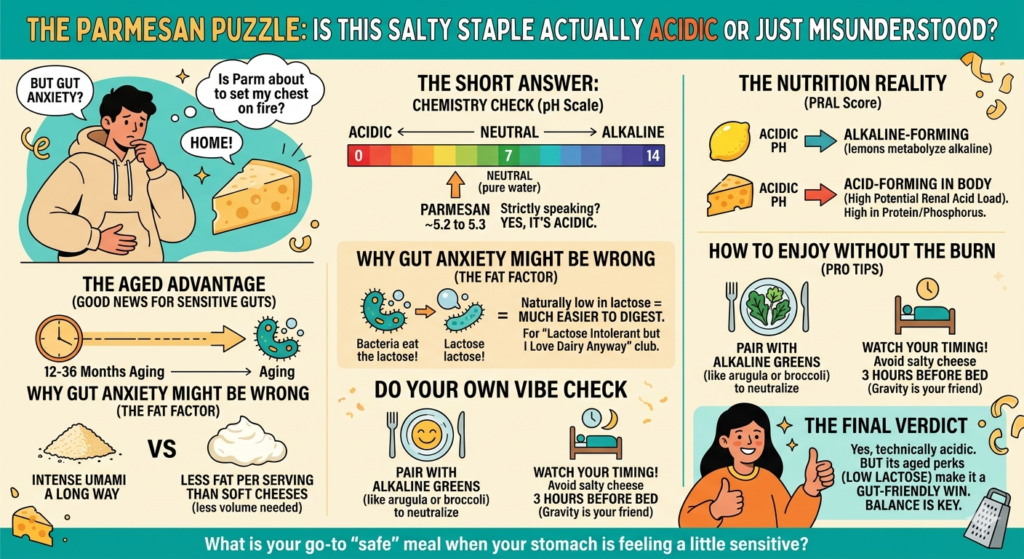
Most Parmesan cheese has a pH level of around 5.2 to 5.3.
By the strict definition of chemistry, yes, Parmesan cheese is acidic.
However, before you throw your grater out the window, we need to talk about why that number doesn’t tell the whole story. In the world of nutrition, there is a big difference between a food being “acidic” on a plate and being “acid-forming” in your body.
The PRAL Score: The Plot Thickens
If you are 22 and trying to optimize your health, you might have stumbled across the “Alkaline Diet.” The idea is that you want to keep your body’s internal environment slightly alkaline to reduce inflammation.
This is where things get a little bit tricky.
Some foods, like lemons, are super acidic on the pH scale (around 2.0). But once your body metabolizes them, they actually have an alkaline effect.
Cheese, unfortunately, does not work that way.
To measure how a food affects your body after you digest it, scientists use something called the PRAL score (Potential Renal Acid Load).
Parmesan cheese has one of the highest PRAL scores of any food. This is because it is incredibly dense in protein and minerals like phosphorus. When your body breaks down these components, it creates acid as a byproduct.
So, in the “is it acidic” debate, Parmesan takes the win in both categories. It is acidic on the pH scale and it is acid-forming in the body.
Why Does This Matter for Your Gut?
You might be thinking, “Okay, so it’s acidic. Why should I care?”
If you have a stomach made of steel, you probably don’t. But for the rest of us living with “sensitive vibes,” acidity matters for a few reasons.
The first is acid reflux or GERD. When you eat foods that are highly acidic or trigger acid production, it can relax the lower esophageal sphincter (the little “trap door” to your stomach). When that door stays open, stomach acid bubbles up, and suddenly it feels like you swallowed a literal coal.
The second reason is bone health and inflammation. Some theories suggest that if you eat too many acid-forming foods, your body has to “buffer” that acid by pulling alkaline minerals (like calcium) from your bones.
Now, I’m not saying one slice of pizza is going to make your bones crumble. That’s a bit dramatic. But if your entire diet is built on high-PRAL foods, your system has to work a lot harder to maintain its balance.
The Aged Advantage: Why Parmesan Is Still a Winner
Even though we just established that Parmesan is acidic, I have some good news. It is still one of the best cheeses you can eat if you are trying to be “gut-conscious.”
Why? Because Parmesan is a hard, aged cheese.
Most Parmesan is aged for 12, 24, or even 36 months. During this time, something magical happens. The bacteria in the cheese eat up almost all of the lactose.
If you are part of the “lactose intolerant but I love dairy anyway” club, Parmesan is your best friend. It is naturally very low in lactose, making it much easier to digest than soft cheeses like Mozzarella or Ricotta.
Often, what people think is “acid distress” from cheese is actually just their body struggling to process lactose. By switching to a hard, aged cheese like Parm, you might find that your stomach stays much calmer.
The Fat Factor
Another reason people worry about cheese and acidity is the fat content. High-fat foods take a long time to digest. They sit in your stomach, hanging out, which can trigger more acid production.
Parmesan is actually a bit of a hero here, too.
Because it is so flavorful and salty, you usually don’t need a huge amount of it to feel satisfied. A little bit of grated Parm goes a long way compared to a thick slice of cheddar or a mound of melted provolone.
Less volume means less work for your stomach, which means less chance of a “reflux flare-up.”
How to Enjoy Parmesan Without the Burn
If you are worried about the acidity but you aren’t ready to break up with your favorite cheese, you just need a strategy. You need to play “food tetris.”
The key is balance.
If you are eating Parmesan (an acid-forming food), pair it with something highly alkaline.
Instead of putting Parmesan on a big bowl of white pasta (also acid-forming), try grating it over a massive pile of roasted broccoli or a fresh arugula salad. Green leafy vegetables are some of the most alkaline-forming foods on the planet. They act like a “neutralizer” for the cheese.
Another tip? Watch your timing.
Eating a bunch of salty, acidic cheese right before you go to bed is a recipe for a bad time. Give your body at least three hours to process that “acid load” before you lie down. Gravity is your friend when it comes to keeping acid where it belongs.
The Mineral Breakdown: What’s Inside?
To really understand the acidity of Parmesan, we have to look at what it’s made of. This cheese is a powerhouse of calcium, phosphorus, and sodium.
Calcium is technically an alkaline mineral, which is great. But phosphorus is an acid-forming mineral. Because Parmesan has such a high concentration of both, they kind of engage in a tug-of-war.
In the end, the protein and phosphorus win the “acid load” battle, but the calcium still provides massive benefits for your teeth and muscles.
It’s one of those situations where the food is a “package deal.” You get the acidity, but you also get a massive hit of bioavailable protein that helps you stay full and keeps your energy levels stable.
Is It a Trigger Food for You?
At the end of the day, everyone’s “body vibe” is different.
I know people who can eat an entire block of Parmesan and feel like they just ran a marathon. I also know people who have one sprinkle and need a Tums immediately.
If you are trying to figure out if Parmesan is the culprit behind your digestive drama, try keeping a “vibe check” journal for a week.
Note down when you eat it and how you feel two hours later. Do you feel bloated? Is there a burning sensation? Or do you just feel happy and full?
Your body is a much better indicator of what’s “safe” than a pH chart.
The Cultural Context: Why We Love It Anyway
We can talk about pH and PRAL scores all day, but we also have to acknowledge that food is more than just chemistry.
Parmesan is a “umami” bomb. It has that deep, savory flavor that makes your brain light up. For a lot of us, it’s a comfort food.
When we are stressed (which, let’s be real, is most of the time at 22), our bodies actually produce more cortisol, which can increase stomach acid.
If eating a little bit of Parmesan on your favorite meal makes you happy and lowers your stress, that might actually be better for your gut than force-feeding yourself something “alkaline” that you absolutely hate.
The Verdict
So, is Parmesan cheese acidic?
Technically, yes. It has a pH of about 5.2 and it has a high acid load on the body during digestion.
But is it the “villain” of the dairy world? Absolutely not.
In fact, because it is low in lactose and so nutrient-dense, it is often a much better choice for people with sensitive guts than many other foods.
It’s all about the context. If you are burying a greasy burger in Parmesan, the acidity is the least of your worries. But if you are using it as a flavorful accent to a balanced, veggie-heavy meal, your body can handle it just fine.
Life is too short for bland food. You don’t have to fear the grater. Just be smart about it, listen to your gut, and maybe keep a few alkaline greens on your plate to keep the peace.
Now, go enjoy that crunch. You know you want to.
What is your go-to “safe” meal when your stomach is feeling a little sensitive?