So, you finally did it. You got that tiny, pear-shaped troublemaker evicted from your body.
First off, congratulations on surviving the hospital gown life and that weird, lingering anesthesia fog.
But now that you’re back on your own couch, reality is starting to hit. Your stomach feels like it went through a boxing match, and you’re staring at your fridge like it’s a minefield.
One of the biggest questions everyone asks (and honestly, I asked it too) is: what on earth am I allowed to eat without regretting every life choice five minutes later?
Specifically, can you eat applesauce?
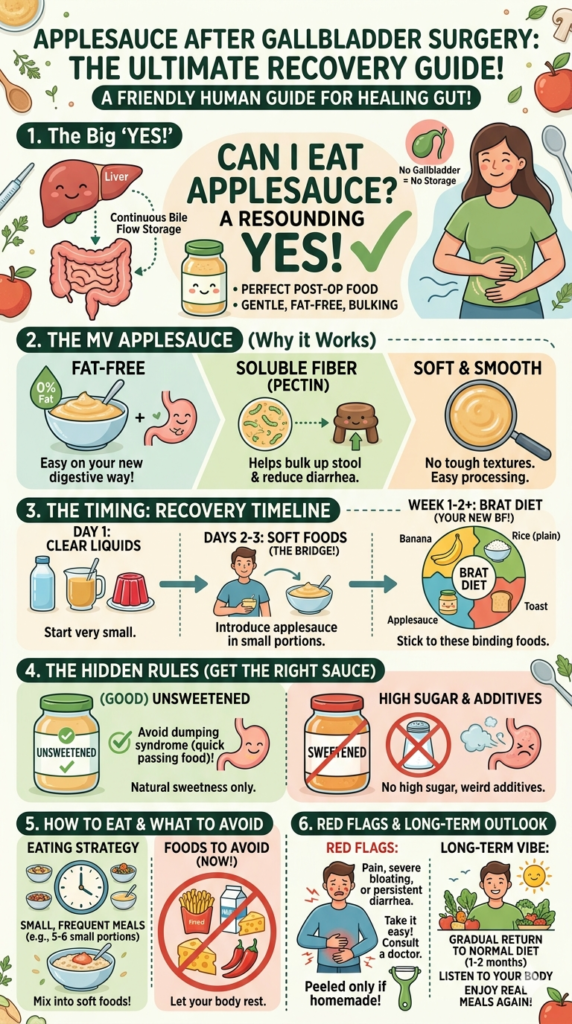
The short answer is a massive, resounding yes.
In fact, applesauce is basically the unofficial mascot of the gallbladder recovery world.
But before you go grabbing a six-pack of the sugary stuff, let’s dive into why it’s a “yes,” how to eat it, and what else you should know about your new digestive system.
Why Applesauce Is the Ultimate Post-Op MVP
When your gallbladder is gone, your body has to learn a whole new way of processing food.
Back in the day, your gallbladder was like a storage unit for bile. When you ate something fatty, it would squirt out a bunch of bile to break it down.
Now? The bile just drips constantly from your liver into your small intestine. It’s like a leaky faucet instead of a high-pressure hose.
Because of this change, your stomach is super sensitive. You need things that are incredibly easy to break down.
Applesauce is a “gold tier” food for a few reasons.
It’s fat-free, which is the most important rule of the first few weeks of recovery.
It’s also packed with something called pectin.
Pectin is a type of soluble fiber that helps “bulk up” your stool. Since diarrhea is a very common (and very annoying) side effect of gallbladder surgery, pectin is basically your new best friend.
Plus, it’s soft. No chewing through tough fibers or dealing with heavy skins that might make your gut work too hard.
Timing Is Everything: When to Start
You shouldn’t just come home from the hospital and immediately start chugging applesauce.
Most doctors will tell you to stick to clear liquids for the first 24 hours. Think broth, apple juice, and maybe some Jell-O if you’re feeling fancy.
Once you’ve proven to your body that you can handle liquids without feeling like you’re going to die, you move into the “soft food” phase.
This is usually around day two or three.
This is the perfect window for applesauce.
It’s the bridge between “I’m living on chicken broth” and “I might actually eat a real meal someday.”
If you try it and feel a little bloated, don’t freak out. Just slow down. Take small bites. Your body is literally relearning how to be a body.
The “Hidden” Rules of Applesauce
Not all applesauce is created equal, and this is where a lot of people mess up.
When you’re browsing the grocery store aisle (or having someone else browse it for you while you stay in your pajamas), you need to be picky.
Go for the Unsweetened Version
You might think you want the extra sugar for a little “treat” while you recover, but sugar can actually trigger some pretty nasty digestive issues right after surgery.
High-sugar foods can lead to “dumping syndrome,” which is exactly as glamorous as it sounds. It’s when food moves too fast through your system and leaves you feeling dizzy, sweaty, and running for the bathroom.
Unsweetened applesauce is much safer. It has the natural sweetness of the fruit without the added junk that messes with your insulin and your gut.
Check for Additives
Some brands throw in weird preservatives or “natural flavors” that might be a bit much for a sensitive stomach.
Keep it simple. The ingredient list should basically just say “apples, water, ascorbic acid (which is just Vitamin C).”
Cinnamon Is Usually Okay
If you’re bored out of your mind with plain applesauce, a little sprinkle of cinnamon is usually fine.
Cinnamon can actually help with digestion for some people, but again, listen to your vibes. If it makes your stomach twinge, stick to the plain stuff for a few more days.
The BRAT Diet: Your New Survival Guide
If you’ve been Googling “gallbladder recovery foods,” you’ve probably seen the acronym BRAT.
It stands for Bananas, Rice, Applesauce, and Toast.
This is the holy grail of recovery eating.
Applesauce is the “A” in BRAT for a reason. These foods are all “binding” foods.
They are low-fiber (specifically low in insoluble fiber) and low-fat.
When you’re in those first seven to ten days, these four items should basically be your entire personality.
I know it sounds boring. Trust me, I get it. You’re going to be craving a burger by day four.
But the “gallbladder attack” feeling is something you never want to experience again, and eating too much too soon is the fastest way to feel that familiar pain.
How to Eat Without Feeling Like a Robot
Since you’re 22 (or just want to feel like a normal human), eating only applesauce and plain toast can get depressing pretty fast.
The trick is small, frequent meals.
Instead of three big meals a day, think about eating five or six tiny snacks.
An individual-sized cup of applesauce is the perfect portion.
If you’re feeling a little more adventurous after a few days, you can try mixing your applesauce into some plain oatmeal.
It adds flavor without adding fat.
Just make sure the oatmeal is well-cooked and soft.
The goal here is “minimum effort” for your digestive tract.
The Red Flags: When Applesauce (and Other Foods) Go Wrong
While applesauce is super safe, everyone’s body is a little different.
Some people find that even fruit sugars can cause a bit of gas right after surgery.
If you notice that you’re getting super bloated or having sharp pains after eating it, you might want to wait another day or two.
Also, watch out for the “skin” factor.
If you’re making your own applesauce at home (honestly, who has the energy for that right after surgery? But if you do, kudos), make sure you peel the apples completely.
Apple skins contain a lot of insoluble fiber, which is much harder for your “new” digestive system to process than the soft inside of the apple.
What to Avoid While You’re in Your Applesauce Era
To make sure the applesauce can actually do its job, you have to keep the “bad” stuff away.
Think of your stomach like a construction zone. You can’t bring in heavy machinery (like a double cheeseburger) while the workers are still trying to pave the road.
Avoid anything fried. This is the big one. Even a few french fries can cause a literal nightmare.
Avoid heavy dairy. Whole milk, cheese, and butter are basically a one-way ticket to discomfort.
Avoid spicy stuff. Your internal lining is sensitive right now. Don’t provoke it.
If you stay in the “safe zone” with your applesauce and toast, your recovery will go so much faster.
The Long-Term Vibe
Eventually, you won’t have to live on applesauce.
Most people can return to a relatively normal diet within a month or two.
But don’t rush it.
The first two weeks are the most critical. If you treat your body with a little respect and feed it easy-to-digest stuff like applesauce, you’ll be back to eating tacos (in moderation!) before you know it.
Think of this time as a “digestive reset.”
It’s a chance to really pay attention to how certain foods make you feel.
You might find that you actually feel better without all the heavy, greasy stuff anyway.
Or you might just really appreciate a good slice of pizza once you’re finally cleared to eat it.
Wrapping It Up
So, can you eat applesauce after gallbladder surgery?
Yes. 100%. Absolutely.
It’s delicious, it’s soothing, and it’s one of the best things you can do for your healing gut.
Just keep it unsweetened, keep the portions small, and don’t try to get too fancy too fast.
You’ve got this. The worst part is over, the surgery is done, and now you just have to focus on being kind to yourself.
And if that means eating five cups of applesauce while binge-watching your favorite show, then that’s exactly what you should do.
Happy healing!
Your body is going to thank you for the pectin, the hydration, and the break from trying to process grease.
Now go grab a spoon and take it easy.