So, you have joined the “No Gallbladder Club.” Welcome!
It is a weird transition, isn’t it? One day you are living your life, and the next, you are googling every single thing you put in your mouth because you are terrified of a bathroom emergency.
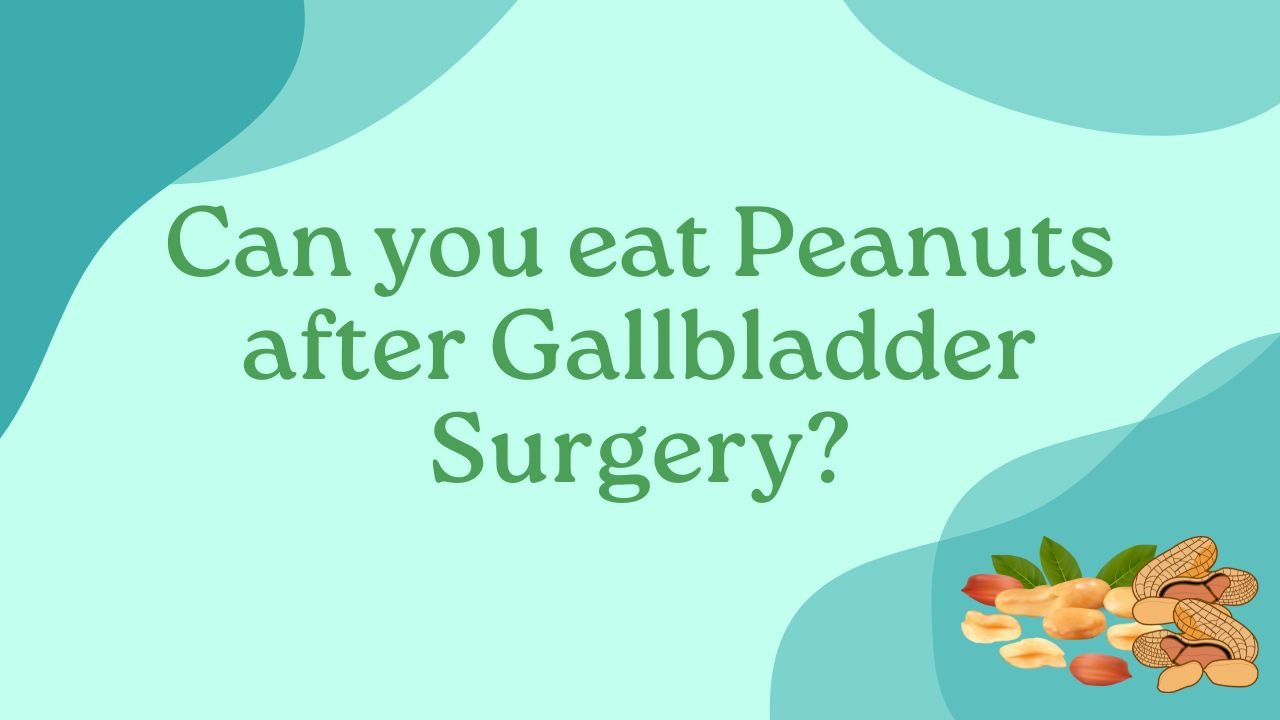
If you are like me, you probably have a deep, emotional connection to snacks. And when it comes to the goat of all snacks, peanuts are right up there at the top.
Whether it is a handful of roasted peanuts at a game, a spoonful of peanut butter at 2 a.m., or those spicy little cocktail nuts, they are a staple.
But now that your gallbladder is officially in the medical waste bin, can you still eat them? Or are peanuts about to become your new arch-nemesis?
Let us dive into the oily, crunchy reality of eating peanuts after surgery.
Why Peanuts are a “Boss Fight” for Your Gut
To understand why peanuts are such a big deal now, we have to look at what they actually are.
Peanuts are great. They have protein, fiber, and all those “good” unsaturated fats. But the keyword there is fats.
Even though they are healthy fats, your body doesn’t really care about the “quality” of the fat when it is trying to digest them without a gallbladder. It just sees a massive load of lipids.
As we talked about before, your gallbladder was the storage unit for bile. Without it, your liver is just dripping bile into your intestines like a leaky faucet.
When you eat something high in fat like peanuts, your body needs a big “squirt” of bile to break it down. Since you don’t have a storage tank anymore, your body can’t provide that big burst.
The result? The fat doesn’t get broken down properly. It just sits there, or worse, it slides through your system like a slip-and-slide.
This is why peanuts are basically a “boss fight” for your digestive tract in those first few weeks.
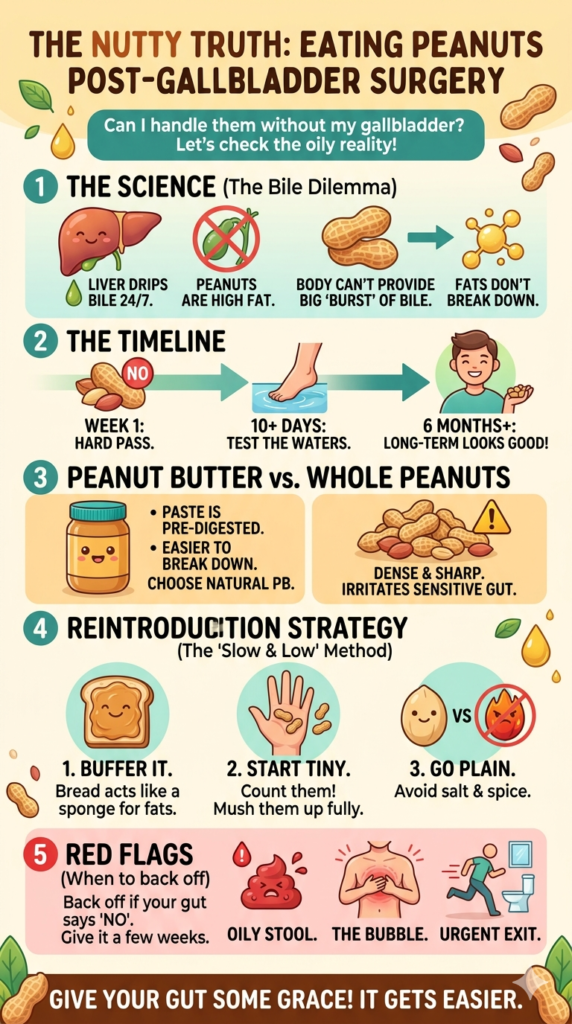
The First Week: Just Don’t Do It
I know, I know. You are hungry and you are tired of eating plain toast and applesauce. But trust me on this one.
In the first seven days after surgery, your body is in high-alert mode. Your incisions are healing, your insides are rearranged, and your liver is trying to figure out its new job description.
Peanuts are very dense. Not only are they high in fat, but they are also physically hard. If you don’t chew them into a literal liquid, those little crunchy bits can be really irritating to a sensitive gut.
If you try to smash a bag of peanuts right after surgery, you are probably going to experience what we call the “Peanut Panic.”
This includes massive bloating, sharp pains that feel like the surgery pain is coming back, and a very sudden need to run for the door.
Give yourself at least ten days before you even think about looking at a nut.
Peanut Butter vs. Whole Peanuts
Once you are past that initial “everything hurts” phase, you might start craving that peanut flavor.
If you have to choose, peanut butter is usually a much safer bet than whole peanuts.
Think about it this way. Peanut butter is already “pre-digested” in a sense because it is ground down into a smooth paste. Your stomach doesn’t have to work nearly as hard to break it down.
However, you have to be careful with the type of peanut butter you choose.
A lot of the commercial brands are loaded with extra oils and sugars to keep them creamy. Those extra oils are exactly what you want to avoid right now.
If you are going to try it, go for a “natural” version where the only ingredients are peanuts and maybe a little salt.
And for the love of everything, start with a tiny amount. I’m talking half a teaspoon. See how your body reacts before you go making a full PB&J.
The Strategy for Reintroduction
You can’t just dive back into a jar of Planters. You have to be tactical about this.
I call this the “Slow and Low” method.
Start by pairing your peanuts with something very high in fiber or a simple carb.
If you want to try peanut butter, spread a very thin layer on a piece of whole-wheat toast. The bread acts like a sponge, helping to soak up the fats and slowing down the digestion process.
This gives your “slow-drip” bile a better chance of keeping up with the workload.
If you are trying whole peanuts, literally count them out. Start with five peanuts. Just five.
Eat them slowly, chew them until they are basically mush, and then wait a few hours.
If your stomach doesn’t start growling like a monster or feeling like it is inflating like a balloon, you might be okay to try ten peanuts the next day.
The Hidden Danger: Salt and Seasoning
It isn’t just the fat in peanuts that can cause issues. It is also the stuff we put on the peanuts.
A lot of roasted peanuts are covered in salt, chili powder, or honey coatings.
Sodium can cause you to bloat, which is already a huge problem after laparoscopic surgery because of the gas they use to inflate your abdomen.
Spicy seasonings can irritate your stomach lining, which is already sensitive because of the bile shift.
If you are going to test the waters, stick to plain, unsalted, dry-roasted peanuts. They aren’t as exciting, but they are much kinder to your healing insides.
Social Situations and Peer Pressure
Being twenty-two and having no gallbladder is a struggle when you are out with friends.
You’re at a bar, there’s a bowl of peanuts on the table, everyone is grabbing them, and you’re just sitting there sipping your water.
It is tempting to just grab a handful because you don’t want to explain your medical history to everyone.
But trust me, explaining why you don’t have a gallbladder is way less awkward than having to sprint to the bathroom in the middle of a conversation.
If you are out, just keep a “safe snack” in your bag, like some pretzels or a plain granola bar. You can still participate in the “hand-to-mouth” snacking motion without the internal chaos.
Signs Your Body is Saying “No”
Your body is going to be very vocal about its feelings. You just have to listen.
If you eat peanuts and experience any of the following, it means you need to back off for a few more weeks.
First, there is the “Floating Stool” situation. It is gross to talk about, but if your bathroom trips look oily or pale, that is a direct sign that the fat from the peanuts is not being digested.
Second, watch out for “The Bubble.” This is that feeling of intense pressure right under your ribs or in your chest. It feels like a heart attack but it is actually just trapped gas from the undigested fats.
Third, the “Urgent Exit.” If you eat peanuts and within thirty minutes you feel like your intestines are turning into a literal waterfall, that is dumping syndrome. Your body is just trying to get the fats out as fast as possible.
If these happen, don’t panic. It just means you aren’t ready yet. Drink some water, maybe some ginger tea, and try again in two weeks.
The Long-Term Outlook
The good news is that most people can eventually return to a totally normal diet, peanuts included.
Your body is a master at compensating. Eventually, your bile duct will widen slightly to store a tiny bit of bile, and your intestines will get more efficient at processing fats.
By the six-month mark, most people can eat a normal serving of peanuts or a big PB&J without any drama at all.
It feels like forever when you are in the middle of it, but it is just a temporary phase.
Don’t let the “no gallbladder” thing make you feel like a “food monk” for the rest of your life. You will get your snacks back.
A Quick Summary for the Impatient
If you just scrolled to the bottom because you have a bag of peanuts in your hand right now, here is the TL;DR version.
Don’t eat them in the first week. Seriously.
When you do try them, start with peanut butter instead of whole nuts.
Dilute the experience by eating them with bread or crackers.
Keep the portion sizes tiny. Think “sample size,” not “snack size.”
Avoid the salty, spicy, or honey-roasted versions for at least a month.
And most importantly, don’t stress. One bad reaction doesn’t mean you can never eat them again. It just means “not today.”
Your gut is doing its best. Give it some time, give it some grace, and you will be back to your nutty self before you know it.
Stay strong, fellow gallbladder-less friend! It gets so much easier from here.