
So, you finally did it. You parted ways with that tiny, pear-shaped organ that was causing you a world of pain. First off, huge congrats on surviving the surgery. Whether it was a planned thing or a “get to the ER right now” situation, gallbladder removal is a major life pivot.
I remember when my cousin had hers out at 23. She honestly thought she would be back to eating pizza and drinking mimosas in forty-eight hours. Narrator voice: she was not. She learned the hard way that the body needs a minute to recalibrate.
One of the biggest questions that pops up during that weird recovery phase is about orange juice. It seems harmless, right? It is just fruit. It has Vitamin C. It is a breakfast staple. But when you do not have a gallbladder to regulate your bile, orange juice can suddenly feel like you are drinking liquid fire or setting off a literal bomb in your gut.
Let us break down the real deal on OJ after surgery, why your stomach might be acting like a total drama queen, and how to navigate the breakfast table without living in your bathroom.
Why Your Body is Acting Different Now
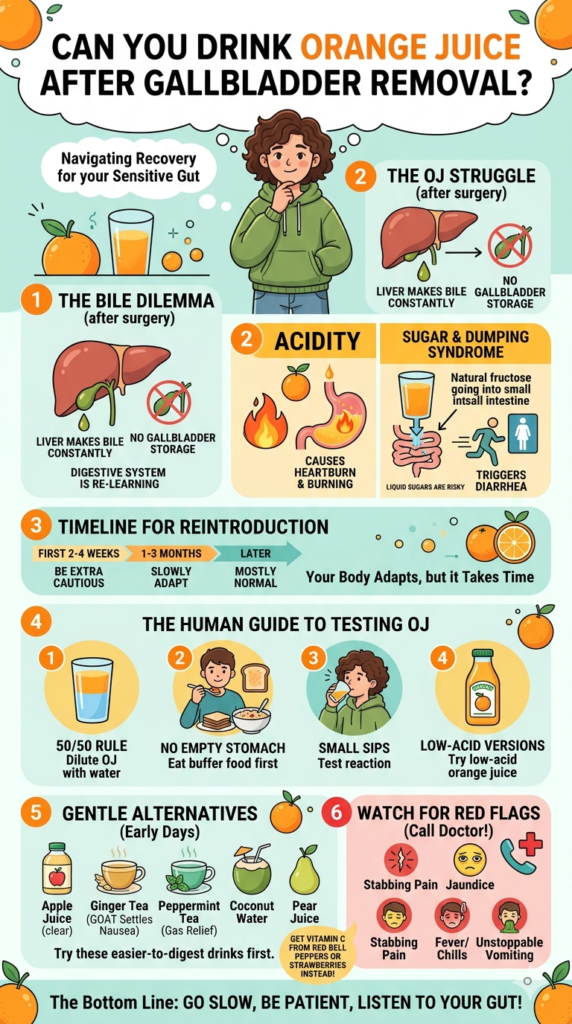
To understand why orange juice might be a problem, we have to talk about what your gallbladder actually did. Think of your gallbladder as a little storage unit. Your liver makes bile, which is the stuff that breaks down fat, and the gallbladder holds onto it until you eat something greasy or heavy.
Then, it squeezes that bile into your small intestine like a concentrated shot of dish soap to clean up the grease. Now that the storage unit is gone, your liver just leaks bile into your system twenty-four seven. It is a constant, slow drip.
Because the bile is not concentrated anymore, your body is not as efficient at handling certain things. Your digestive tract is now extra sensitive to anything that moves too fast or hits too hard. This is where the orange juice struggle begins.
The Acid Problem
Orange juice is famously acidic. On a normal day with a gallbladder, your body handles that acid like a pro. But post-surgery? Your internal chemistry is basically re-learning how to function.
When you pour highly acidic OJ into a stomach that is already dealing with a constant trickle of alkaline bile, it can create a bit of a war zone. For a lot of people, this manifests as immediate heartburn or that burning sensation in the upper abdomen.
It is not just in your head. Your tissues are literally more sensitive right now as they heal from the trauma of surgery and the shift in bile flow. Adding a high-acid liquid to that mix is like putting lemon juice on a paper cut, but on the inside.
The Sugar Rush and Dumping Syndrome
Here is the part people do not talk about enough: the sugar. Even if you are drinking the “no sugar added” fancy stuff, orange juice is packed with natural fructose. When you drink a big glass of juice on an empty stomach, that sugar hits your small intestine fast.
Without a gallbladder to help balance the digestive process, your body might react by pulling a bunch of water into your gut to flush the sugar through. In the medical world, they call this “dumping syndrome.” In the real world, we call it “I have thirty seconds to find a restroom or it is game over.”
Liquid sugars like those in fruit juices are one of the biggest triggers for post-surgery diarrhea. It is not fun, it is not cute, and it is definitely not how you want to spend your recovery.
Is it Forever?
The good news is that for most people, this sensitivity is not a life sentence. Your body is incredibly adaptable. Over a few months, your common bile duct will actually stretch a little bit to take over some of the storage duties the gallbladder used to handle.
Your intestines also get used to the constant presence of bile. Usually, the first two to four weeks are the danger zone for OJ. After that, most people can slowly reintroduce it. But if you try to chug a huge glass of juice three days after surgery, you are probably going to regret your life choices.
How to Test the Waters
If you are craving that citrus hit and feel like you are ready to try, do not just go for it full-throttle. You have to be strategic. Here is the human guide to reintroducing OJ.
First, try the 50/50 Rule. Fill your glass halfway with water or sparkling water and the other half with orange juice. This cuts the acidity and the sugar concentration in half, making it way easier on your gut. It still tastes like OJ, but without the violent aftermath.
Second, never drink it on an empty stomach. Drinking OJ first thing in the morning is a recipe for disaster right now. Eat some toast or oatmeal first. Give your stomach a buffer so the juice does not just slide right through you.
Third, take small sips. Treat it like a fine wine, not a Gatorade after a marathon. See how your stomach feels after a few ounces. If you feel cramping or bloating within twenty minutes, stop right there.
Fourth, look for low-acid versions. Check the grocery store for the juices specifically labeled as “Low Acid.” They exist for a reason, and right now, you are that reason.
Better Alternatives for the Early Days
If your body is hard-vetoing the orange juice, you do not have to stick to plain water for the rest of your life. There are plenty of safe liquids that won’t make your insides feel like they are being scrubbed with steel wool.
Clear apple juice is usually much easier to digest than citrus, as long as it isn’t the unfiltered, cloudy kind which can have too much fiber for a healing gut.
Ginger tea is the greatest of all time for post-op recovery. It settles the nausea and does not trigger bile issues. Peppermint is also great for the gas pain, which is honestly the worst part of the first week of recovery.
If you are worried about electrolytes or just want something with flavor, coconut water is super gentle and hydrating. Pear juice is also surprisingly delicious and way less acidic than anything in the citrus family.
The Reality of Brunch Post-Surgery
Let’s talk about the social aspect. You are twenty-two, your friends want to go to brunch, and everyone is ordering bottomless mimosas. It feels isolating to sit there with a plain water while everyone else is vibing.
If you are at a restaurant, ask for a glass of water with a single orange slice squeezed in. You get the scent and a hint of the flavor without the acid bomb. Or, see if they have a non-citrus juice like peach nectar or cranberry.
Just remember that “bottomless” is a dangerous word for someone without a gallbladder. Even if you feel okay after one glass, the cumulative effect of the sugar and acid can catch up to you an hour later when you are halfway home.
A Note on Vitamin C and Healing
A lot of people want OJ after surgery because they know Vitamin C helps with wound healing. And you are right. You definitely need it to help those incisions close up and to keep your immune system from tanking while you recover.
But you do not need orange juice to get it. You can get your Vitamin C from bell peppers, strawberries, or even a supplement if your doctor says it is cool. Don’t feel like you have to suffer through stomach cramps just for the vitamins.
Red bell peppers actually have more Vitamin C than oranges anyway, and they are way less likely to cause a “bathroom emergency.”
When to Call Your Doctor
While a little bit of unrest is normal after eating new things post-surgery, there are a few red flags you should not ignore. If drinking juice or eating anything causes severe, stabbing pain in the upper right side, that is a problem.
If you notice yellowing of your eyes or skin, which is called jaundice, or if you run a fever, call your surgeon. These can be signs of a bile duct blockage or an infection. Those are definitely not just the juice talking.
The Bottom Line
Can you drink orange juice after gallbladder removal? Yes, eventually. Should you drink it right now? If you are still in the first two weeks of recovery, maybe hold off or dilute it heavily.
Your body just went through a major under the hood renovation. You wouldn’t floor a car right after a total engine rebuild, so don’t do it to your digestive system. Listen to your gut. If it rumbles, growls, or hurts, it is telling you it is not ready.
Give yourself some grace, stick to the bland stuff for a little longer, and before you know it, you will be back to enjoying your breakfast without scouting the nearest exit. Stay hydrated, stay patient, and happy healing! It gets better, I promise.