Let’s be totally real for a second. If you just had your gallbladder taken out, you are probably dealing with a lot of “new normals.” You are navigating the world of low fat eating, you are learning exactly where every public restroom is located within a five mile radius, and you are probably feeling a little bit like your body is a stranger.
But there is one question that is likely hitting you harder than the rest as you wake up in the morning. When can I have my coffee back?
For many of us, coffee isn’t just a drink. It is a personality trait. It is the only thing standing between us and a very unproductive day. The thought of giving it up forever because of a little surgery feels like a personal attack.
I get it. I really do. But before you go running to the nearest Starbucks, we need to talk about what is actually happening inside your gut right now. Your digestive system just went through a major renovation, and the plumbing works a little differently than it used to.
We are going to break down why coffee is such a “hot topic” after gallbladder surgery, how to reintroduce it without a disaster, and what you can do to keep your gut happy while still getting your caffeine fix.
The Gallbladder 101: What Changed?
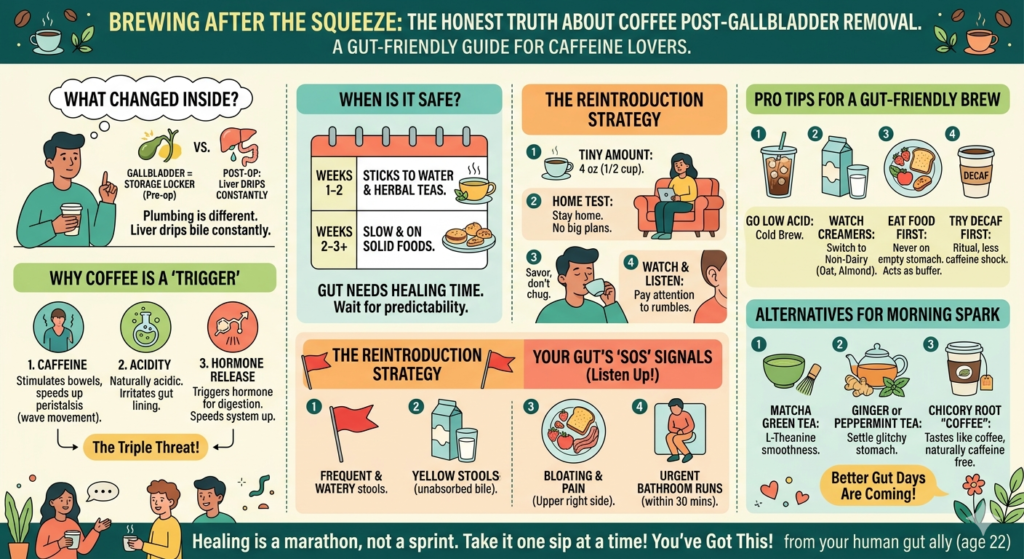
To understand why coffee might be a problem, you have to understand what your gallbladder actually did. It was basically a tiny storage locker for bile.
Bile is the green fluid your liver makes to help you break down fats. Before surgery, when you ate something greasy or drank something like a latte, your gallbladder would get a signal to “squirt” a concentrated dose of bile into your small intestine to help digest everything.
Now that the storage locker is gone, your liver just drips bile into your intestine constantly. It is like a leaky faucet instead of a high pressure hose.
This means that when you consume something that triggers digestion, like coffee, your body might not have enough concentrated bile ready to handle the load, or the bile that is there is just irritating your empty intestines.
Why Coffee Is a “Gut Trigger”
Coffee is a bit of a triple threat when it comes to post-op digestion.
First, there is the caffeine. Caffeine is a stimulant, and it doesn’t just stimulate your brain. It stimulates your bowels. It speeds up something called peristalsis, which is the wave like movement that pushes food through your system.
Second, coffee is naturally acidic. That acid can irritate the lining of your stomach and your intestines, especially now that the bile flow is different.
Third, coffee actually triggers the release of cholecystokinin. That is a fancy hormone that normally tells your gallbladder to contract. Even though your gallbladder is gone, your body still sends that signal, which can cause your digestive tract to go into overdrive.
The result? The “emergency bathroom run” that many gallbladder veterans know all too well.
Timing Is Everything: When Is It Safe?
If you are still in the first week after surgery, you probably want to stick to water and herbal tea. Your body is still dealing with anesthesia and the physical trauma of the procedure. Adding a stimulant like coffee to the mix is like trying to run a marathon while you have the flu.
Most doctors suggest waiting at least two to three weeks before trying coffee again. You want to wait until you are back on solid foods and your bathroom trips have started to become somewhat predictable.
If you try it too early, you risk triggering severe cramping and diarrhea, which is the last thing you want while your incisions are still healing.
Trust me, as much as you want that iced vanilla latte, waiting an extra week is way better than spending four hours in the bathroom regretting your life choices.
How to Reintroduce Coffee (The Strategy)
When you are finally ready to take the plunge, do not go for a “venti” anything. You have to treat this like a science experiment.
Start with a very small amount. I’m talking four ounces or half a cup. Drink it at home, on a day when you don’t have to be anywhere important.
Drink it slowly. Don’t chug it. Give your system a chance to realize what is happening.
Pay attention to how you feel over the next few hours. If you feel fine, you might be one of the lucky ones who can handle coffee just like before. If you feel “the rumble,” then you know you need to slow down and try a different approach.
Pro Tips for a Gallbladder Friendly Brew
If standard coffee is giving you trouble, you don’t necessarily have to quit. You just might need to change your style.
Go Low Acid: Cold brew coffee is naturally much lower in acid than hot brewed coffee. Because the beans aren’t exposed to high heat, the bitter oils and acids don’t release as much. Many people find cold brew is way easier on their post-op gut.
Watch the Creamer: This is a big one. It might not be the coffee that is hurting you; it might be the dairy. High fat creamers and whole milk are common triggers for gallbladder-less people. Try switching to oat milk or almond milk. They are lower in fat and usually much easier to digest.
Don’t Drink It on an Empty Stomach: Having coffee on an empty stomach is like throwing a match into a pile of dry leaves. Always have a little bit of food first, ideally something with a tiny bit of fiber or protein, to act as a “buffer” for the acid and caffeine.
Try Decaf First: If you just miss the taste and the ritual, try decaf. You still get the acid and the hormone trigger, but you lose the intense stimulant effect of the caffeine. It is a good way to “test the waters.”
The “Yellow Flag” Warning Signs
Your body is going to communicate with you, and you need to listen. If you start having coffee again and notice these things, it might mean your gut isn’t ready.
Frequent, watery, or yellow stools are a sign that the bile is moving through you too fast and isn’t being used correctly.
Bloating and sharp, stabbing pains in your upper right abdomen (where your gallbladder used to be) are also signs of irritation.
If you find that every cup of coffee leads to an urgent bathroom trip within thirty minutes, your body is telling you that the stimulation is too much for your current bile flow.
Alternatives to Consider
If coffee just isn’t working out for you right now, don’t panic. There are other ways to get that morning spark.
Matcha green tea is a great option. It still has caffeine, but it also contains L-theanine, which helps slow down the absorption of the caffeine so it isn’t such a “shock” to your system. Plus, it is generally less acidic than coffee.
Ginger tea or peppermint tea are amazing for settling a “glitchy” stomach. While they won’t give you a caffeine buzz, they can help manage the bloating and nausea that sometimes come after gallbladder surgery.
Chicory root “coffee” is another old school trick. It tastes remarkably like coffee but is naturally caffeine free and contains inulin, which can actually help with digestion. Just be careful, as too much inulin can cause gas for some people!
The Long Term Outlook
The good news is that for most people, the “bathroom emergency” phase is temporary. Your body is incredibly adaptable. Over time, your bile duct will actually stretch slightly to take over some of the storage duties that the gallbladder used to handle.
Within a few months to a year, many people find they can go back to drinking their regular coffee exactly how they used to.
It is all about patience. You have been through a lot, and your digestive system is basically relearning how to be a human. Be kind to it.
If you find that months have passed and you still can’t handle even a sip of coffee without a disaster, it is worth talking to your doctor. Sometimes, people develop something called Bile Acid Malabsorption (BAM) after surgery, and there are medications that can help bind the bile and stop the running.
Final Thoughts
Living without a gallbladder doesn’t mean you have to live without joy, and if coffee is your joy, there is a very good chance you will get it back.
Just remember: start slow, watch the fat content of your creamers, and don’t ignore what your gut is telling you.
You’ve got this. Your mornings might look a little different for a few weeks, but you are on the road to recovery. Take it one sip at a time, stay hydrated, and don’t be afraid to experiment with new ways to enjoy your brew.
Better gut days are definitely on the horizon. Until then, maybe just keep those leggings on and stay close to a bathroom, just in case!