Let’s set the scene. It’s Saturday morning. You finally slept in, the sun is hitting your room just right, and you’ve managed to drag yourself to your favorite local bagel spot.
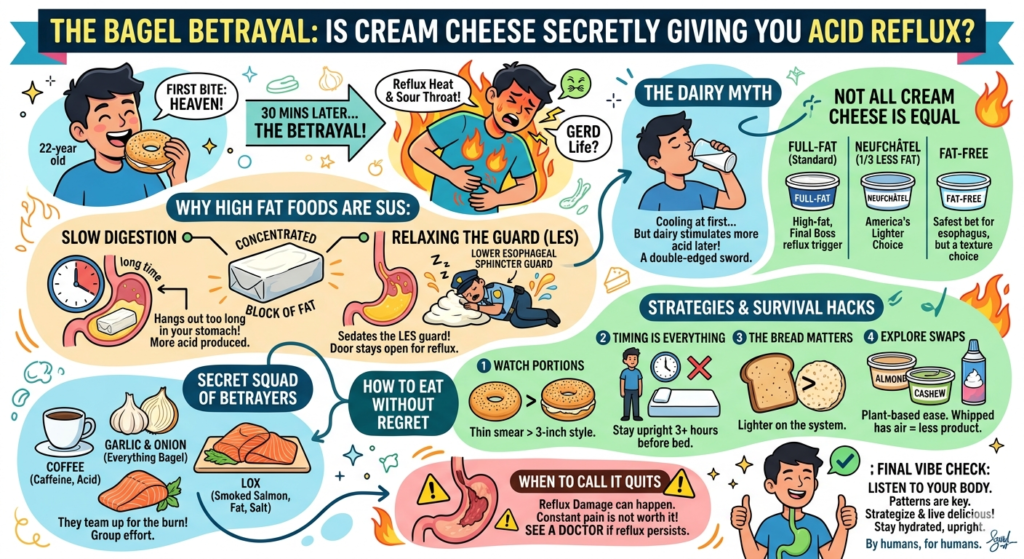
You order the classic. Everything bagel, toasted, with a thick, satisfying smear of cream cheese. It looks iconic. The first bite is literal heaven.
But then, about thirty minutes later, the vibe shifts.
That familiar, annoying heat starts climbing up your chest. Your throat feels a little sour. You start doing that weird “silent burp” thing to try and relieve the pressure.
Tbh, it is a total betrayal. You and that bagel had a connection, and now your body is acting like you just swallowed a literal firework.
If you are living the acid reflux life, you know exactly what I’m talking about. And if you’ve been wondering if your cream cheese obsession is the culprit, we need to have a serious talk about what is actually going on in your stomach.
The Lowdown on Cream Cheese and the Burn
First off, let’s be real: cream cheese is one of the greatest inventions of all time. It’s creamy, it’s tangy, and it makes basically everything taste better. But for people with GERD (Gastroesophageal Reflux Disease) or chronic heartburn, it can be a major red flag.
Why? Because cream cheese is essentially a concentrated block of fat.
I’m not saying that to be a buzzkill, it’s just the science of the snack. Most standard cream cheeses are made from a mix of milk and cream, and they have a pretty high fat content.
And when it comes to acid reflux, fat is usually the main villain in the story.
Why High Fat Foods are Sus for Your Stomach
To understand why cream cheese might be ruining your morning, we have to look at how your body handles fat.
When you eat something high in fat, two things happen that are basically a “how-to” guide for getting heartburn.
First, fat takes a really long time to digest. While a piece of fruit might fly through your system, a heavy smear of cream cheese likes to hang out in your stomach for a while.
The longer food stays in your stomach, the more acid your body produces to try and break it down. More acid equals a higher chance of that acid splashing back up into places it doesn’t belong.
Second, fat has this weird ability to tell your Lower Esophageal Sphincter (the LES) to take a nap.
Think of the LES as a little security guard at the top of your stomach. Its only job is to stay shut so acid doesn’t get into your throat. But high-fat foods act like a sedative for that guard. The guard falls asleep, the door stays open, and suddenly you’re dynamic-dying from the burn.
The Dairy Myth: Isn’t Milk a Base?
I used to hear this all the time from my parents. “If your stomach hurts, just drink some milk! It neutralizes the acid!”
Tbh, that is some old-school logic that doesn’t quite hold up.
While milk is technically less acidic than something like orange juice, dairy can be a double-edged sword.
The protein and fat in dairy products (like cream cheese) actually stimulate your stomach to produce more acid. So, while it might feel cool and soothing for the five seconds it’s in your throat, it’s actually setting up a bigger fire in your stomach for later.
It’s like putting a tiny ice cube on a sunburn while you’re still standing in the middle of the desert. It feels good for a second, but the underlying problem is still very much there.
Is All Cream Cheese Created Equal?
If you aren’t ready to break up with cream cheese yet, I have some semi-good news. Not every tub in the dairy aisle is going to treat your stomach the same way.
Standard, full-fat cream cheese is the most likely to cause issues. It’s the “final boss” of reflux triggers in the bagel world.
However, you’ve probably seen “Neufchâtel” cheese or “1/3 Less Fat” cream cheese.
Neufchâtel is originally a French cheese, but in the US, it’s basically just a lower-fat version of cream cheese. It has more moisture and less fat than the regular stuff.
For some people, switching to a lower-fat version can be enough to keep the heartburn at bay. Since there’s less fat to slow down your digestion or relax that LES guard, your stomach might not take it so personally.
Then you have fat-free cream cheese. I’m going to be 100% honest with you: the texture is… a choice. It doesn’t melt the same way and it definitely lacks that rich vibe. But if you are in a massive reflux flare-up and absolutely need that bagel fix, it’s the safest bet for your esophagus.
The Secret Trigger: It’s Not Just the Cheese
Sometimes, cream cheese isn’t acting alone. It’s part of a squad of triggers that all team up to ruin your day.
Think about what usually goes with cream cheese.
If you’re having it on an “Everything” bagel, you’re also eating garlic and onion. Both of those are massive, top-tier triggers for acid reflux.
If you’re having it with a giant cup of coffee, the caffeine is relaxing your LES even more while the acidity of the coffee adds to the fire.
If you’re adding lox (smoked salmon), you’re adding even more fat and salt.
Sometimes we blame the cream cheese when it was really the combination of everything together that pushed our stomach over the edge. It’s a group effort of betrayal.
How to Eat Cream Cheese Without the Regret
If you’re like me and “never eating cream cheese again” sounds like a personal nightmare, you don’t necessarily have to quit cold turkey. You just have to be smarter about it.
1. Watch the portion size. The “New York Style” smear that is three inches thick? That is a reflux disaster waiting to happen. Try a thin layer. You still get the flavor, but your stomach doesn’t have to work nearly as hard.
2. Timing is everything. Don’t eat a cream cheese laden bagel and then immediately go lay down on the couch to scroll TikTok. You need gravity on your side. Stand up, walk around, and give your stomach at least three hours to process that fat before you hit the bed.
3. The Bread Matters. Instead of a heavy, doughy bagel (which can also cause bloating and pressure), try your cream cheese on a piece of whole-grain toast or a rice cake. It’s lighter on the system.
4. Explore the Swaps. There are some surprisingly good plant-based cream cheeses out there now. Some are made from almonds or cashews. While they still have healthy fats, some people find they are much easier to digest than cow’s milk dairy.
Another pro-tip: try whipped cream cheese. Because it’s full of air, you naturally end up eating less actual product per bite, which might save your chest from the burn.
When to Call It Quits
I know we’re keeping this casual, but if you are experiencing “the burn” every single time you eat, or if it’s happening more than twice a week, it might be more than just a cream cheese problem.
GERD can actually cause damage to your esophagus over time if you just ignore it and keep chugging antacids. If you’ve tried the low-fat swaps and the smaller portions and your chest still feels like it’s being haunted by a ghost made of fire, it’s definitely time to talk to a doctor.
Tbh, no food is worth constant pain. Not even a perfect, toasted, salt bagel with a smear.
The Final Vibe Check
At the end of the day, your relationship with cream cheese is between you and your stomach.
Is it a common trigger? Yes. Is it high in fat? Definitely. Is it going to give everyone heartburn? Not necessarily.
Everyone has a different “tolerance level” for fat. Some people can eat a whole tub and feel fine, while others just have to look at a cheesecake and their throat starts burning.
The goal is to listen to your body. If you notice a pattern where every bagel morning turns into a “why did I do this to myself” afternoon, it’s time to make a change.
Try the low-fat version. Try the thin smear. Skip the extra coffee.
You can still have a delicious life without the constant betrayal of acid reflux. It just takes a little bit of strategy and a lot of listening to what your gut is trying to tell you.