So, I am 22, and I am already carrying Tums in my bag like they are breath mints.
It is honestly a vibe I did not ask for. You would think at this age my biggest worry would be finishing a degree or figuring out how to budget for a concert, but instead, I am out here googling “can I eat cheese without dying” at 2 AM.
If you have ever felt that slow, rising heat in your chest after a late-night taco run or even just a slice of pizza, you know the struggle. Acid reflux is the ultimate party pooper. It is that uninvited guest that shows up right when you are trying to relax.
Lately, there has been a lot of talk in the “gut health” corners of the internet about cottage cheese. Some people swear it is a literal lifesaver for their stomach, while others think dairy is the enemy.
I decided to do the deep dive so you don’t have to. Is cottage cheese actually good for acid reflux, or is it just another food that is going to betray us?
Let’s break down the science, the flavors, and the reality of eating curds when your esophagus is on fire.
The Heartburn : Why Everything Hurts
To understand why cottage cheese might be a hero, we have to look at why we are in pain in the first place.
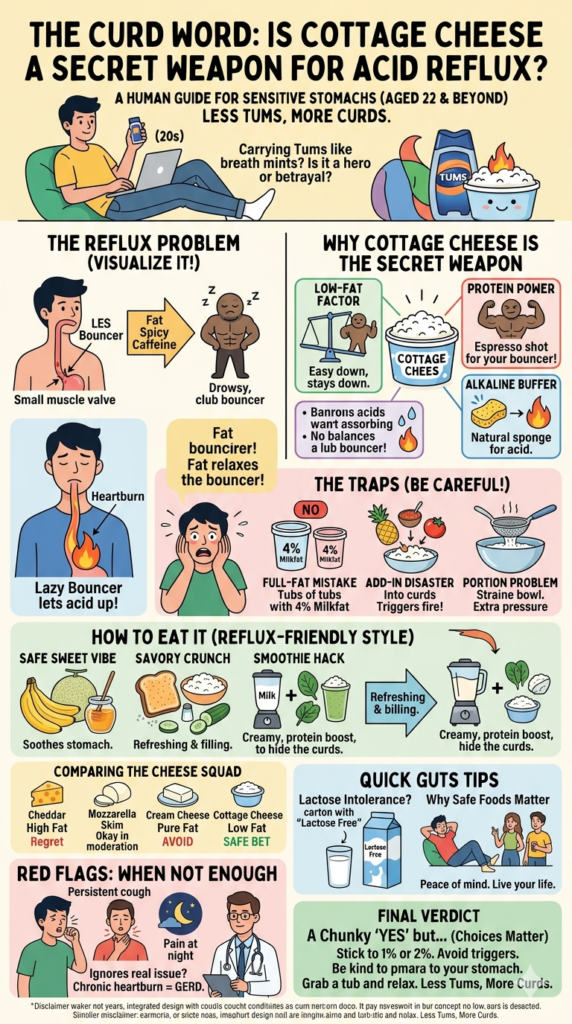
Basically, you have a little muscular valve called the Lower Esophageal Sphincter, or the LES. I like to think of it as the bouncer for your stomach. Its only job is to let food go down and keep the stomach acid from coming back up.
When that bouncer gets sleepy or lazy, acid splashes up into your throat. That is the “burn” we all know and hate.
A lot of things make that bouncer lazy. Fried foods, caffeine, spicy stuff, and especially high-fat foods. Fat is like a sedative for your stomach bouncer. When you eat a huge, greasy burger, your LES basically takes a nap, and the acid party starts in your esophagus.
Enter the Hero: Why Cottage Cheese is Different
Most cheeses are a massive “no” when you have acid reflux. Brie, cheddar, parmesan, they are all delicious, but they are also packed with fat. They are basically a one-way ticket to Heartburn City.
But cottage cheese is the weird, chunky cousin of the cheese family that actually plays by different rules.
Here is why it is lowkey a game-changer for people with reflux.
1. The Low-Fat Factor
If you grab the low-fat or fat-free version of cottage cheese, you are giving your stomach a break. Unlike a greasy slice of mozzarella, low-fat cottage cheese doesn’t force your stomach to work overtime.
Because it is low in fat, it doesn’t trigger that “sleepy bouncer” effect as much as other dairy products. It goes down easy and stays down.
2. The Protein Power
Cottage cheese is a protein beast. Protein is actually thought to help strengthen the LES. While fat relaxes that valve, protein can actually help it stay firm and closed.
By eating a snack that is high in protein and low in fat, you are basically giving your stomach bouncer a shot of espresso instead of a sedative.
3. It is Relatively Alkaline
The pH scale is everything when it comes to reflux. You want to avoid acidic foods like lemons and tomatoes and lean into alkaline or neutral foods.
Cottage cheese isn’t perfectly alkaline, but it is much closer to neutral than many other snacks. It can actually help “buffer” the acid that is already sitting in your stomach, acting like a bit of a natural sponge.
Probiotics: The Secret Gut Hack
Some brands of cottage cheese come with “live and active cultures.” This is fancy talk for probiotics.
If you have been alive and on social media for the last two years, you know that probiotics are the holy grail of gut health. They help balance the bacteria in your system.
When your gut bacteria are balanced, your digestion is smoother. When your digestion is smoother, food moves out of your stomach faster.
Remember the “traffic jam” analogy? If food moves quickly through your stomach, there is less pressure on your LES, which means less chance for acid to escape.
The Trap: When Cottage Cheese Goes Wrong
Before you go and buy ten tubs of cottage cheese, we need to talk about the fine print. Not all cottage cheese is created equal, and you can definitely mess this up.
The Full-Fat Mistake
If you buy the “4% milkfat” version and eat a giant bowl of it, you might still get heartburn. For a sensitive stomach, 4% is still high enough to cause issues. If you are in the middle of a reflux flare-up, you really want to stick to the 1% or 2% versions.
The Add-In Disaster
Cottage cheese by itself is pretty bland. Most people want to add stuff to it.
If you add pineapple, oranges, or spicy salsa to your cottage cheese, you have officially canceled out all the benefits. Those are high-acid triggers. You are essentially putting fire on top of your fire-extinguisher.
The Portion Problem
Even the healthiest food can cause reflux if you eat too much of it. If you overfill your stomach, the sheer pressure will force that bouncer valve open. Small meals are the golden rule for “adulting” with a sensitive stomach.
How to Eat It: My Favorite Reflux-Friendly Pairings
If you want to actually enjoy your cottage cheese without the burn, you have to be smart about your toppings. Here are a few 22-year-old-approved ways to make it taste good.
The “Safe” Sweet Vibe: Mix your cottage cheese with sliced bananas or small pieces of melon. Both of these fruits are super low-acid and actually help soothe the stomach. A drizzle of honey is usually safe too.
The Savory Crunch: Put a scoop of cottage cheese on a piece of whole-grain toast. Sprinkle a tiny bit of salt and some cucumber slices on top. It is refreshing, filling, and won’t make your chest feel like it’s melting.
The Smoothie Hack: If you can’t stand the texture of cottage cheese (I get it, the curds are a choice), throw it in a blender with some almond milk and a handful of spinach. It makes the smoothie incredibly creamy and adds a massive protein boost without the fat of a milkshake.
Comparing the Cheese Squad
If you are still wondering if you can just stick to your regular cheese, let’s look at the numbers.
Cheddar: High fat, high sodium, high chance of regret. Mozzarella: Usually okay in small amounts if it is part-skim, but still riskier than cottage cheese. Cream Cheese: Basically pure fat. Avoid it if you are already feeling the burn. Cottage Cheese: Low fat, high protein, and generally the safest bet in the dairy aisle.
A Note on Lactose Intolerance
This is a big one. A lot of people have acid reflux because they are struggling to digest lactose. If your body hates dairy, cottage cheese is not going to be your friend.
Even though it is “good” for reflux, the lactose could cause gas and bloating, which increases stomach pressure and, you guessed it, causes more reflux.
If you are dairy-sensitive, look for the lactose-free versions of cottage cheese. They exist, and they taste exactly the same.
The Emotional Toll of the Burn
I know it sounds dramatic to talk about the “emotional toll” of cheese, but when you are young and trying to have a social life, acid reflux is exhausting.
It makes you the “picky eater” at dinner. It makes you afraid to grab a late-night snack with your friends.
Finding “safe” foods like cottage cheese is about more than just nutrition. It is about peace of mind. It is about knowing you can eat something, feel full, and not have to spend the next three hours sitting bolt upright on your bed waiting for the pain to pass.
Red Flags: When Cottage Cheese Isn’t Enough
Look, I love a good food hack, but I am also a realist. If you are eating low-fat cottage cheese and following all the rules, but you still feel like you are swallowing hot coals, you need to see a doctor.
Chronic heartburn can lead to something called GERD, which can actually scar your esophagus over time. Don’t be the person who ignores a real medical issue because they think they can fix it with just “diet and lifestyle.”
If you have a cough that won’t go away, a hoarse voice, or pain that wakes you up at night, go talk to a professional.
The Final Verdict
So, is cottage cheese good for acid reflux?
The answer is a big, chunky yes. As long as you stick to the low-fat version and don’t load it up with acidic fruit or spicy seasonings, it is one of the safest snacks you can have. It provides the protein you need to keep your digestive bouncer strong and the pH balance to keep your stomach calm.
It might not be the most “aesthetic” food in your fridge, but it is a literal lifesaver when you want to eat like a normal human without the consequences.
Be kind to your stomach. It is doing its best with the hand it was dealt. Grab a tub of the 1%, find some safe toppings, and enjoy the rare sensation of a chest that isn’t on fire.
Stay cool, stay full, and maybe keep the Tums around just for emergencies.