Okay, let’s get real. When you are going through a rough patch with your digestion, life starts to feel like a very bland, very sad version of itself.
You spend your days staring at plain rice and boiled chicken, and eventually, your brain starts doing some dangerous bargaining.
You start looking at the snack cabinet.
You spot that bag of classic, salty potato chips, and you think to yourself, “Wait, potatoes are soft, right? And they aren’t ‘fibrous’ like kale? Maybe, just maybe, these are okay.”
It is the classic “stomach-on-a-soft-food-diet” fantasy.
But before you dive into that bag of golden, crunchy goodness, we need to have a serious talk about whether potato chips are actually “low residue.”
Spoiler alert: it is not as simple as just “potatoes are soft.”
Being 22 is all about learning the difference between what we want to eat and what our gut actually allows us to eat, so let’s get into the nitty-gritty of why your favorite salty snack might be a total trap.
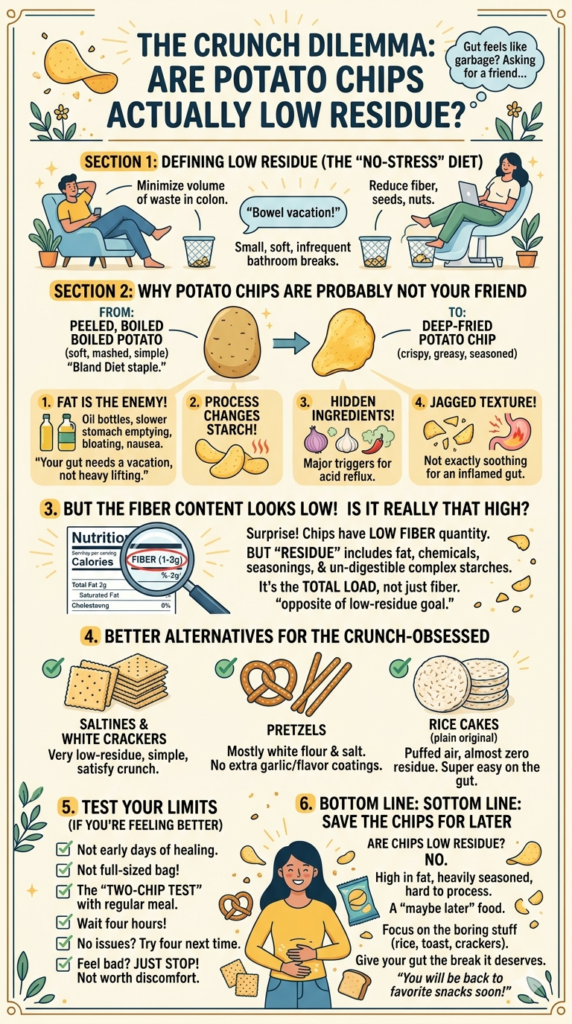
Defining Low Residue: The “No-Stress” Diet
If you remember from our deep dive into low residue dog food, the whole point of a low residue diet is to reduce the amount of “stuff” that makes it all the way to your colon.
We are talking about minimizing fiber, seeds, nuts, and anything that takes a lot of heavy lifting to break down.
A true low residue diet is about giving your digestive tract a vacation.
It is designed to minimize the physical volume of waste and keep your bowel movements small, soft, and infrequent.
When you look at a potato, the raw vegetable itself is actually a bit of a mixed bag.
It has some fiber, but if you peel it and boil it until it is mushy, it becomes a staple of the “bland diet.”
But there is a massive leap from a boiled, peeled potato to a deep-fried, salted potato chip.
That leap is where all your stomach’s problems are waiting.
Why Potato Chips Are Probably Not Your Friend
When a potato becomes a chip, it undergoes a transformation that completely changes its digestive profile.
First, there is the oil.
Most potato chips are deep-fried in vegetable oils.
Fat is the enemy of a sensitive gut.
When you consume a high amount of fat, it slows down your stomach emptying.
This causes food to sit there longer, which can lead to bloating, nausea, and—if your gallbladder is already acting up—a world of pain.
Then there is the frying process itself.
The high heat changes the structure of the starch in the potato.
While the potato is still a starch, it is now covered in fat and often seasoned with things like onion powder, garlic powder, or chili spices.
These “hidden” ingredients are major triggers for acid reflux and gas.
And finally, there is the texture.
Even though they feel light and airy, potato chips are jagged.
If you are dealing with a raw, inflamed gut, those little shards of fried potato are not exactly the soothing, soft food your system is craving.
The Fiber Content: Is It Really That Low?
Here is the thing that surprises people: potato chips aren’t exactly “high fiber” in the traditional sense.
If you look at the nutrition label, a serving of chips usually only has one or two grams of fiber.
In terms of fiber quantity, they look like they might pass the test.
But “residue” isn’t just about fiber.
It is about the total load on your system.
It is the fat, the chemicals, the seasonings, and the complex starches that don’t fully break down in the small intestine.
When you eat a big bowl of chips, you are putting a massive amount of “undigestible” fat and residue into a gut that is already struggling to cope.
It is the opposite of the “low residue” goal.
It’s basically throwing a party in your gut where the guest of honor (your digestion) is currently trying to hide in the bathroom.
What About Baked Chips?
I know what you are thinking.
“Okay, fried is out. What about baked chips? They have way less fat, right?”
It is a slightly better option, but it is still risky.
Baked chips are still processed, they still have those concentrated seasonings, and they are still going to be harder to digest than something like a saltine cracker or a piece of white toast.
If you are really, really craving a crunch and you are past the absolute “emergency” phase of your recovery, a few baked chips might not kill you.
But if you are still in the early days of healing—like, if you are still living on rice and broth—baked chips are still too much work.
Your stomach doesn’t care if the chip was baked or fried.
It just cares that it’s a jagged, processed piece of starch that it has to turn into mush.
Better Alternatives for the Crunch-Obsessed
I get it. The craving for a “crunch” is real.
When you have been eating soft mush for three days straight, you would trade your soul for something that makes a noise when you bite into it.
If you need a snack that hits that spot without wrecking your gut, here are the “safer” ways to get that crunch:
Saltines or White Crackers
They are simple, they are processed (in a good way), and they are very low residue.
They provide that satisfying crunch without the heavy fat content of chips.
Pretzels
Plain, standard pretzels are surprisingly low residue.
They are basically just white flour and salt.
They are much easier on the stomach than anything fried.
Just make sure they are plain—no extra garlic or “pizza flavor” coatings.
Rice Cakes
If you get the plain, original rice cakes, they are basically puffed air.
They have almost zero residue and are super easy to digest.
You can even put a tiny bit of plain peanut butter on them if you are feeling crazy (though check with your doctor first if you have major issues).
How to Test Your Limits
If you are feeling better and you want to see if you can handle a potato chip again, do not just open a family-sized bag and go to town.
Start with the “two-chip test.”
Eat two chips with a meal that you already know is safe for you.
Then wait.
Wait four hours.
If you don’t have any bloating, cramping, or “urgent” bathroom needs, you can try four chips next time.
It is all about titration.
Your body will give you a very clear signal if you have pushed it too far.
If you feel bad, just stop.
It is not worth the discomfort, and there will be plenty of potato chips waiting for you once your gut is fully healed.
When to Stop Bargaining with Your Gut
I know it’s hard when you are young and you want to just “be normal” and eat snacks with your friends.
But sometimes, you have to be the adult in the room—even if you are only 22.
If you find that you are constantly craving things that make you feel like garbage, take a step back.
Are you actually hungry, or are you just bored?
Sometimes, we reach for the chips because we are stuck at home or stressed out, and we need a distraction.
Try to find a different way to relax that doesn’t involve testing your digestive system’s limits.
If you are dealing with chronic issues where nothing seems to be low residue enough, you really need to see a GI specialist (yes, like one of those Dr. Noels we talked about).
You might have something going on that isn’t going to go away just by switching snacks.
The Bottom Line: Save the Chips for Later
Are potato chips low residue?
No.
They are high in fat, heavily seasoned, and processed in a way that makes them difficult for a sensitive gut to handle.
They are a “maybe later” food, not a “healing” food.
Keep them out of the house for a while if you are really trying to get your stomach back on track.
Focus on the boring stuff—the rice, the toast, the crackers—and let your gut finish its repair job.
Once you are back to 100 percent, you can enjoy a bag of chips without a second thought.
Hang in there, keep your snacks boring for a little bit longer, and remember that this phase is just temporary.
Your stomach is working hard to heal, so give it the break it deserves.
You will be back to your favorite snacks before you know it!