Let’s be totally honest for a second. Life without cheese isn’t really a life at all. It is the glue that holds our social lives together. Pizza nights with your roommates, late night grilled cheese sessions when you are stressed about finals, or that beautiful caprese salad you pretend to eat to feel like a healthy adult.
But if you are dealing with acid reflux or GERD, cheese can feel like a toxic relationship. You love it, but it definitely does not love you back. You eat two slices of pizza and suddenly your chest is on fire, your throat feels like you swallowed a hot coal, and you are upright at 3 AM wondering why your body is betraying you.
When you start looking up “GERD friendly diets,” most of them tell you to just give up joy entirely. No spice, no chocolate, no caffeine, and definitely no fat. It feels like you are being sentenced to a lifetime of boiled chicken and plain white rice.
But here is the thing. Not all cheeses are created equal. If you are a cheese addict trying to manage a glitchy esophagus, mozzarella might actually be your secret weapon.
We are going to dive into the science of why mozzarella is usually the “safest” bet for reflux sufferers, how to eat it without triggering a flare-up, and why the way you pair your cheese matters way more than the cheese itself.
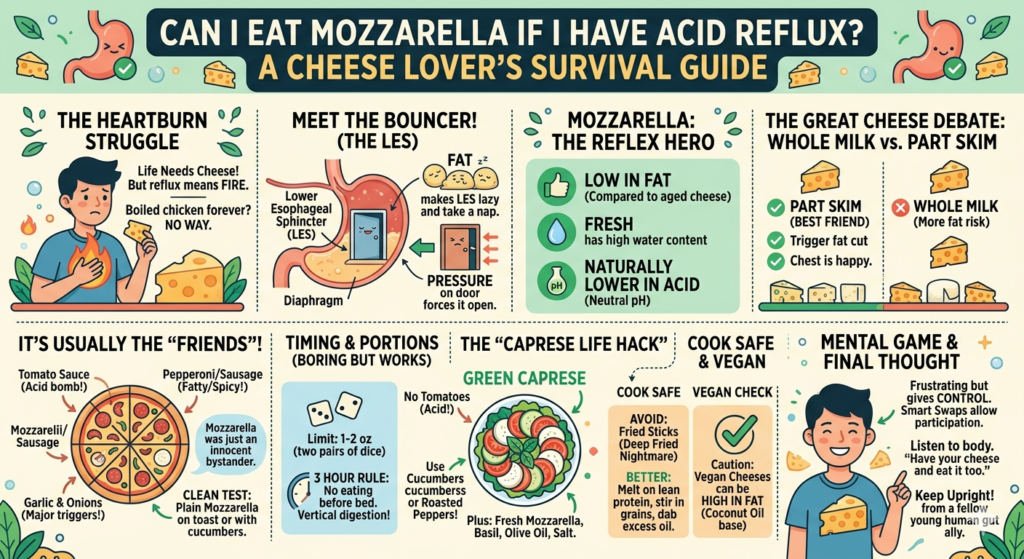
The Science of the “Bouncer” (Your LES)
To understand why cheese causes issues, we have to look at the bouncer of your stomach: the Lower Esophageal Sphincter (LES).
The LES is a little ring of muscle at the bottom of your throat. Its only job is to open when you swallow food and then slam shut to keep stomach acid where it belongs. When the LES gets “lazy” or weak, acid creeps back up, and that is where the burning starts.
Fat is one of the biggest reasons the LES stops doing its job. High fat foods take a long time to digest, which means they sit in your stomach forever. This creates pressure. Plus, fat actually tells the LES to relax and take a nap.
This is why a super fatty, aged cheddar or a creamy brie can be a total disaster for reflux. They are packed with fats that keep that “door” open for hours.
Why Mozzarella is the “Good Guy”
Mozzarella is a bit of an outlier in the cheese world. Compared to hard, aged cheeses, it is relatively low in fat, especially if you are choosing the right kind.
When we talk about mozzarella, we are usually talking about two different things: the fresh, watery stuff in the deli section and the low-moisture, shredded stuff we put on pizza.
Fresh mozzarella is actually one of the best options for people with sensitive stomachs. Because it is a “fresh” cheese and isn’t aged for months, it has a higher water content and a lower fat concentration per gram than something like parmesan or sharp cheddar.
It is also naturally lower in acid. Some fermented or aged cheeses can be quite acidic themselves, which adds more fuel to the fire in your stomach. Mozzarella is much more neutral, making it a “calmer” choice for your digestive tract.
Part Skim vs. Whole Milk: The Great Debate
If you are at the grocery store, you have a choice to make. Do you go for the “Whole Milk” mozzarella or the “Part Skim” version?
If you have acid reflux, “Part Skim” is going to be your best friend.
The goal with a reflux diet is to keep the total fat content of your meal low enough that your stomach can process it quickly. By choosing part skim mozzarella, you are cutting out a significant amount of the trigger fat while still getting that cheesy flavor and the protein.
It might not be quite as “melty” as the full fat version, but your chest will thank you later that night.
It’s Usually the “Friends,” Not the Cheese
Here is the biggest plot twist when it comes to mozzarella and reflux. Most of the time, when people say “mozzarella gave me heartburn,” they are actually talking about pizza or pasta.
Think about what usually goes with mozzarella. You’ve got tomato sauce (super acidic), pepperoni or sausage (super fatty and spicy), and maybe some garlic and onions (major reflux triggers).
When you eat a slice of pepperoni pizza, your stomach isn’t just reacting to the cheese. It is being hit with a quadruple threat of acid, spice, fat, and garlic. The mozzarella is basically just an innocent bystander in a high speed chase.
If you want to test if mozzarella is actually a trigger for you, try eating it in a “clean” way. Have a slice of part skim mozzarella on a piece of whole grain toast or with some cucumber slices. If you feel fine, then you know the cheese isn’t the enemy; it’s the pizza toppings.
Timing and Portion Control (The Boring Stuff That Works)
I know, I know. No one wants to hear about “portion control” when there is a cheese board in front of them. But with reflux, the amount you eat is just as important as what you eat.
Even a “safe” food can cause reflux if you eat so much of it that your stomach is physically distended. When your stomach is too full, it puts physical pressure on the LES, forcing it open.
Try to stick to about an ounce or two of mozzarella at a time. This is roughly the size of two pairs of dice. It’s enough to satisfy the craving without overloading the system.
Also, the “3 Hour Rule” is non-negotiable. Do not eat mozzarella (or anything else) within three hours of going to bed. Digestion is a vertical process. If you eat a bunch of cheese and then immediately lie down to watch Netflix, you are basically inviting that acid to gravity-crawl back up your throat.
The “Caprese Life Hack”
One of the best ways to enjoy mozzarella if you have GERD is a modified Caprese salad.
Traditionally, this is tomatoes, fresh mozzarella, basil, and balsamic glaze. But tomatoes are basically liquid acid.
Instead, try making a “Green Caprese.” Use sliced cucumbers or even roasted red peppers (if you can handle them) instead of tomatoes. Use fresh mozzarella, lots of fresh basil, and a tiny bit of olive oil and salt.
It gives you that fresh, creamy cheese fix without the acid bomb that usually comes with tomatoes. It’s a total game changer for summer snacking.
What About Vegan Mozzarella?
A lot of people think that switching to vegan cheese will solve their reflux issues. Not so fast.
Many vegan cheeses are made with a base of coconut oil or cashews. While they don’t have dairy, they are actually incredibly high in fat. Coconut oil is almost pure saturated fat, which, as we discussed, is the #1 reason the LES relaxes.
If you find that dairy specifically triggers your reflux (some people have a sensitivity to the proteins in cow’s milk), then a vegan option might help. But if your trigger is fat, a vegan mozzarella might actually be worse for you than the real thing. Always read the nutrition label and check that fat content!
Cooking Methods Matter
How you prepare your mozzarella also changes the “reflux risk.”
Fried mozzarella sticks? They are a nightmare. You are taking cheese, coating it in carbs, and then deep frying it in more fat. That is a one way ticket to Heartburn City.
Melting it on top of some lean chicken or stirring a little bit of shredded part skim into some quinoa? Much safer.
When you melt cheese, it releases some of the oils. If you are baking something with mozzarella, you can sometimes dab off the excess oil with a paper towel before eating it. It sounds a little extra, but every bit of fat you remove is a bit of relief for your esophagus.
The Mental Game of Reflux
Dealing with acid reflux at 22 is honestly frustrating. You feel like you are too young to be worried about “trigger foods” and “sleeping on an incline.” It can make you feel antisocial or like you are a “difficult” person to eat with.
But remember that managing your diet isn’t about restriction; it’s about control. By choosing something like mozzarella over a high fat cheddar, you are giving yourself the freedom to enjoy food without the fear of pain later.
It’s about making smart swaps so you can still go out and be a person. If everyone is getting pizza, maybe you get the thin crust with light cheese and veggies instead of the deep dish meat lovers. You still get to participate, but you don’t pay for it at 2 AM.
Final Thoughts
The “mozzarella verdict” is generally positive. It is one of the most reflux friendly cheeses out there because of its lower fat content and neutral pH.
If you stick to part skim, watch your portions, and keep it away from “bad influences” like spicy pepperoni and acidic tomato sauce, you can absolutely keep it in your life.
Listen to your body. If you have a flare-up, take a break for a few days and let things calm down. But don’t feel like you have to banish the cheese drawer forever.
You’ve got this. Your gut is a little sensitive right now, but with a few smart moves, you can still have your cheese and eat it too. Stay hydrated, keep your head up (literally, stay upright!), and enjoy that mozzarella!