Being a dog parent in your early 20s is a whole vibe.
It is basically practice for actual parenthood, but with more fur and significantly more time spent analyzing things you never thought you would be looking at so closely.
If you are like me, you probably spent a lot of time picking out the perfect aesthetic harness and finding the most instagrammable dog park in the city.
But then, reality hits.
Your dog starts having tummy troubles.
I am not just talking about a little gas. I am talking about the kind of digestive drama that makes you question every life choice you have ever made while you are standing on a sidewalk at 3 a.m. with a flashlight and a plastic bag.
Whether you are living in a small rental with beige carpet (a literal nightmare for a sick dog) or you just want your pup to feel their best, the food you put in their bowl is everything.
Enter the world of low residue dog food.
It sounds like something out of a science lab, but it is actually a pretty simple concept that can save your sanity and your dog’s gut.
Let’s break down what it is, why it matters, and how to tell if your dog needs to join the low residue club.
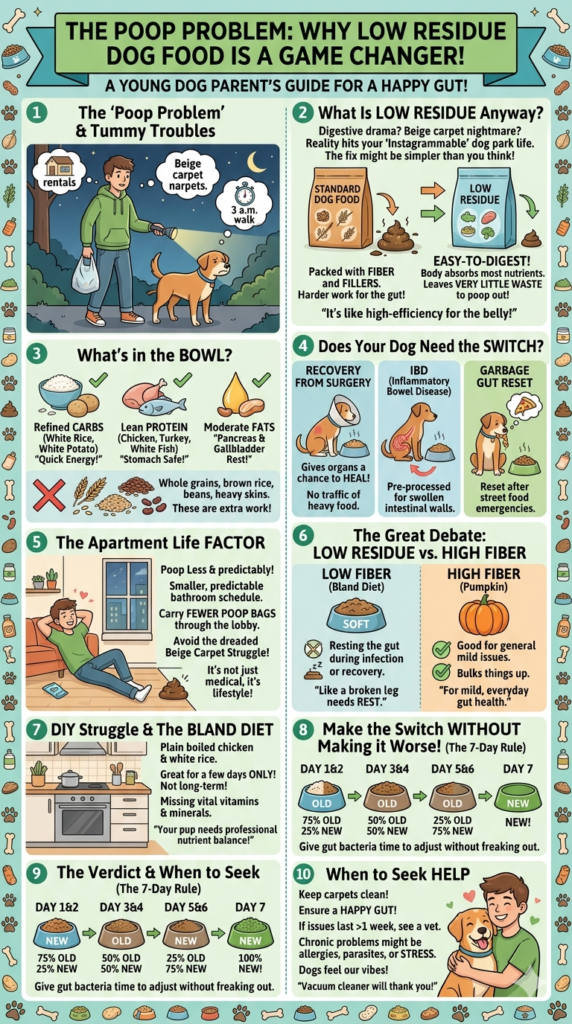
What on Earth Does Low Residue Even Mean?
If you are looking at that term and thinking it sounds like something left behind after a chemistry experiment, you are not alone.
In the world of dog nutrition, residue is just a polite way of saying the stuff that does not get digested.
Basically, it is the waste that ends up as poop.
Low residue dog food is designed to be incredibly easy to digest.
The goal is for the dog’s body to absorb as much of the nutrients as possible, leaving very little residue to pass through the system.
It is like the high efficiency version of dog food.
Most standard dog foods are packed with fiber and various fillers. Fiber is usually great for humans and dogs alike because it keeps things moving.
But sometimes, moving is the last thing your dog’s gut needs to be doing.
If their system is irritated, inflamed, or recovering from a major event, they need a break.
Low residue food provides that break by being low fiber and high absorption.
The Ingredients: What Is Actually in the Bowl?
When you are scanning the back of a bag for low residue options, you are not going to see a bunch of whole grains, beans, or heavy vegetable skins.
Instead, you are looking for clean sources of energy.
The protein is usually something very lean and easy on the stomach, like chicken, turkey, or white fish.
The carbohydrates are usually refined rather than whole grain.
Think white rice or even white potatoes.
In the human world, we are always told to eat brown rice and whole wheat because of the fiber.
But in the sensitive dog world, those husks and fibers are just extra work for an already tired digestive tract.
By using white rice, the body can turn those carbs into energy almost immediately without having to grind through tough fibers.
It also usually has a very specific fat content.
Fat is harder to digest than protein or carbs, so low residue diets are usually moderate to low in fat to keep the gallbladder and pancreas from having to work overtime.
Why Your Dog Might Need the Switch
There are a few big reasons why a vet might point you toward this specific type of diet.
One of the most common is recovery from surgery.
If your dog just had an operation, especially anything involving their belly, the last thing they need is a bunch of bulky fiber pushing through their system.
It is the same reason humans eat Jell-O and broth after surgery. You want to give the organs a chance to heal without the traffic of heavy food.
Another big one is IBD or Inflammatory Bowel Disease.
Just like people deal with Crohn’s or UC, dogs can have chronic inflammation in their gut.
When the walls of the intestine are swollen, they cannot absorb nutrients properly.
A low residue diet helps because the food is already pre-processed in a sense, making it much easier for those inflamed walls to grab the nutrients.
Then there is the dreaded garbage gut.
We have all been there. You turn your back for two seconds and your dog has eaten a week-old slice of pizza they found on the sidewalk.
When their system is in a state of emergency from eating something they should not have, a week or two of low residue food can help reset their stomach and get things back to normal.
The Apartment Life Factor
I have to be real with you for a second.
If you are living in a small apartment or a rental property, the residue factor is a massive deal.
When you do not have a backyard and you have to walk your dog through a hallway and down an elevator every time they need to go, you really start to appreciate a dog with a predictable, low volume bathroom schedule.
Dogs on a low residue diet generally poop less.
Since they are absorbing more of their food, there is literally less waste to come out the other end.
For those of us who have to carry poop bags through a lobby or deal with the beige carpet struggle, this is a massive hidden benefit.
It is not just about the medical stuff; it is about making life a little bit easier for both of you.
Low Residue vs. High Fiber: The Great Debate
There is a lot of confusing info out there about fiber.
Sometimes people tell you to give your dog pumpkin for their stomach, which is high in fiber.
So why would you want low fiber?
It really depends on what is actually going on.
High fiber is great for regularity. If your dog is a little backed up or has some mild issues, fiber can help bulk things up and move them along.
But if your dog has an actual infection, inflammation, or is recovering from a major illness, moving things along can actually cause more pain.
Think of it like this: if you have a broken leg, you do not want to go for a run. You want to rest.
Low residue food is rest for the intestines.
Once the leg (the gut) is healed, you can slowly go back to the running (the fiber).
Can You Do It Yourself? The DIY Struggle
As a 22-year-old who barely has the patience to meal prep for myself, the idea of home-cooking for my dog sounds like a lot.
But for some people, the only way to get a truly low residue diet is to cook it at home.
The bland diet is the DIY version of low residue food.
It is usually a 2:1 ratio of white rice to boiled chicken breast. No skin, no bones, no seasoning.
While this is great for a couple of days, it is NOT a long-term solution.
Dogs need a ton of vitamins and minerals that they just will not get from plain chicken and rice.
If you find that your dog needs a low residue diet for more than a few days, you really need to look into professional brands or prescription diets.
They make sure all the hidden stuff like calcium and taurine are in there so your dog does not end up with other health problems while you are trying to fix their stomach.
How to Make the Switch Without Making It Worse
If you decide to try a low residue food, do not just swap the bowls overnight.
I know it is tempting when you are frustrated with the current situation, but a sudden change in food is the fastest way to trigger even more stomach issues.
The 7-Day Rule is your best friend here.
Day 1 and 2: 75 percent old food, 25 percent new low residue food.
Day 3 and 4: 50/50 split.
Day 5 and 6: 25 percent old food, 75 percent new food.
Day 7: 100 percent new food.
This gives the bacteria in their gut time to adjust to the new efficiency of the food without freaking out.
What to Watch Out For
While low residue food is a lifesaver for many, it is not a cure-all.
If you put your dog on this diet and they are still having issues after a week, it is time to talk to a professional.
Chronic stomach issues can be a sign of something bigger, like allergies, parasites, or even stress.
Our dogs feel our vibes. If you are stressed out about your job or your rent, they can pick up on that, and it often manifests in their stomach.
Sometimes the best low residue treatment is a combination of good food and a little less stress in the house.
The Verdict
At the end of the day, we just want our pups to be happy and our carpets to stay clean.
Low residue dog food is one of those boring but essential tools in the dog-parenting toolkit.
It is not as fun as buying a new squeaky toy, but the peace of mind you get from a dog with a happy gut is priceless.
If you are dealing with frequent accidents, weird stomach noises, or just want to make life easier after a surgery, give it a shot.
Your dog and your vacuum cleaner will thank you.
Remember to keep it simple, stick to the transition plan, and do not be afraid to ask for help if things do not get better.
You have got this, and your pup is lucky to have someone who cares enough to do the research.
Now, go enjoy a walk that does not involve a digestive emergency!