Let’s be honest. When you hear the words “high fiber,” you probably think of your grandma’s cereal or, worse, a bowl of bland, sawdust-textured bran flakes that taste like pure disappointment.
For the longest time, I thought fiber was just that boring stuff you were supposed to eat because “it’s good for you,” which is basically code for “it makes you go to the bathroom.”
But now that I’m 22 and actually paying attention to why I feel sluggish after lunch or why my stomach feels like a balloon, I’ve realized that fiber is the absolute MVP of the nutrition world.
It’s not just about keeping things regular. It’s about energy levels, skin health, and not feeling like you need a three-hour nap the second you finish eating.
But what does a “high fiber diet” actually look like?
Are we just talking about eating raw kale until we cry, or is there a way to do this that doesn’t feel like a punishment?
Let’s break it down so you can get your fiber game on point without losing your mind.
The Fiber Basics: Why Are We Obsessed With It?
First, what is fiber anyway?
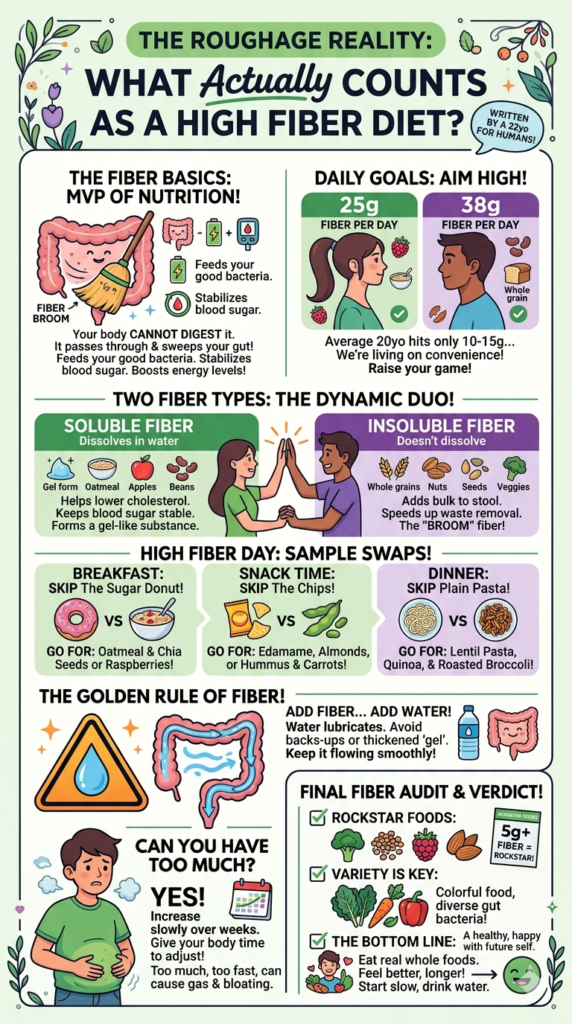
Simply put, it is the part of plants that your body cannot actually digest.
Wait, don’t scroll away! That is actually why it’s so cool.
Because your body can’t break it down, it passes through your system mostly intact.
This is where the magic happens.
Think of it like a broom for your intestines. It sweeps everything along, keeps your blood sugar from doing wild roller coaster loops, and even feeds the “good” bacteria in your gut.
When you don’t get enough, your system gets sluggish, your blood sugar crashes, and you end up feeling hangry by 3 p.m. every single day.
So, what is the goal?
Most experts suggest that women aim for around 25 grams of fiber a day, and men should shoot for about 38 grams.
Most of us in our 20s? We are lucky if we hit 10 or 15 grams because we are living on fast coffee and convenience food.
The Two Types: Soluble vs. Insoluble
Fiber isn’t just one big blob; it comes in two flavors, and they both do different jobs for your body.
Soluble fiber is the one that dissolves in water and turns into a gel-like substance in your gut.
This is the stuff that helps lower your cholesterol and keeps your blood sugar stable.
You find this in things like oatmeal, beans, apples, and blueberries.
Then you have insoluble fiber, which doesn’t dissolve at all.
This is the “broom” fiber that adds bulk to your stool and makes sure everything moves out of your system on schedule.
Think of whole grains, nuts, seeds, and the skins of veggies like zucchini or carrots.
A truly high fiber diet includes a mix of both.
If you are only eating insoluble fiber, you might feel a little bloated. If you are only doing soluble, you might miss out on that “moving” benefit.
You need the tag team to make your digestive system actually work the way it was designed to.
What Does a High Fiber Day Really Look Like?
If you are starting from near zero, don’t just wake up tomorrow and decide to eat three cans of beans.
Your gut will absolutely riot, and you will regret everything.
A high fiber diet is about making small, sustainable swaps throughout the day.
For breakfast, skip the sugary donut and go for a bowl of steel-cut oats topped with chia seeds or raspberries.
Raspberries are actually one of the fiber kings of the fruit world.
For lunch, if you usually have a white bread sandwich, swap it for whole-grain bread or, even better, load up a wrap with as many crunchy greens, peppers, and cucumbers as you can fit.
Snack time is where you can really rack up the numbers.
Grab a handful of almonds, an apple with the skin on, or even some edamame.
If you are a fan of hummus, dip some carrots or celery in it.
Dinner is when you can lean into those “complex” carbs.
Instead of white pasta, try a lentil-based pasta or quinoa.
Load your plate with roasted broccoli, cauliflower, or Brussels sprouts.
These aren’t just sides; they are the main event if you want to reach that 25-gram mark.
The “Golden Rule” of Fiber
I cannot stress this enough: if you increase your fiber, you MUST increase your water intake.
Remember how I said soluble fiber turns into a gel?
If you eat a ton of fiber but you aren’t drinking enough water, that gel gets really thick and sticky.
Instead of moving things along, it can actually cause a backup.
You want the fiber to be hydrated so it can slide through your system.
If you are adding an extra serving of beans or whole grains, make sure you have an extra glass of water to go with it.
Think of water as the “lubricant” that lets the fiber do its job.
Without it, you are just adding bulk without the flow, and trust me, that is not a fun situation to be in.
Is It Possible to Have Too Much?
Can you have too much of a good thing?
Yes, absolutely.
If you go from eating 10 grams of fiber to 60 grams overnight, your body is going to freak out.
You will likely experience bloating, gas, cramping, and maybe even some “I need to find a bathroom immediately” moments.
Your gut bacteria need time to adjust to the new workload.
When you introduce more fiber, you are literally feeding the bacteria in your gut, and they might have a bit of a party (in the form of gas) before they settle down.
Increase your fiber slowly over the course of a few weeks.
Give your body time to figure out what is going on.
If you feel miserable, back off a little, focus on water, and try again in a few days.
Listen to your stomach, because it is the best gauge you have.
How to Check Your Progress
You don’t need a fancy app to track every single crumb you eat, but it is helpful to do a “fiber audit” for a few days.
Look at what you normally eat and see how much fiber is actually in there.
You might be shocked to realize that your “healthy” salad only has two grams of fiber because it’s mostly iceberg lettuce.
Switching to spinach, kale, or adding some chickpeas can bump that number up to 10 grams in one meal.
Focus on labels.
If a product has at least three grams of fiber per serving, it’s a decent source.
If it has five grams or more, it’s a rockstar food.
Aim for at least one “rockstar” food in every single meal, and you will hit your goals without even trying that hard.
Don’t Forget About Variety
A lot of people get stuck in a “fiber rut” where they eat the same thing every day.
Maybe you become the person who only eats black beans, or the person who only eats oatmeal.
Variety is actually really important for your gut microbiome.
Different plants have different types of fiber and different nutrients.
Try to aim for a mix of colors on your plate.
If your dinner is all brown and beige, you are probably missing out on some key fiber types found in colorful veggies.
The more diverse your plant intake, the more diverse your gut bacteria, and the better you will feel overall.
The Bottom Line
A high fiber diet doesn’t have to be boring.
It doesn’t have to involve weird supplements or drinking chalky fiber powder if you don’t want to.
It’s about eating real, whole foods that happen to be packed with the stuff your body actually wants.
It’s about grabbing the apple instead of the chips, choosing the bean burrito instead of the plain meat one, and throwing some seeds on whatever you are eating.
Being 22 is a wild time, and you need all the energy you can get.
Don’t let a sluggish gut hold you back from doing the things you want to do.
Start slow, drink your water, and watch how much better you feel when your body is actually running on the good stuff.
Your future self (and your digestive tract) will thank you.