
Have you ever done everything right during the day only to wake up with a fasting blood sugar number that makes zero sense?
You ate your 30g protein lunch, you hit the gym, you stayed hydrated, but then you check your levels in the morning and it looks like you spent the night eating cake in your sleep.
It is a total vibe killer. Dealing with erratic overnight blood sugar is one of the most frustrating parts of managing metabolic health or prediabetes. It feels like you are losing a game while you aren’t even awake to play it.
When our blood sugar does a roller coaster move at 3 AM, it ruins our sleep quality and leaves us feeling like a zoned-out zombie the next day.
But here is the good news: you actually have a lot more control over your overnight levels than you think.
It is all about the decisions you make in the four hours before your head hits the pillow. We are going to look at how to stop the spikes, prevent the crashes, and finally wake up feeling fully human.
Keep Your Blood Sugar Flat While Sleeping
Understanding the Morning Mystery: The Dawn Phenomenon
Before we fix it, we have to understand what is actually happening. Most people see a spike in the morning because of something called the Dawn Phenomenon.
Around 4 AM to 8 AM, your body naturally prepares to wake up. It releases a surge of hormones like cortisol and growth hormone. These hormones tell your liver to dump some stored glucose into your bloodstream to give you the energy to start your day.
For someone with a perfectly tuned metabolic system, the body releases enough insulin to handle this. But if you have insulin resistance or prediabetes, your body can’t keep up, and you wake up with a high number.
There is also something called the Somogyi Effect, which happens if your blood sugar drops too low in the middle of the night. Your body panics, releases stress hormones, and overcorrects by dumping way too much sugar.
Whether it is a natural morning surge or a middle-of-the-night bounce back, the solution is the same: stability.
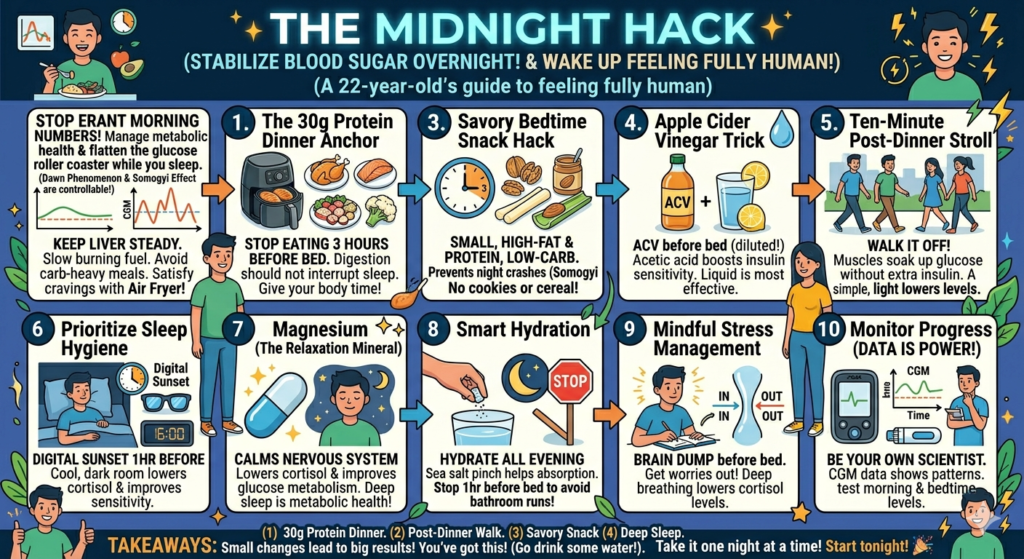
The 30g Protein Dinner Anchor
Just like we talked about with lunch and breakfast, dinner needs an anchor. If you eat a carb-heavy dinner like pasta or a giant bowl of white rice, your blood sugar is going to be on a wild ride all night long.
You want to aim for at least 30 grams of protein at dinner. This slows down digestion and provides a steady, slow-burning fuel source that keeps your liver from getting bored and dumping glucose.
Try a large piece of salmon or a chicken breast. If you want that satisfying texture, use an air fryer. You can get those extra-starchy, crispy ridges on veggies like radishes or cauliflower by scoring them with a knife and air frying them until they are charred.
This satisfies your craving for something crunchy and starchy without the massive glucose spike of a potato. When you pair high-quality protein with high-fiber veggies, you are setting a flat baseline for the entire night.
The Three-Hour Rule
Timing is everything. If you eat a huge meal and then go straight to bed, your body has to multitask. It is trying to digest a heavy meal while also trying to enter a restorative sleep state.
Usually, the digestion wins, and your blood sugar stays elevated for hours while you sleep. This also messes with your heart rate and prevents you from getting deep REM sleep.
Try to finish your last meal at least three hours before you go to bed. This gives your body enough time to process the bulk of the glucose and return to a steady state before you drift off.
If you find yourself getting hungry right before bed, we will talk about a strategic snack, but try to make the actual dinner a distinct event that happens well before sleep.
The Savory Bedtime Snack Hack
If you are someone who tends to crash in the middle of the night, a small, strategic snack might be your secret weapon. But we are not talking about cookies or cereal.
You want a savory snack that is high in fat and protein but very low in carbs. Think of it like a safety net for your blood sugar.
A handful of walnuts, a piece of string cheese, or a tablespoon of almond butter on a celery stick are all great options. The fat in these snacks provides a very slow, sustained energy source that can prevent the Somogyi Effect.
By giving your body a tiny bit of slow-burning fuel, you prevent the liver from panicking and dumping sugar at 3 AM. It keeps the line on your CGM (Continuous Glucose Monitor) looking like a flat prairie instead of a mountain range.
The Apple Cider Vinegar Trick
This sounds like total hippie nonsense, but there is actually some solid science behind it. Taking one to two tablespoons of apple cider vinegar (ACV) before bed has been shown in some studies to lower fasting blood sugar levels in the morning.
The acetic acid in the vinegar interferes with the enzymes that break down starches, and it also seems to improve insulin sensitivity in the liver.
Don’t drink it straight because it will wreck your tooth enamel. Mix it into a big glass of water or herbal tea. If you find the taste too intense, you can find capsules, but the liquid diluted in water is usually the most effective.
It is a small, low-effort habit that can have a big impact on that morning number.
The Power of the Ten-Minute Post-Dinner Stroll
One of the most effective ways to lower your blood sugar after a meal is to move your muscles. Your muscles are like sponges for glucose. When they contract, they can pull sugar out of your bloodstream even without a lot of insulin.
After you finish dinner, instead of collapsing on the couch to watch Netflix, go for a ten-minute walk. It doesn’t have to be a power walk; a simple stroll around the block is enough.
This clears out the excess sugar from your dinner and tells your body to stay in a fat-burning, stable-energy state. It is a manual override for a glucose spike. If it is raining or you can’t get outside, just doing some light stretching or ten minutes of tidying up the house can do the trick.
Sleep Hygiene is Metabolic Health
We can’t talk about blood sugar without talking about sleep quality. If you are scrolling on your phone until the second you close your eyes, you are sabotaging your metabolism.
The blue light from your phone tells your brain that it is daytime, which triggers a release of cortisol. Cortisol is a stress hormone that directly raises blood sugar.
Try a digital sunset. Turn off the screens an hour before bed. Read a physical book or journal. Keeping your bedroom cool and dark also helps lower your core body temperature, which is a signal for your body to enter a deep, restorative state.
When you sleep well, your insulin sensitivity improves. When you are sleep-deprived, your body becomes more insulin resistant, which makes it even harder to manage your levels the next day. It is a cycle that you definitely want to be on the right side of.
Magnesium: The Relaxation Mineral
Magnesium is responsible for over 300 biochemical reactions in the body, and it plays a huge role in glucose metabolism. Most people are deficient in it, especially if they are under a lot of stress.
Taking a magnesium supplement (specifically magnesium glycinate) before bed can help relax your muscles and your nervous system.
When your nervous system is calm, your cortisol levels stay low. When cortisol is low, your blood sugar stays stable. It also helps you fall into a deeper sleep, which we already know is a massive win for your A1C.
Always check with your doctor before adding supplements, but for many people, magnesium is the missing piece of the overnight puzzle.
Hydration Without the Middle-of-the-Night Bathroom Runs
Dehydration makes your blood sugar appear higher because your blood volume is lower, making the sugar more concentrated. Staying hydrated throughout the evening is crucial.
However, you don’t want to chug a gallon of water right before bed and then have to wake up every two hours to use the bathroom. That interrupts your sleep and causes a stress response.
Focus on hydrating consistently throughout the afternoon and early evening. Stop the heavy fluid intake about an hour before bed. If you get thirsty, just take small sips.
Adding a tiny pinch of sea salt to your evening water can also help your cells actually absorb the hydration instead of it just running right through you.
Stress Management: The Brain Dump Redux
If you go to bed with a racing mind, your body is in fight or flight mode all night. This internal stress keeps your blood sugar elevated because your body thinks it needs to be ready to fight a tiger.
Just like we mentioned for focus, a brain dump is essential for overnight stability. Write down everything that is bothering you or everything you need to do tomorrow.
Once it is on the paper, it is out of your head. Combining this with some slow, deep breathing can lower your heart rate and signal to your liver that it doesn’t need to dump any emergency glucose.
A calm mind leads to a calm metabolism.
Monitoring Your Progress
If you really want to master your overnight blood sugar, you need data. If you have access to a Continuous Glucose Monitor (CGM), use it to see how different dinners and evening habits affect your line.
If you don’t have a CGM, try testing your blood sugar right before bed and then again as soon as you wake up. This will help you identify if you are experiencing the Dawn Phenomenon or the Somogyi Effect.
Once you know the pattern, you can tweak your habits. Maybe you find that you need that bedtime snack, or maybe you find that the ten-minute walk is the only thing that works for you. Everyone is different, so be your own scientist.
Final Encouragement
Stabilizing your blood sugar overnight isn’t about being perfect. It is about creating a routine that supports your body’s natural rhythms.
Give yourself some grace as you figure this out. Some nights will be better than others. But by focusing on high-protein dinners, limiting late-night carbs, moving after you eat, and prioritizing deep sleep, you are giving your body the best possible chance to heal.
You don’t have to wake up feeling like a zombie. You can wake up feeling refreshed, focused, and ready to take on the day.
Take it one night at a time. Start with the three-hour rule tonight and see how you feel tomorrow. Small changes lead to massive results for your long-term health.
You have got this! Now go drink some water, put your phone away, and get some amazing sleep. Your body is going to thank you in the morning!