Let’s be real for a second. Somewhere along the way, “low-fat” got a bit of a bad reputation. We all remember those weird, chemically packed snacks from the early 2000s that tasted like flavored cardboard. It was a whole era that most of us would rather forget.
But here is the thing: whether you are trying to lean out, prepping for a specific health goal, or just tired of that “food coma” feeling that hits after a greasy burger, low-fat eating doesn’t have to be depressing. In fact, if you do it right, it’s actually the secret to having way more energy for your actual life.
As someone navigating their 20s, I know the struggle. We are busy. We are trying to figure out “adulting.” We want food that is quick, cheap, and actually makes us feel good instead of needing a three-hour nap after lunch.
The goal isn’t to live on air and ice cubes. The goal is to find a balance where you are fueling your body without the heavy, sluggish side effects.
Here is the ultimate breakdown of low-fat foods that actually taste like real food.
The Foundation: Fruits and Vegetables
This is the “free” category. Almost every fruit and veggie is naturally low-fat. If you are looking to fill your plate without adding a ton of fat, these are your best friends.
Leafy Greens: Spinach, kale, arugula, and Swiss chard. These are basically the MVPs of any meal. You can throw a handful of spinach into almost anything: smoothies, pasta, or stir-fry: and you won’t even taste it, but your body will definitely feel the boost.
Cruciferous Veggies: Broccoli, cauliflower, and Brussels sprouts. If you have an air fryer, these are a game changer. Toss them in a tiny bit of lemon juice and some garlic powder, and they get that perfect crunch without needing a vat of oil.
Root Vegetables: Carrots, sweet potatoes, and beets. These are great because they are “filling” carbs. They give you that satisfied feeling that sometimes goes missing when you cut back on fats.
Berries: Strawberries, blueberries, and raspberries. These are the ultimate “snackable” fruits. They are low in sugar compared to other fruits and have basically zero fat.
Melons: Watermelon, cantaloupe, and honeydew. Since these are mostly water, they are incredibly hydrating and refreshing, especially in the summer.
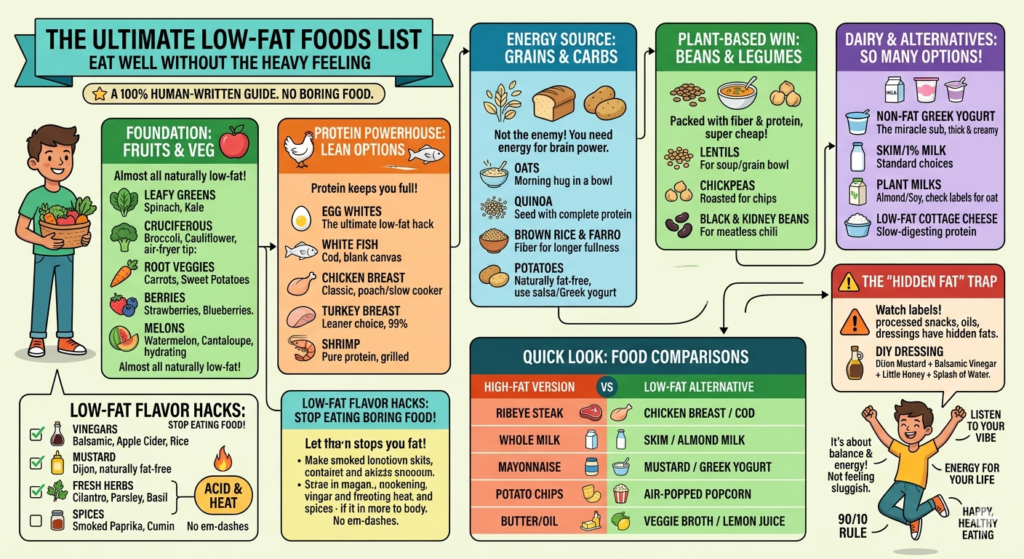
The Protein Powerhouse: Lean Options
Protein is what keeps you full. If you go low-fat and low-protein at the same time, you are going to be “hangry” within twenty minutes. The key is finding sources that give you the muscle-building benefits without the hidden saturated fats.
Egg Whites: This is the ultimate low-fat hack. While the yolk has the nutrients and the fat, the white is pure protein. You can do a mix of one whole egg and three whites for a breakfast that feels substantial but stays light.
White Fish: Think cod, tilapia, or halibut. These are much leaner than fatty fish like salmon. They are also very “blank canvas” foods, meaning they take on the flavor of whatever spices or salsa you put on them.
Chicken Breast: The classic. The legend. To keep it from being boring, try poaching it or cooking it in a slow cooker with some salsa. It stays juicy without needing added butter or oil.
Turkey Breast: Just like chicken, but often even leaner. Look for the “99% lean” ground turkey if you are making tacos or pasta sauce.
Shrimp: These are basically pure protein. You can grill them, sauté them in a little broth, or throw them in a salad. Just skip the butter dipping sauce.
The Plant-Based Win: Legumes and Beans
If you are trying to save money (and let’s be honest, who isn’t?), beans are the way to go. They are incredibly cheap and packed with fiber and protein.
Lentils: Great for soups or as a base for a “grain bowl.” They cook much faster than dry beans and have a great earthy flavor.
Chickpeas: You can roast these until they are crunchy for a low-fat alternative to chips, or toss them into a salad for some extra “oomph.”
Black Beans and Kidney Beans: Perfect for meatless chili or adding to a wrap. They are hearty enough to make you forget you are eating a low-fat meal.
Grains and Carbs: The Energy Source
Carbs are not the enemy. You need them for brain power and for getting through your day. The trick is choosing the ones that haven’t been processed with extra fats.
Oats: A bowl of oatmeal in the morning is like a hug for your stomach. Use water or a splash of skim milk/oat milk instead of cream to keep the fat content down.
Quinoa: This is technically a seed, but we use it like a grain. It’s a complete protein and very low-fat.
Brown Rice and Farro: These have more fiber than white rice, which means they keep you full for longer.
Potatoes: Believe it or not, potatoes are naturally fat-free. It’s what we put on them (butter, sour cream, cheese) that makes them a “fatty” food. Try a baked potato with salsa or Greek yogurt instead of the usual toppings.
Dairy and Modern Alternatives
This used to be the hardest category to navigate, but now we have so many options.
Non-Fat Greek Yogurt: This stuff is a miracle. It’s thick, creamy, and packed with protein. You can use it as a base for smoothies, or even as a sub for sour cream on your tacos.
Skim Milk or 1% Milk: If you aren’t ready to go plant-based, these are the standard low-fat options.
Plant Milks: Unsweetened almond milk and soy milk are generally very low in fat. Oat milk is delicious but can be a bit higher in carbs and fats depending on the brand, so just check the label.
Low-Fat Cottage Cheese: It might have a “grandma” reputation, but it’s an incredible source of casein protein, which digests slowly and keeps you full.
Low-Fat Flavor Hacks: Don’t Eat Boring Food
The biggest mistake people make on a low-fat diet is forgetting the seasoning. Fat carries flavor, so when you remove it, you have to be more intentional with your spices.
Pro Tip: Use “Acid and Heat.” If a dish feels like it’s “missing something,” it’s usually either salt or acid. A squeeze of lime juice or a dash of hot sauce can make a low-fat dish taste gourmet without adding a single gram of fat.
- Vinegars: Balsamic, apple cider, and rice vinegar add a huge punch of flavor to salads and marinades.
- Mustard: Most mustards (Dijon, yellow, spicy brown) are naturally fat-free and add a ton of tang.
- Fresh Herbs: Cilantro, parsley, basil, and mint. Use them liberally.
- Spices: Smoked paprika, cumin, garlic powder, and onion powder are your new best friends.
A Quick Look: Low-Fat Food Comparisons
| Food Category | High-Fat Version | Low-Fat Alternative |
| Protein | Ribeye Steak | Chicken Breast or Cod |
| Dairy | Whole Milk | Skim Milk or Almond Milk |
| Toppings | Mayonnaise | Mustard or Greek Yogurt |
| Snacks | Potato Chips | Air-Popped Popcorn |
| Cooking Base | Butter / Heavy Oil | Vegetable Broth / Lemon Juice |
The “Hidden Fat” Trap
When you are looking at labels, keep an eye out for “hidden” fats. Sometimes foods that seem healthy are actually loaded with fats to make them taste better.
Processed snacks, even the “organic” ones, often use palm oil or coconut oil. Salad dressings are another huge culprit. A “healthy” salad can quickly become a high-fat meal if you pour on a half-cup of ranch dressing.
Instead, try making your own “dump” dressing: just whisk together some Dijon mustard, balsamic vinegar, a little honey, and a splash of water. It’s delicious and basically fat-free.
Listening to Your “Body Vibe”
At the end of the day, food is fuel. You should finish a meal feeling energized, not like you need to go into hibernation.
If you find that you are constantly hungry or your skin is getting really dry, you might be cutting your fats too low. Your body does need a little bit of healthy fat (like those found in avocados or nuts) for hormone health and brain function.
It’s all about the “90/10 rule.” If 90% of your diet comes from this low-fat foods list, that other 10% can be for the things you really love.
Life is too short to never have a slice of pizza or a good piece of chocolate. The goal of this list is to give you a solid foundation so that when you do treat yourself, your body is healthy enough to handle it without a problem.
Final Thoughts
Eating low-fat doesn’t have to be a chore. It’s actually a really cool way to rediscover the actual flavor of food without everything being covered in grease or butter.
Start small. Maybe swap your morning latte to one with skim or almond milk. Try one meatless, low-fat dinner a week.
You’ll be surprised at how much better you feel once your digestive system isn’t constantly working overtime to break down heavy fats.
You’ve got this. Happy, healthy eating!
What is the first low-fat meal you are going to try making this week?