
Let’s be totally real for a second. If you are in your early twenties and dealing with acid reflux, your TikTok feed is probably a chaotic mix of “what I eat in a day” videos and people trying to convince you that cottage cheese is the secret to everything from clear skin to a six pack.
Cottage cheese is having a massive moment right now. It is in everything. People are blending it into pasta sauces, making “ice cream” out of it, and putting it on literally every piece of toast they can find.
But when you have Gastroesophageal Reflux Disease (GERD), you can’t just follow every trend blindly. You have to be a bit of a detective. You are sitting there looking at that tub of lumpy white cheese and wondering if it is going to be a high protein win or if it is going to set your chest on fire for the next six hours.
I have been there. I know the struggle of wanting to hit your protein goals while also trying to keep your esophagus from feeling like a literal volcano.
The good news? Cottage cheese is actually one of the “good guys” when it comes to reflux friendly dairy. But, like everything in life, there are some rules you need to follow to make sure it doesn’t turn into a total betrayal.
Let’s break down the science of the “bouncer,” why the fat percentage on the label matters more than you think, and how to enjoy cottage cheese without the dreaded burn.
Meet the Bouncer: Your LES
To understand why cottage cheese is usually a safe bet, we have to talk about the bouncer of your stomach. Everyone has a little ring of muscle at the bottom of their throat called the Lower Esophageal Sphincter, or the LES.
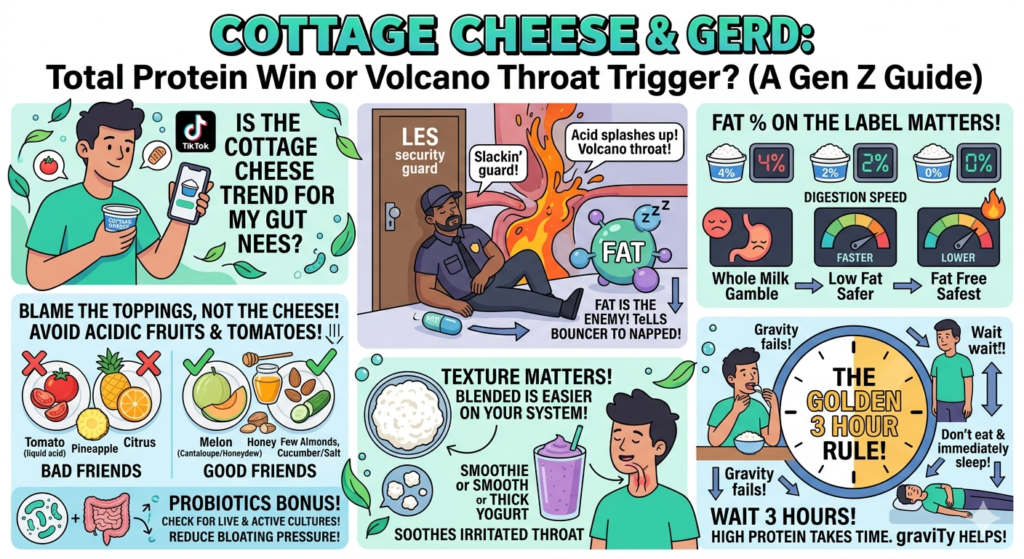
Think of the LES as a security guard for your stomach. Its only job is to stay shut and keep your stomach acid down where it belongs. When you have GERD, that security guard is a bit of a slacker. It stays open when it should be closed, or it relaxes too much, letting acid splash back up.
Fat is the number one thing that tells your LES to take a nap. When you eat high fat foods, your body releases hormones that tell the LES to relax. That is why a greasy burger or a super fatty cheese like brie is a nightmare for reflux.
Cottage cheese is special because, unlike those hard, aged cheeses, it is naturally much lower in fat. This means it is less likely to offend the bouncer at the door.
The Fat Percentage Trap
When you go to the store, you are going to see three main types of cottage cheese: 4% (Whole Milk), 2% (Low Fat), and 0% (Fat Free).
If you are a normal human without a glitchy gut, 4% is usually the tastiest. It is creamy and rich. But for us, that 4% can be a bit of a gamble.
While 4% fat is still lower than most other cheeses, it can still be enough to trigger symptoms for some people, especially if you eat a large portion.
If you are currently in a “flare up” phase where your chest feels sensitive, your best bet is the 1% or the Fat Free version. It might not be quite as decadent, but it gives your system a break while still giving you that massive hit of protein.
The goal here is “gastric emptying.” You want food to move through your stomach as fast as possible. Fat slows that process down. The lower the fat, the faster the exit, and the less time acid has to cause trouble.
The Probiotic Bonus
Here is something that makes cottage cheese even cooler. Many brands are now adding live and active cultures to their cottage cheese, much like yogurt.
If you find a brand with probiotics, you are basically giving your gut a little toolkit for better health. Probiotics help balance the bacteria in your digestive system, which can help with bloating and overall digestion.
Less bloating means less pressure on your stomach. And since physical pressure on your stomach can force acid up through your LES, anything that keeps the bloat down is a win for your reflux.
Just make sure to check the label for “live and active cultures.” If it doesn’t say it on the tub, it probably doesn’t have them.
The “Friends” Problem: What Are You Adding?
In the world of nutrition, we often blame the main ingredient when the “friends” are the real problem.
Cottage cheese is a bit like a blank canvas. If you eat it plain, it is usually very safe. But nobody eats it plain.
If you are topping your cottage cheese with chunks of pineapple, orange slices, or a mountain of berries, you might think the cheese is giving you heartburn, but it is actually the acidic fruit.
For a reflux friendly bowl, you want to stick to low acid toppings. Think about things like:
- Sliced melon (cantaloupe or honeydew are amazing)
- A little bit of honey
- A few almond slivers (not too many!)
- Sliced cucumber and a tiny bit of salt for a savory vibe
If you are blending cottage cheese into a pasta sauce, watch out for the tomato sauce. Tomatoes are basically liquid acid. Blending cottage cheese into a pesto or a light garlic sauce (if you can handle a little garlic) is a much safer way to get that creamy texture.
Texture Matters: Blended vs. Chunky
This is a weird one, but the texture of cottage cheese can actually change how your body handles it.
The “blended cottage cheese” trend is actually great for GERD. When you blend it until it is smooth like a thick yogurt, you are basically doing some of the work for your stomach.
The easier it is for your body to break down food, the faster it can move it out of the stomach and into the small intestine. Plus, the smooth texture is super soothing for an irritated esophagus. If your throat is feeling raw from a day of reflux, a cold, blended bowl of cottage cheese can feel like a dream.
Timing is Everything
I know we talk about this a lot, but it is the golden rule of GERD: the 3 hour rule.
Cottage cheese is high in protein. Protein is amazing for keeping you full, but it does take longer to digest than a simple carb like a cracker.
If you have a big bowl of cottage cheese at 10 PM and then hit the hay at 11 PM, you are asking for a rough night. Your stomach is still working hard to process that protein, and gravity isn’t there to keep the acid down.
Try to make your cottage cheese a breakfast or lunch staple. It is a killer way to start the day with 25 grams of protein, and it gives you all day to digest it while you are upright and moving.
The Mental Game: Not Being “That Person”
Being 22 and having to think about “digestive health” can make you feel like a total buzzkill. You go to a brunch and everyone is getting the greasy breakfast burritos, and you are there looking for the lowest fat dairy option.
It is easy to get frustrated and just say “screw it” and eat the trigger food. But remember: cottage cheese isn’t “boring.” It is a tool.
When you choose a safe food like cottage cheese, you are choosing to feel good for the rest of the day. You are choosing to not have that brain fog and chest pain that comes with a flare up.
You can still be social. You can still be a foodie. You just have to be a foodie with a plan. Bring your own cottage cheese bowl to a picnic or find a cafe that offers it as a side. You are taking control of your health, and that is honestly pretty cool.
Transitions and “Testing”
If you haven’t eaten cottage cheese in a while, don’t go out and eat a whole pint of it at once.
Start with a small half cup serving. See how your body feels after two hours. If you don’t have any rumbles or burning, you have officially found a new safe food.
Every body is a little different. Some people with GERD can’t handle any dairy at all. If that is you, don’t force it. There are some almond based or cashew based “cottage cheese” alternatives coming out now that might work better for your specific system.
Final Thoughts
Is cottage cheese bad for GERD? Generally, no. In fact, it is one of the best high protein options you can have.
By sticking to low fat or fat free versions, picking low acid toppings, and making sure to eat it well before bed, you can enjoy this “trend” without the literal burn.
Your gut is a work in progress, and that is okay. Be patient with your body. Listen to the signals it is sending you. You are doing the work to feel better, and that is something to be proud of.
Go grab a tub of the low fat stuff, blend it up if you want to be fancy, and enjoy the protein win. You’ve got this!