
Is it just me or does it feel like we are all collectively exhausted lately? I’m not just talking about the “I stayed up too late watching TikToks” kind of tired. I mean that deep-down-in-your-soul brain fog where you’re staring at your laptop for three hours and the only thing you’ve actually accomplished is organized your Spotify playlists for the fifth time this week.
If you’re feeling like a literal potato most days, you aren’t alone. We live in a world that is basically designed to drain our batteries. Between the constant notifications, the pressure to “grind” 24/7, and the fact that most of us are basically living on iced coffee and vibes, it’s no wonder our focus is non-existent.
The good news is that you don’t need a medical degree or a thousand-dollar biohacking kit to fix this. You just need to understand how your body actually works.
Let’s break down how to actually get your brain back online and stop feeling like you’re buffering all day long.
The Blood Sugar Rollercoaster (The Silent Energy Killer)
We have to talk about the 2 PM crash. You know the one. You eat a big lunch, feel okay for an hour, and then suddenly you want to nap under your desk.
This usually happens because of what I call the “Sugar Spike.” If you eat a meal that is super heavy on refined carbs or sugar, your blood sugar levels go through the roof. Your body panics, releases a ton of insulin, and then your sugar levels plummet.
That crash is where the brain fog lives.
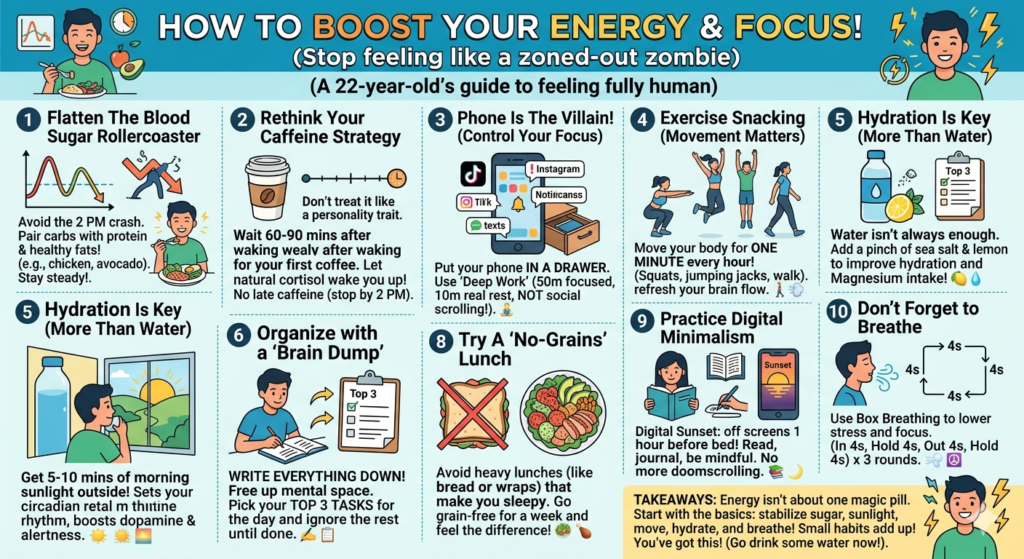
To keep your energy stable, you want to focus on “flattening the curve.” Think about pairing your carbs with protein and healthy fats. Instead of just a bowl of pasta, add some chicken and some olive oil or avocado.
The goal is a slow, steady release of energy instead of a giant explosion followed by a total blackout. Keeping your glucose levels steady is lowkey the ultimate hack for staying sharp all afternoon.
Stop Treating Caffeine Like a Personality Trait
Look, I love an oat milk latte as much as the next person. But if you’re drinking coffee the second you wake up, you might be sabotaging yourself.
When you wake up, your body naturally produces cortisol to get you going. If you dump caffeine into your system immediately, your body stops producing that natural “wake up” hormone because it thinks the coffee has it covered.
Then, when the coffee wears off, you crash twice as hard.
Try waiting 60 to 90 minutes after you wake up before having your first cup. This allows your natural hormones to do their thing first.
Also, maybe stop the caffeine intake by 2 PM. Even if you think you can “sleep fine” after a late-night espresso, the quality of your deep sleep is getting absolutely wrecked. If you don’t get deep sleep, you’ll wake up tired, and the cycle starts all over again.
The “Focus” Environment: Your Phone Is the Villain
You cannot focus if your phone is face-up on your desk. You just can’t.
Every time a notification pings or your screen lights up, your brain does a little “micro-task switch.” Even if you don’t pick up the phone, your brain has already lost the flow of what you were doing. It can take up to 20 minutes to get back into a deep state of focus after an interruption.
If you have work to do, put your phone in another room. Or at the very least, put it in a drawer. Out of sight, out of mind is a cliché because it actually works.
Try the “Deep Work” method. Set a timer for 50 minutes. No phone, no tabs that aren’t related to your task, just you and the work. Then, take a 10-minute break where you actually get up and move. Do not use that break to scroll on your phone! That’s just “junk rest.”
Go look out a window. Stretch. Get some water. Your brain needs a real reset, not more blue light.
Movement is Not Just for the Gym
I used to think that if I didn’t go to a 45-minute HIIT class, movement didn’t count. I was wrong.
If you are sitting still for four hours straight, your blood flow slows down, and your brain starts to get sleepy. Movement is literally a signal to your body that it needs to be awake.
Try “exercise snacking.” It sounds weird, but stay with me. Every hour, do one minute of something active. 20 air squats, some jumping jacks, or just a quick walk to the mailbox.
It gets your heart rate up just enough to deliver fresh oxygen to your brain. It’s like hitting the “refresh” button on your browser but for your body.
Hydration is More Than Just Water
If you’re feeling sluggish, there is a 90% chance you are just dehydrated. Your brain is mostly water, so when you’re even slightly “thirsty,” your cognitive function drops.
But sometimes water isn’t enough. If you’re drinking a ton of water but still feeling tired, you might be low on electrolytes (sodium, potassium, magnesium).
You don’t need those neon-colored sports drinks filled with sugar. Just add a tiny pinch of sea salt and a squeeze of lemon to your water in the morning. It helps your cells actually absorb the hydration instead of it just passing right through you.
Magnesium, specifically, is a huge one for focus. Most people are deficient in it, and it’s responsible for like 300 different reactions in your body, including energy production.
The Power of the “Brain Dump”
A lot of the time, our lack of focus isn’t because we’re tired—it’s because we’re overwhelmed.
If you have 50 different things you need to do floating around in your head, your brain is using a ton of energy just trying to remember them all. It’s like having too many apps open in the background of your phone.
Every morning (or the night before), do a brain dump. Write down every single thing you’re worried about or need to do. Once it’s on paper, your brain can stop “holding” it, which frees up that mental energy for actual focus.
Pick the top three things that actually matter. Ignore the rest until those three are done. Productivity isn’t about doing everything; it’s about doing the right things without losing your mind.
Sunlight: The Original Battery Charger
If you spend all day in a dimly lit room with only artificial light, your body has no idea what time it is.
Our bodies operate on a circadian rhythm, which is basically an internal clock. To set this clock correctly, you need “viewing of morning sunlight.”
Try to get outside for 5 to 10 minutes within the first hour of waking up. Even if it’s cloudy, the light energy is way stronger than anything your desk lamp can produce.
This triggers a release of dopamine and sets a timer for melatonin production later that night. It makes you more alert during the day and help you fall asleep faster at night. It’s free, it’s easy, and it’s a total game-changer.
The “No-Grains” Lunch Experiment
This might be controversial, but try having a grain-free lunch for a week.
Often, things like bread, wraps, or heavy rice can make us feel really heavy and sleepy in the afternoon. Try a “big salad” with lots of greens, some protein (eggs, chicken, chickpeas), and a good fat like nuts or avocado.
You’ll notice that you don’t get that “heavy” feeling after eating. When your digestion doesn’t have to work overtime to break down heavy starches, that energy stays in your brain where you actually need it.
Digital Minimalism and Mental Clarity
We are the first generation to have the entire world’s information in our pockets 24/7. It’s exhausting.
If you find yourself “doomscrolling” before bed or as soon as you wake up, you are starting your day in a reactive state. You’re letting other people’s lives, news, and opinions dictate your mood before you’ve even had breakfast.
Try a “Digital Sunset.” Turn off your screens an hour before bed. Read a physical book, journal, or just exist without a screen in front of your face.
It feels uncomfortable at first because we are literally addicted to the dopamine hits from our phones. But after a few days, you’ll notice your “baseline” focus level starts to rise. You’ll be able to sit with your own thoughts without feeling the itch to check Instagram.
Don’t Forget to Breathe (Literally)
When we’re stressed or focused, we tend to take very shallow breaths. This keeps us in a “fight or flight” state, which is very energy-consuming.
If you feel your focus slipping, try the “Box Breathing” technique. Inhale for four seconds, hold for four, exhale for four, and hold for four.
Doing this just three times tells your nervous system that you are safe. It lowers your heart rate and clears the “static” out of your brain. It’s like a manual override for stress.
Final Thoughts on the Energy Journey
Increasing your energy isn’t about one “magic pill.” It’s about a bunch of small habits that add up.
Stop looking for the perfect supplement or the perfect productivity app. Start with the basics: stabilize your blood sugar, get some sunlight, move your body, and put your phone in another room.
You weren’t meant to feel like a zombie. You were meant to feel vibrant and focused. Give your body what it needs, and it will give you the energy to do all the cool stuff you want to do.
Take it one day at a time. If you mess up and eat a giant box of donuts and scroll for four hours, don’t beat yourself up. Just reset and try again tomorrow.