Let’s be totally real for a second. There is nothing that ruins a vibe faster than “main character energy” being cut short by a sudden, burning internal glitch.
You are out with your friends, trying that new aesthetic Italian spot everyone is posting about, and you order the garlic bread because, honestly, who wouldn’t? But twenty minutes later, your chest feels like it’s hosting a small bonfire.
If you are in your early twenties, you are probably used to your body being pretty resilient. You can pull an all-nighter, crush a workout, and survive on questionable caffeine levels.
But then, out of nowhere, acid reflux enters the chat. It feels like a major system error when your favorite flavor profile starts attacking your internal plumbing.
If you have spent any time scrolling through nutritional science or wellness circles in 2026, you know that gut health is basically the software update everyone is talking about.
And right at the center of that conversation is a very popular, very pungent ingredient: garlic.
We love it for the flavor, the health benefits, and the way it makes literally any savory dish 100% better.
But the question remains. Is garlic the secret villain behind your recurring heartburn?
Let’s dive into the science, the “why” behind the burn, and how you can keep living your best culinary life without the constant chest fire.
The Gatekeeper: Understanding the LES
To understand if garlic is the culprit, we have to look at how your digestive system is actually wired.
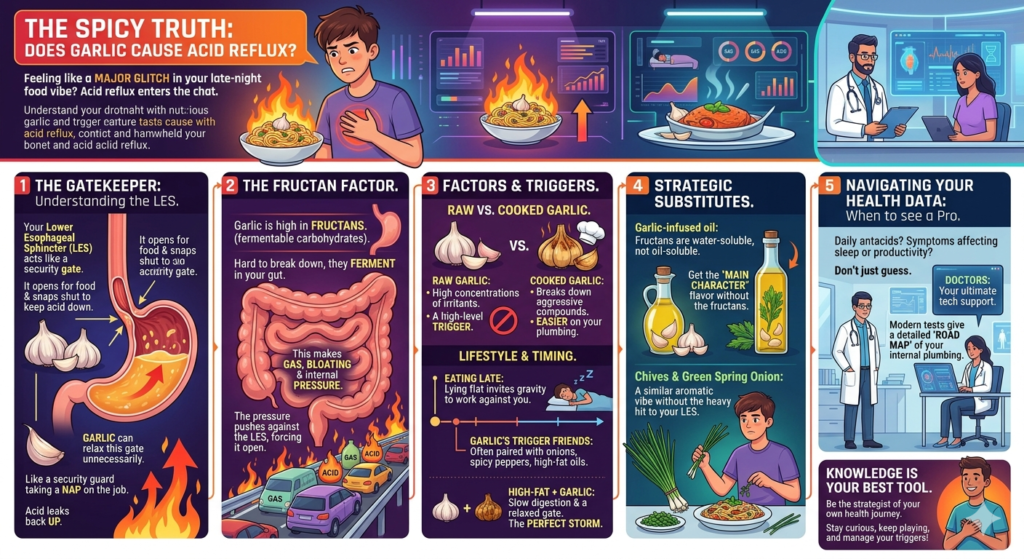
Think of your esophagus as a high-speed transit tube for food. At the bottom of that tube, right where it meets your stomach, there is a muscular ring called the Lower Esophageal Sphincter, or the LES.
In a perfectly functioning system, the LES acts like a one-way security gate. It opens to let food into the stomach and then snaps shut to keep the stomach acid where it belongs.
When that gate gets “glitchy” or stays open too long, acid leaks back up into the esophagus. That is the literal definition of acid reflux.
Now, here is where garlic comes in.
Research in nutritional science suggests that garlic can actually cause the LES to relax. It’s like a security guard taking a nap on the job.
When the LES relaxes unnecessarily, it creates the perfect environment for acid to escape, leading to that familiar, uncomfortable burn.
The Fructan Factor: More Than Just Heartburn
It isn’t just about the “gatekeeper” muscle, though. Garlic is also packed with something called fructans.
If you have ever looked into low-FODMAP diets, you have definitely seen this term. Fructans are a type of fermentable carbohydrate that can be a bit of a nightmare for people with sensitive systems.
When your body struggles to break down these fructans in the small intestine, they travel to the large intestine where they ferment.
This process creates gas, bloating, and internal pressure.
Think about it like this. If your stomach is full of gas and pressure from fermenting garlic, that pressure has to go somewhere.
Often, it pushes upward against the LES, forcing it open and allowing acid to flood your esophagus.
So, you aren’t just dealing with the direct relaxation of the muscle, you are also dealing with a “traffic jam” in your gut that is pushing acid back up the pipes.
Raw vs. Cooked: The Great Flavor Debate
Not all garlic is created equal when it comes to how your body handles it.
If you are a fan of raw garlic—maybe in a fresh salsa or a spicy pesto—you are much more likely to experience a “system crash.”
Raw garlic contains higher concentrations of the compounds that irritate the esophageal lining and relax the LES. It is potent, powerful, and, unfortunately, a high-level trigger for reflux.
On the flip side, many people find that roasted or thoroughly cooked garlic is much easier on their internal plumbing.
The cooking process breaks down some of those aggressive compounds and fructans, making it less likely to cause a massive flare-up.
If you are currently navigating a sensitive stomach but can’t imagine a life without garlic, the technical precision of how you cook it matters.
Slow-roasting garlic until it is sweet and soft can sometimes satisfy the craving without triggering the bonfire in your chest.
The Lifestyle Glitch: Why It Hits Different in Your 20s
When you are 22, your lifestyle is often fast-paced.
You might be grabbing a quick meal between meetings as a digital strategist or eating late at night after a long shift.
The timing of when you eat garlic can be just as important as the garlic itself.
If you eat a heavy, garlic-laden meal and then immediately lay down to scroll through your phone or go to bed, you are basically inviting gravity to work against you.
Lying flat makes it incredibly easy for acid to slip past a relaxed LES.
It is also worth noting that garlic rarely acts alone.
Usually, it is hanging out with other “trigger friends” like onions, spicy peppers, or high-fat oils.
When you combine a high-fat meal with garlic, you are creating a double-whammy for your digestive system.
The fat slows down digestion, keeping the food in your stomach longer, while the garlic relaxes the LES gate.
It is the perfect storm for a long night of discomfort.
Strategic Substitutes: Flavor Without the Fire
If you have realized that garlic is indeed the “glitch” in your system, don’t panic. You don’t have to eat bland food for the rest of your life.
Taking control of your health means being a strategist with your ingredients.
One of the best hacks in nutritional science for garlic lovers is garlic-infused oil.
Since fructans are water-soluble but not oil-soluble, the flavor of the garlic can be infused into the oil without bringing the irritating carbohydrates along for the ride.
You get the “main character” flavor without the “system error” symptoms.
Another great option is using herbs like chives or the green parts of spring onions.
These provide a similar aromatic vibe without the heavy hit to your LES.
It’s all about technical precision in your cooking.
You can still create incredible content and culinary adventures by just swapping the delivery method of your flavors.
Navigating the Data: When to See a Pro
In 2026, we have more health data at our fingertips than ever before.
It is easy to over-analyze every little symptom, but it is important to remember that occasional reflux after a garlicky pizza is pretty normal.
However, if you find that you are reaching for antacids every single day, or if the burn is starting to affect your sleep and your productivity, it is time for a professional check-up.
Chronic acid reflux, or GERD, can lead to more serious issues with your esophageal lining over time.
Think of a doctor as the ultimate tech support for your body.
They can help you determine if your issue is just a sensitivity to garlic or if there is something else going on with your internal plumbing.
Modern imaging and tests can provide a detailed “road map” of what is happening inside, so you don’t have to keep guessing.
Final Thoughts: Be the Strategist of Your Health
Dealing with acid reflux in your early twenties can feel like a total drag.
You want to be focused on your career, your social life, and your next big project, not worrying about whether a clove of garlic is going to ruin your week.
But understanding how your body responds to certain triggers is actually a major power move.
Knowledge is your best tool for staying in the game.
By paying attention to the “why” behind the burn, you can make informed choices that support your system.
Whether it is switching to garlic-infused oil, focusing on cooked over raw, or just being mindful of late-night meals, you have the power to manage your health journey.
Stay curious about the science, stay hydrated, and remember that you are in control of the strategy.
You’ve got this!