Let’s be totally real for a second. Being in your early twenties and suddenly having to care about the fat content in your lunch feels like a major system error. You are supposed to be out here living your best life, maybe crushing it as a digital strategist or planning your next big trip, not worrying about the diameter of your internal tubes.
But here we are. Maybe you have been looking into a no fat diet plan because your body is sending you some very loud signals. If you have spent any time in 2026 researching nutritional science, you already know that the body is basically a massive, complex network of pipes and signals.
When one of those pipes gets a “traffic jam” in the digestive system, it changes everything about how you eat. Whether you are dealing with a sensitive system or a specific medical finding, understanding the strategy behind a low or no fat approach is the first step in taking control of your health journey.
Understanding the Internal Drainage System
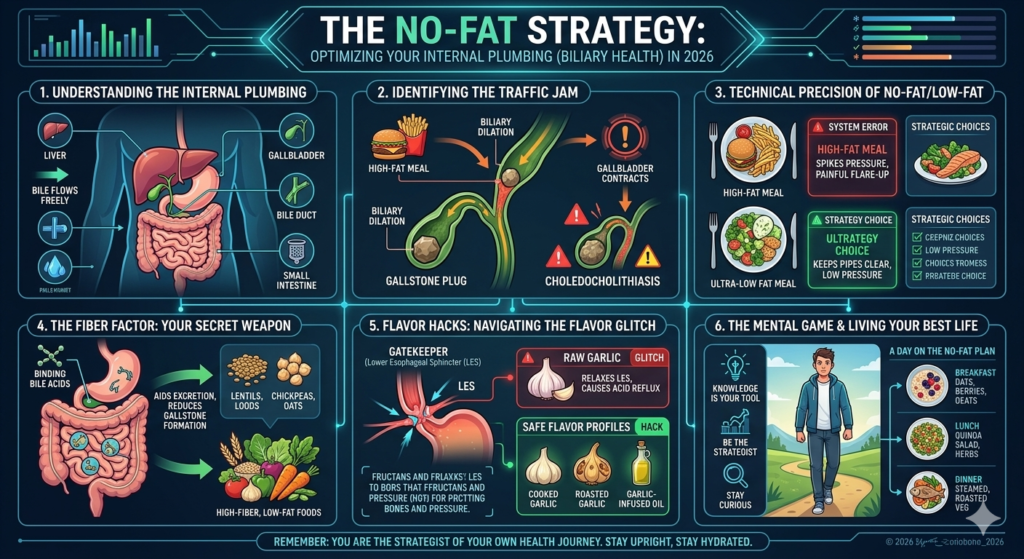
To understand why a no fat diet plan matters, you have to understand what your “plumbing” actually does. Think of your bile duct as the main drainage pipe for your liver and gallbladder. Its primary role is to transport bile down to the small intestine.
Bile is that yellow-green fluid that helps you digest fats. When everything is working perfectly, it flows freely like a clear highway. However, if there is a blockage or a narrowing in that pipe, the bile starts to back up.
This pressure causes the duct to stretch and enlarge, which is technically known as biliary dilation. It is essentially your body’s version of a clogged sink that is starting to overflow. When you eat fat, your gallbladder acts like a little pump that contracts to release bile.
If you have a blockage, like a wandering gallstone, that contraction can accidentally push the stone deeper into the duct. This condition is called choledocholithiasis, and it creates a literal plug in the drain. This is why a high-fat meal can spike the pressure in your system and cause immediate, significant discomfort that you definitely won’t be able to ignore.
The Technical Precision of a No Fat Approach
In 2026, research into nutritional science has highlighted how dietary planning impacts our biliary health. While a “no fat” plan is often functionally an “ultra-low fat” plan, the goal is to reduce the “load” placed on your entire digestive system.
High-fat meals require a lot more bile for digestion. If your duct is already narrowed or partially blocked, a high-fat meal can worsen the dilation or cause a painful flare-up. This is why technical precision in cooking and choosing the right options is a total game changer for people with sensitive systems.
When you are part of a project involving the creation of comprehensive health guides, you realize that what you put on your plate is a strategic choice. A no fat diet plan isn’t about restriction for the sake of it; it is about keeping the “pipes” clear and the pressure low.
The Fiber Factor: Your Secret Weapon
Investigating the impact of fiber-rich diets shows that fiber is a massive player in this game. Fiber helps bind to bile acids in the gut. This aids in their excretion and can potentially reduce the formation of new gallstones in the first place.
It is all about creating a balanced environment where your internal plumbing doesn’t have to work harder than it needs to. When you are planning your meals, you want to focus on high-fiber, low-fat options that keep things moving smoothly.
Think about things like lentils, chickpeas, oats, and a rainbow of vegetables. These provide the bulk your system needs without the heavy fat load that triggers a biliary system error.
Navigating the Flavor Glitch: Garlic and Reflux
When you are following a strict no fat diet plan, you might be tempted to load up on aromatics like garlic to make up for the lack of fat-based flavor. But you have to be careful here too.
Garlic contains compounds that can actually cause your “gatekeeper” muscle, the LES, to relax. When this muscle relaxes unnecessarily, it allows stomach acid to leak back up into the esophagus. This is the literal definition of acid reflux.
Furthermore, garlic is high in fructans, which are fermentable carbohydrates. If your system is already struggling with a “traffic jam,” these fructans can ferment in the gut, creating gas and internal pressure. That pressure pushes against the LES, forcing it open and allowing acid to flood your pipes.
If you are navigating a sensitive system, the technical precision of how you handle flavor matters. Roasted or thoroughly cooked garlic is often easier on the system than raw garlic. Some people even find success with garlic-infused oil, which provides the flavor without the irritating fructans.
Identifying the Traffic Jam
If you are experiencing symptoms like discomfort after eating or signs of a glitchy system, doctors use high-tech imaging to see exactly where the “traffic jam” is located.
Usually, an ultrasound is the first line of defense to check for dilation or obvious stones. If they need more detail, they might order an MRCP, which is a specialized MRI that provides a detailed road map of your entire biliary tree.
In some cases, they might use an ERCP. This involves a camera and allows doctors to both see the blockage and sometimes even remove it, like fishing out a stuck stone, at the same time.
The key is to remember that a finding like a “dilated duct” is just a signal from your body that it needs a plumbing check-up. Many causes are highly treatable when caught early through the technical precision of modern imaging.
The Mental Game: Being the Strategist
Hearing terms like “biliary dilation” or “choledocholithiasis” can trigger some real health anxiety, especially when you are part of a generation that is used to providing the answers rather than being the subject of the medical data.
It is incredibly easy to over-analyze your own medical data when you are navigating these health guides. The key is to stay focused on the next step of the plan. Don’t let the medical jargon get in your head; you are the strategist of your own health journey.
An enlarged bile duct or a sensitive digestive system is a finding, not a final diagnosis. By adjusting your diet to a no fat or ultra-low fat plan, you are actively taking control and supporting your body’s natural processes.
Living Your Best Life on a No Fat Plan
So, what does a day in the life look like when you are dodging fats to keep your plumbing happy? It is about being creative and technical with your cooking.
Breakfast might be a massive bowl of oatmeal with fresh berries and a sprinkle of cinnamon. No butter, no whole milk, just pure fiber-rich goodness that keeps the bile demand low.
Lunch could be a vibrant quinoa salad packed with cucumbers, tomatoes, and plenty of fresh herbs. Instead of a heavy oil-based dressing, you might use a splash of lemon juice and a hint of garlic-infused oil to get that main character flavor without the reflux risk.
Dinner might involve steamed white fish or grilled chicken breast (no skin, obviously) with a side of roasted root vegetables. Remember that slow-roasting garlic can break down some of those aggressive compounds, making it a safer flavor profile for some.
Final Thoughts
Following a no fat diet plan might feel like a heavy topic to navigate when you are 22, but knowledge is your absolute best tool. Whether you are dealing with a wandering gallstone or general inflammation, your medical team has the tools to find the blockage and clear the path.
Keep staying curious about nutritional science and how your dietary choices, particularly regarding fat and fiber, support your digestive system. Stay upright after eating to help gravity keep things moving, stay hydrated, and remember that you’ve got this.
You are the strategist of your own health journey, and every mindful choice you make is a win for your internal plumbing. Keep playing, keep staying curious, and manage your triggers like a pro.