
If you just got a call about an upcoming blood test and your A1C is currently in the prediabetes range, you might be looking for a “quick fix.” Here is the real talk: A1C isn’t like a standard blood sugar test where you can just skip a cookie the day before and see a lower number. A1C measures your average blood sugar over the last two to three months (Evert et al., 2019).
That said, you can absolutely start making a dent in that average right now. If you have a few weeks or a month before your test, you can steer the ship in a better direction. Here is how to hack your habits to lower that number as efficiently as possible.
The Science of the “Quick” Lowering
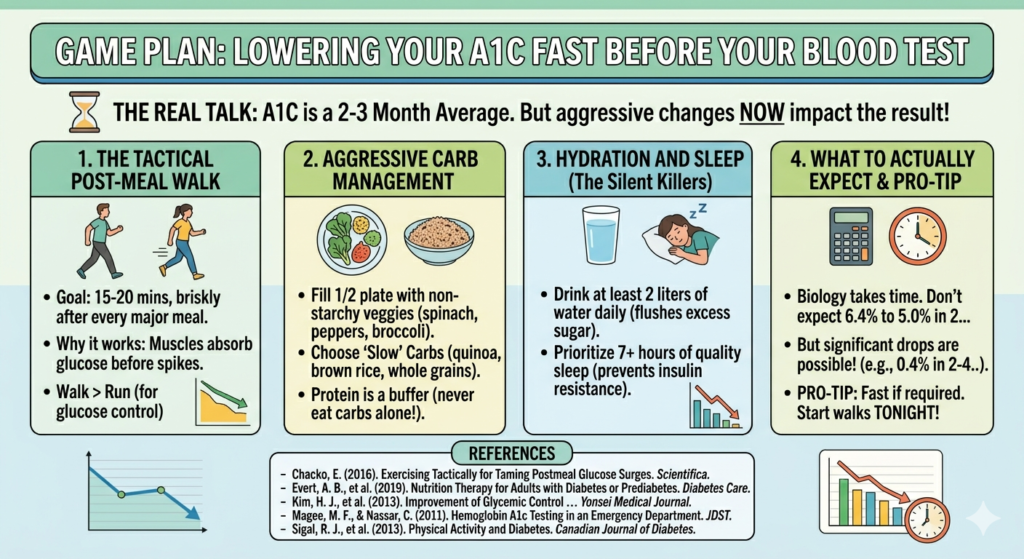
Since your A1C is a weighted average—with the most recent weeks counting for more than the older ones—aggressive changes made right now can actually lower your results by a measurable percentage in a short timeframe (Magee & Nassar, 2011). In clinical studies, intensive lifestyle changes have been shown to drop A1C levels by 0.4% in as little as two to four weeks (Magee & Nassar, 2011; Kim et al., 2013).
Step 1: The Tactical Post-Meal Walk
If there is one “cheat code” for blood sugar, it is movement—specifically right after you eat. When you exercise within 30 minutes of a meal, your muscles soak up the glucose from your food for energy before it has a chance to spike your blood sugar (Chacko, 2016).
- The Goal: A 15–20 minute brisk walk after every major meal (Sigal et al., 2013).
- Why it works: Three 15-minute walks after meals have actually been shown to be more effective at controlling 24-hour blood sugar than one long 45-minute walk in the morning (Chacko, 2016).
Step 2: Aggressive Carb Management
You don’t have to go full keto forever, but if you’re trying to drop numbers fast, lowering your carbohydrate intake is the most direct lever you can pull.
- Emphasize Non-Starchy Veggies: Fill half your plate with things like spinach, peppers, or broccoli (Evert et al., 2019).
- The “Slow” Carb Rule: If you’re going to eat carbs, stick to whole grains like quinoa or brown rice, which have fiber that slows down sugar absorption (Evert et al., 2019).
- Protein is Your Buffer: Never eat a carb alone. Pairing a piece of fruit with a handful of nuts or a piece of cheese prevents a sharp glucose spike (Evert et al., 2019).
Step 3: Hydration and Sleep (The Silent Killers)
Being dehydrated makes the sugar in your blood more concentrated, which can lead to higher readings. More importantly, poor sleep can actually cause your body to become more insulin resistant the very next day.
- Drink Water: Aim for at least 2 liters a day to help your kidneys flush out excess sugar.
- Prioritize 7+ Hours: Sleep quality is essential for maintaining glycemic control; chronic sleep deprivation is directly linked to higher HbA1c levels.
What You Can Actually Expect
Don’t expect to go from a 6.4% to a 5.0% in two weeks—biology doesn’t work that way. However, by being “tactical” with your exercise and strict with your carbs, you can see a significant improvement that shows your doctor you are moving in the right direction.
Pro-Tip: If your test is tomorrow, just make sure you fast properly if they asked you to. But for the long-term win, start those post-dinner walks tonight!