
So you just got the news that you have Type 2 diabetes. Honestly, it feels like the universe just dropped a giant homework assignment on your desk that you never asked for. I get it. Being 22 and trying to navigate a “chronic condition” while also trying to figure out your career, your social life, and why rent is so expensive is a lot. But here is the vibe check: managing diabetes in 2026 is a completely different game than it was for our parents.
We have the tech, we have the research, and we have a much better understanding of how to make this work without making it your entire personality. This is not about being a “perfect patient” who only eats kale. This is about self care that actually fits into a real life. We are talking about using data to your advantage and making small moves that pay off in a big way.
Here is the 100 percent real, human guide to keeping your blood sugar in check while still living your best life.
1. The Tech Revolution: Data Over Guesses
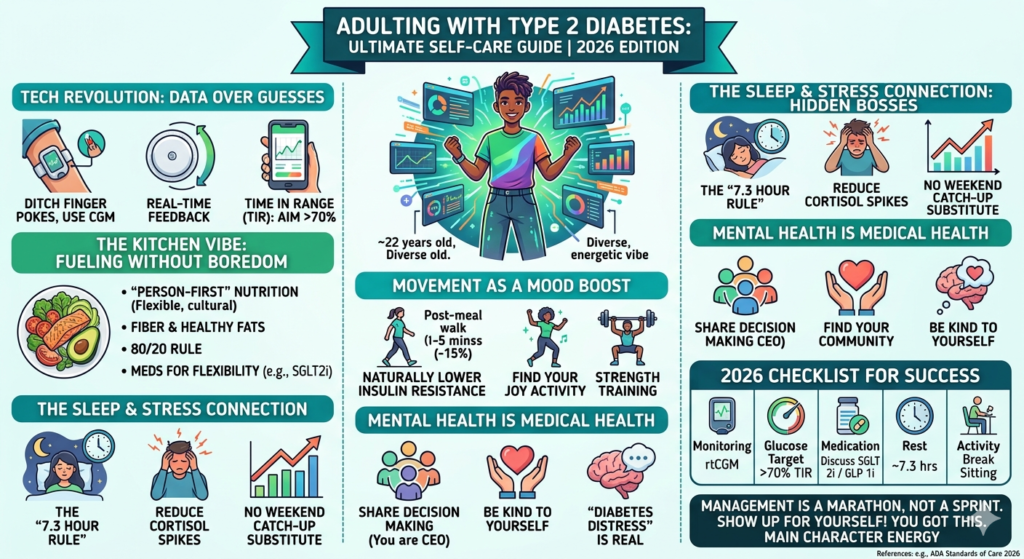
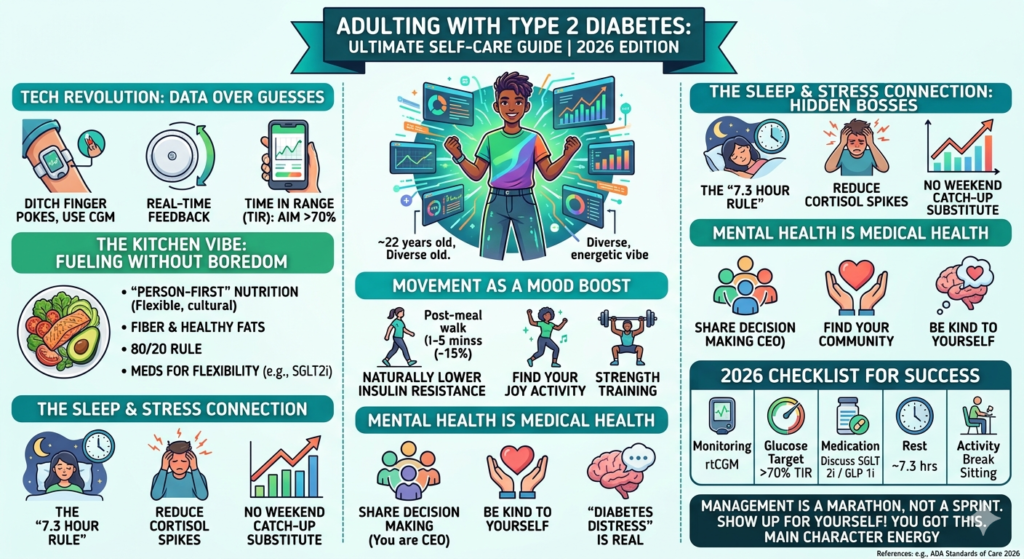
Back in the day, managing diabetes meant poking your finger all the time and guessing how that pizza affected you. In 2026, we are way past that. The biggest upgrade you can give yourself is a Continuous Glucose Monitor or CGM.
Current medical standards now recommend that everyone with Type 2 diabetes should have access to a CGM from the very first day of their diagnosis. It does not matter if you are on insulin or just taking oral meds; having that real time data is a total game changer.
- Real Time Feedback: Instead of a single number, you see a graph. You can literally see your sugar go up when you are stressed during a meeting or down when you take a quick walk.
- Time In Range (TIR): This is the new gold standard metric. Instead of just looking at your A1C every few months, we aim to stay “in range” (between 70 and 180 mg/dL) for more than 70 percent of the day.
- No More Guessing: You stop wondering if certain foods “work” for you. Your CGM will tell you exactly how your body reacts to a late night taco vs a bowl of pasta.
2. The Kitchen Vibe: Fueling Without the Boredom
Let’s kill the myth right now: a “diabetic diet” is just healthy eating. It is not a punishment. The goal is to avoid the massive sugar spikes that leave you feeling like a zombie two hours later.
The coolest thing about the 2026 guidelines is the shift toward “Person First” nutrition. It means there is no one size fits all meal plan. You get to decide what works for your culture, your budget, and your taste buds.
- The SGLT 2 Advantage: Many people are now being prescribed SGLT 2 inhibitors alongside metformin right away. These help your kidneys flush out extra sugar, which gives you a bit more flexibility with your meals while protecting your heart and kidneys.
- Fiber is Your Bestie: Think of fiber as a slow motion button for your digestion. It stops sugar from rushing into your blood all at once.
- Don’t Fear the Fats: Healthy fats from avocados, nuts, and olive oil keep you full and stabilize your energy.
- The 80/20 Rule: If 80 percent of your choices are solid, that other 20 percent for a birthday dinner or a night out isn’t going to break the system.
3. Movement as a Mood Boost
I know, “exercise” sounds like a chore. But for diabetes self care, we are looking at movement as a way to make your cells more sensitive to insulin.
New research shows that simply replacing 30 minutes of sitting with some moderate activity can drop your insulin resistance by a massive 15 percent. You do not need to be a gym rat. You just need to move your body.
- The Post Meal Power Walk: Taking a 10 to 15 minute walk right after you eat is one of the most effective ways to blunt a blood sugar spike. Your muscles soak up that extra glucose for energy.
- Find Your Joy: If you hate running, don’t run. Dance in your room, go for a hike, or try a bouldering gym. If it feels like play, you will actually do it.
- Strength Training: Muscles are like sponges for blood sugar. The more muscle mass you have, the easier it is for your body to manage glucose even when you are just chilling on the couch.
4. The Sleep and Stress Connection (The Hidden Bosses)
This is the part most people ignore, but it is actually huge. You can eat perfectly and exercise every day, but if you are stressed and sleep deprived, your blood sugar will still be a mess.
- The Cortisol Spike: When you are stressed, your body pumps out cortisol and adrenaline. These hormones tell your liver to dump extra sugar into your blood for “energy” to fight a threat that isn’t there.
- The 7.3 Hour Rule: Recent studies have found that the “sweet spot” for sleep is about 7.3 hours. Getting less than that can spike your insulin resistance by 30 percent in just one night.
- Sleep Debt is Real: Trying to “catch up” on sleep over the weekend only works in moderation. Consistency during the week is what actually protects your metabolism.
5. Mental Health is Medical Health
Living with a chronic condition is a mental load. It is okay to admit that it sucks sometimes. “Diabetes distress” is a real thing, and the 2026 standards explicitly mention the importance of psychosocial support.
- Shared Decision Making: You are the CEO of your health. Your doctor is your consultant. If a medication makes you feel terrible or a plan feels impossible, speak up.
- Community Matters: Find your people. Whether it is a local group or an online community, talking to others who “get it” makes the journey feel way less lonely.
- Be Kind to Yourself: You are going to have high sugar days. You are going to have days where you forget your meds. That doesn’t make you a failure. It makes you a human. Just reset and move forward.
6. The 2026 Checklist for Success
To keep things simple, here is your high level self care checklist to stay on top of the game:
| Area of Focus | The 2026 Goal | Why it Matters |
| Monitoring | Use a rtCGM (Real Time CGM) | Instant data to prevent spikes and lows. |
| Glucose Target | Aim for >70% Time In Range | Better long term health than just A1C alone. |
| Medication | Discuss SGLT 2i or GLP 1 options | Protects your heart and kidneys from day one. |
| Rest | Aim for ~7.3 hours of quality sleep | Prevents hormonal spikes in blood sugar. |
| Activity | Break up 30 mins of sitting with movement | Naturally lowers insulin resistance. |
“Ongoing diabetes self management education and support are critical to empowering people and reducing the risk of long term complications.”
Final Thoughts
Look, Type 2 diabetes is a marathon, not a sprint. Some days you will feel like you are winning, and other days you will feel like you are tripping over your own feet. The most important part of self care is showing up for yourself even when it is hard.
With the technology we have in 2026, you have more control than ever before. Use the tools, listen to your body, and don’t let a diagnosis stop you from doing the things you love. You have the main character energy to handle this. You have got this.