Let’s be totally real for a second. If you are reading this, you are probably tired. You are tired of feeling like you are six months pregnant after eating a single cracker. You are tired of the “food fear” that creeps in every time you look at a menu. And you are definitely tired of people telling you to “just eat more fiber” when you know, deep down, that fiber is currently your worst enemy.
I get it. Small Intestinal Bacterial Overgrowth (SIBO) is a total vibe killer. It’s not just about a little bit of gas. It’s the brain fog, the fatigue, and the constant, uncomfortable pressure in your abdomen that makes you want to live in leggings for the rest of your life.
But here is the good news. While SIBO feels like a mountain you can’t climb, the way you eat is one of the most powerful tools you have to take your life back. We are going to break down the SIBO diet in a way that actually makes sense, without the medical gatekeeping or the boring textbook talk.
What Is SIBO Anyway? (The 60 Second Version)
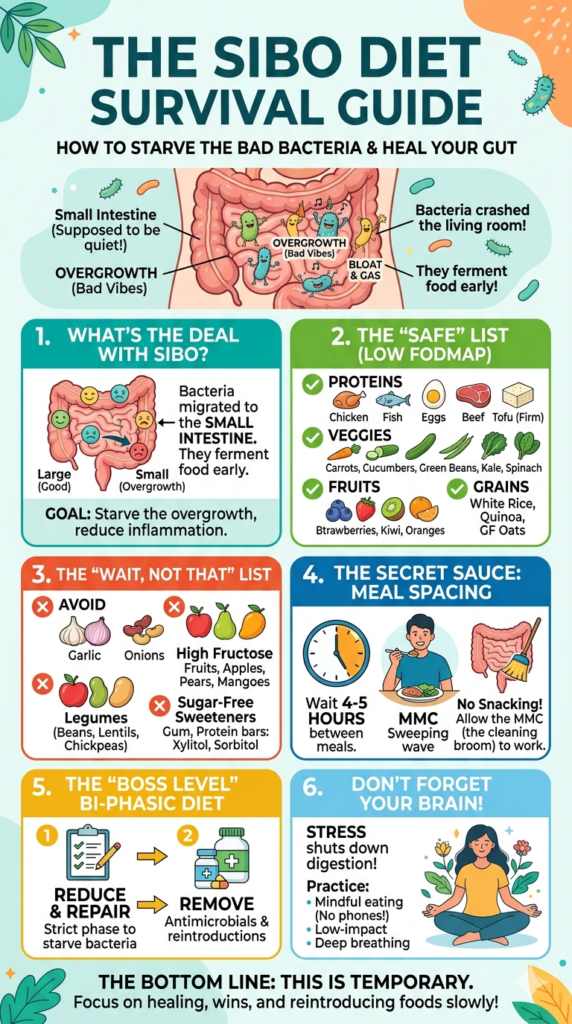
Basically, your gut is like a high school party. Most of the “cool kids” (the good bacteria) are supposed to stay in the large intestine. That’s the backyard where they can hang out and do their thing. SIBO happens when those bacteria decide to crash the living room (the small intestine).
The small intestine is supposed to be relatively quiet so it can absorb your nutrients. When bacteria set up shop there, they start fermenting your food before you can even digest it. This fermentation creates gas. That gas leads to the bloat.
The goal of a SIBO diet isn’t necessarily to “cure” the overgrowth on its own (usually you need some help from a doctor or a practitioner for that), but it is 100% about starving those bacteria so they stop making your life miserable while you heal.
The Gold Standard: The Low FODMAP Diet
If you have spent even five minutes on Google looking for gut help, you have seen the word FODMAP. It sounds like a secret government agency, but it actually stands for Fermentable Oligosaccharides, Disaccharides, Monosaccharides, and Polyols.
In human English? These are just short-chain carbs that your gut bacteria absolutely love to eat. When you eat them, the bacteria in your small intestine throw a feast, and the byproduct is that uncomfortable gas.
By following a Low FODMAP diet, you are essentially cutting off the supply chain to the bacteria.
What You Can Actually Eat (The Good Stuff)
A lot of people think a SIBO diet means eating air and ice cubes. It doesn’t have to be that way. You can still eat delicious food; you just have to be a bit more selective.
For protein, you are pretty much in the clear. Chicken, beef, fish, eggs, and tofu (firm) are all great because bacteria don’t ferment protein the same way they do carbs.
For veggies, think about carrots, cucumbers, eggplant, green beans, and kale. Spinach is also a total win.
For fruits, you want to stick to things like blueberries, strawberries, kiwi, and oranges.
For grains, white rice is usually the safest bet. Quinoa and gluten-free oats are also generally okay for most people.
The Bi-Phasic Diet: The Strategic Approach
Some people find the standard Low FODMAP diet a little too broad. That is where the Bi-Phasic Diet comes in. This was developed by Dr. Nirala Jacobi, and it’s basically the “SIBO boss level” strategy.
Phase 1 is the “Reduce and Repair” phase. This is the strictest part. You are cutting out almost all fermentable starches to really starve those bacteria out. You do this for about two to four weeks.
Phase 2 is the “Remove” phase. This is when you might start using antimicrobials or antibiotics prescribed by a professional, and you slowly start to add a few more foods back in to see how your body reacts.
The point of this is to give your small intestine a total break so the inflammation can go down. It’s like hitting the reset button on your digestive system.
The Villains: Foods to Avoid for Now
I know, I know. Some of these are “healthy” foods. That is the most frustrating part of SIBO. You think you are doing something good by eating a giant salad with garlic and onions, but your gut is screaming at you.
Garlic and onions are the biggest offenders. They are incredibly high in fructans (a type of FODMAP). Even a little bit of onion powder can set off a bloat storm for some people.
Legumes like beans, lentils, and chickpeas are also tough. They are high in fiber and complex sugars that SIBO bacteria love.
Certain fruits like apples, pears, and mangoes are high in fructose, which can be a huge trigger.
And then there are the “sugar-free” sweeteners like xylitol and sorbitol. These are polyols, and they are notorious for causing digestive distress even in people who don’t have SIBO. Always read the labels on your gum and “healthy” protein bars!
Meal Spacing: The Secret Sauce No One Talks About
This is probably the most important part of the SIBO diet that has nothing to do with what is on your plate and everything to do with when you eat.
Inside your gut, you have something called the Migrating Motor Complex (MMC). Think of it as a “cleansing wave” or a literal broom that sweeps through your small intestine to push out leftover food and bacteria.
The catch? The MMC only works when you are fasting.
If you are snacking every two hours, your “internal broom” never gets a chance to sweep. This allows bacteria to sit there and multiply.
Ideally, you want to leave four to five hours between meals. No snacking. Just water, black coffee, or plain tea. This gives your gut the time it needs to clean itself out. It’s a total game changer for managing symptoms.
What About the “Elemental Diet”?
If you are in a really dark place with your gut health, you might hear about the Elemental Diet. This isn’t really a “diet” in the traditional sense; it’s a medical meal replacement.
You drink a pre-digested formula that contains all your nutrients (amino acids, fats, vitamins) in their simplest form. Because the nutrients are already broken down, your body absorbs them within the first few inches of your small intestine.
This means the bacteria further down get zero food. Literally nothing. It’s basically a 2 week “fast” for your bacteria while you stay nourished. It’s tough to do because you don’t get to chew any food, but it has a very high success rate for clearing SIBO. Definitely talk to a pro before trying this one, though.
The Lifestyle Piece: Stress and the Gut
I would be lying to you if I said food was the only factor. You can eat the “perfect” SIBO diet and still feel like trash if you are chronically stressed.
Your brain and your gut are constantly talking to each other. When you are stressed, your body goes into “fight or flight” mode, which literally shuts down digestion. Your MMC stops working, and your stomach acid production drops.
Finding ways to chill out (whatever that looks like for you) is just as important as avoiding garlic. Whether it’s yoga, walking, or just making sure you aren’t scrolling through TikTok while you eat, your nervous system needs to feel safe for your gut to heal.
Don’t Let the Diet Become Your Identity
Here is some big sister advice. SIBO diets are meant to be therapeutic and temporary. They are not meant to be how you eat for the next 50 years.
It is very easy to fall into the trap of being afraid of food. When you start feeling better, it is tempting to stay on the strict diet forever because you are scared the bloat will come back. But your large intestine needs variety to stay healthy!
The goal is always to heal, kill the overgrowth, and then slowly reintroduce foods so you can eat a normal, diverse diet again.
Final Thoughts
Healing SIBO is a marathon, not a sprint. You might have days where you accidentally eat something with hidden garlic and feel like a balloon. That’s okay. Don’t beat yourself up.
Focus on the wins. Focus on the days when your brain feels clear and your jeans fit comfortably. Keep your meals simple, give your gut space to breathe between eating, and be patient with your body.
You aren’t broken. You just have some uninvited guests in your small intestine, and you are currently showing them the exit.
Stay hydrated, stay positive, and remember that better gut days are coming. You’ve got this!