So you have finally healed from the surgery.
The incisions are just tiny scars now and you have stopped thinking about the operating room every time you sit down for a meal.
You might think that once the organ is gone the story is over.
But being 22 means you have a lot of life left to live without that little green pouch.
Living for the next sixty or seventy years without a gallbladder is a journey that most people do not really talk about in the doctors office.
They tell you that you do not need it to live and that is true.
But there is a difference between just living and actually thriving.
When you remove an organ your body has to reroute an entire biological process.
It is like taking a major exit off a highway and expecting the traffic to just figure it out.
Eventually the traffic flows but the route is different.
Let us look at the long term effects of gallbladder removal so you can be prepared for the long haul.
We are going to talk about the stuff that shows up months or even years later.
The Constant Bile Drip Reality
The biggest change is how your body handles bile.
Bile is the green liquid your liver makes to break down fat.
Before surgery your gallbladder was like a storage tank.
It held the bile until you ate a slice of pizza or a burger and then it squeezed a big dose into your stomach to handle the grease.
Now that the tank is gone your liver just drips bile into your small intestine all day and all night.
It does not matter if you are eating a salad or sleeping or sitting in class.
This constant drip can change how your gut feels on a daily basis.
For some people this leads to something called bile acid malabsorption.
If there is too much bile and not enough food to soak it up the bile can irritate the lining of your large intestine.
This is why some people deal with urgency or what we call the bathroom dash long after their surgery.
It is not just a recovery thing. It can be a permanent change in how your pipes work.
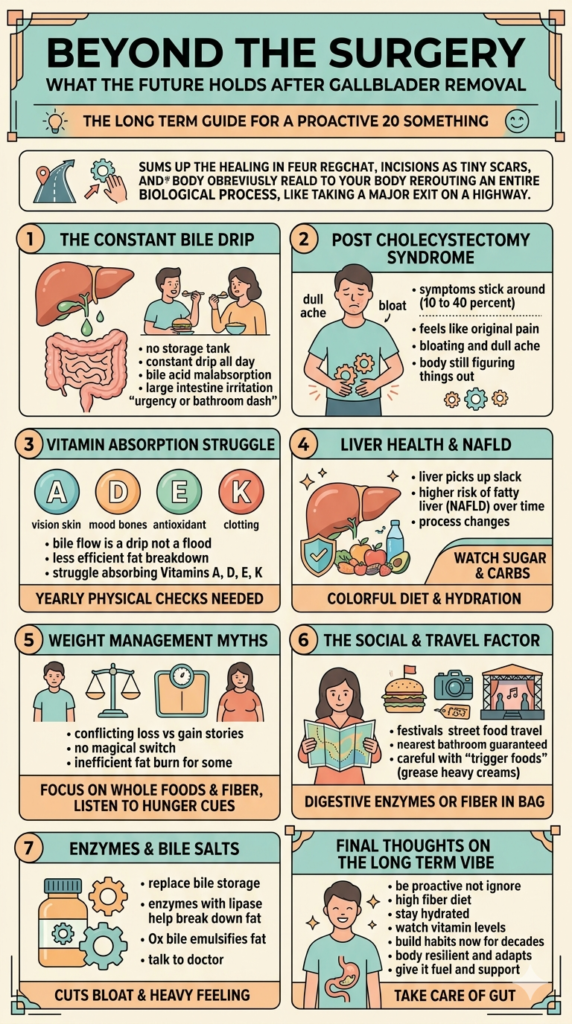
Understanding Post Cholecystectomy Syndrome
There is a fancy medical term called Post Cholecystectomy Syndrome or PCS for short.
It sounds scary but it is actually a catch all term for symptoms that stick around after the gallbladder is gone.
Around 10 to 40 percent of people experience some form of this.
It can feel like the same pain you had before the surgery.
You might get bloating or indigestion or a dull ache in your right side.
Sometimes this happens because the biliary duct which is the tube left behind gets a little stretched out.
Other times it is because your body is still struggling to process certain types of food.
If you are a few years out and still feeling the “ghost” of your gallbladder it is worth mentioning to a specialist.
It does not mean the surgery failed.
It just means your body is still figuring out how to balance the new plumbing.
The Hidden Struggle with Fat Soluble Vitamins
This is the part that most 20 somethings do not think about but it is so important for long term health.
Because your bile flow is now a drip instead of a flood you might not be breaking down fats as efficiently as you used to.
This means your body might struggle to absorb fat soluble vitamins.
We are talking about Vitamins A, D, E, and K.
- Vitamin A is huge for your skin and your vision.
- Vitamin D is the one we all talk about for mood and bone health.
- Vitamin E is a major antioxidant that protects your cells.
- Vitamin K is what helps your blood clot properly.
If you are not absorbing these properly you might feel more tired than usual or notice your skin looks a bit dull.
Over twenty or thirty years a slight deficiency in Vitamin D can lead to bigger issues with bone density.
It is a good idea to get your levels checked during your yearly physical.
You might need to take a high quality supplement or focus on eating these vitamins alongside a tiny bit of healthy fat to help with absorption.
Long Term Liver Health and NAFLD
There is some interesting research coming out about the link between gallbladder removal and the liver.
Since the gallbladder and liver are basically best friends the liver has to pick up the slack once the gallbladder is gone.
Some studies suggest that people without a gallbladder might have a slightly higher risk of developing Non Alcoholic Fatty Liver Disease or NAFLD over time.
This happens because the way your body processes fats and sugars changes.
Without the gallbladder to regulate bile flow the metabolism of lipids in the liver can get a bit wonky.
This is not a reason to panic.
It just means that being the CEO of your own body involves watching your sugar and processed carb intake even more closely.
Keeping your liver happy with plenty of water and a colorful diet is a long term investment.
It is about future proofing your health so you do not run into issues when you are 40 or 50.
The Weight Management Myth
You will hear a lot of conflicting stories about weight after this surgery.
Some people say they lost a ton of weight because they could no longer eat greasy food.
Others say they gained weight because their metabolism changed.
The truth is usually somewhere in the middle.
There is no magical weight gain switch that gets flipped when the gallbladder is removed.
However if you find that you can suddenly eat anything without pain you might end up eating more than you did when you were sick.
On the flip side some people find that their body becomes less efficient at burning fat.
The key is to focus on whole foods and high fiber options.
Fiber helps regulate your blood sugar and keeps you feeling full.
It also helps soak up that extra bile we talked about earlier.
Manage your weight by listening to your hunger cues rather than following a fad diet.
Your body is different now and you have to learn its new language.
The Social and Travel Factor
Let us talk about the wildcard: your social life and traveling.
When you are 22 you want to travel the world and go to music festivals and try street food in foreign countries.
Doing this without a gallbladder requires a bit of a strategy.
You cannot always guarantee where the nearest bathroom is when you are exploring a new city.
Long term many people find that they need to be careful with “trigger foods” while on the road.
Heavy cream sauces or deep fried snacks can cause an immediate reaction.
I always recommend carrying some digestive enzymes or a fiber supplement in your bag.
It is like an insurance policy for your gut.
If you know you are going out for a big dinner with friends taking a supplement can help your body handle the load.
It is all about knowing your limits so you can still enjoy the vibe without the stress.
The Importance of Digestive Enzymes and Bile Salts
Some people find that they never quite feel right until they start using supplements.
Digestive enzymes that contain lipase can help your body break down fats more effectively.
Ox bile is another supplement that some people swear by.
It basically acts as a replacement for the bile your gallbladder used to store.
If you take it with a meal it helps emulsify the fats so your small intestine can actually use them.
This can cut down on the bloating and the “heavy” feeling you get after eating.
Always talk to your doctor before starting these but they can be a game changer for long term comfort.
It is about finding the tools that make your body run smoothly.
Final Thoughts on the Long Term Vibe
Gallbladder removal is a major life event even if it is a common surgery.
Living without this organ is totally doable and most people live long and happy lives.
But you have to be proactive.
Do not just ignore your digestion and hope for the best.
Focus on a high fiber diet and stay hydrated and keep an eye on your vitamin levels.
Being 22 is the perfect time to build these habits because they will serve you for decades to come.
Your body is resilient and it knows how to adapt.
Give it the right fuel and the right support and you will barely even notice the gallbladder is missing.
Take care of your gut and it will take care of you.
You have got a long road ahead and it looks bright.
Stay healthy and stay curious!