
Let’s be real for a second—getting that notification that your blood work is scheduled in a few weeks can feel like seeing blue lights in your rearview mirror. You’re 22, life is chaotic, and suddenly you’re panicking because your A1C might show all those late-night pizza runs and energy drinks. I’ve been there, staring at a lab slip and wondering if there is a “reset” button for my bloodstream.
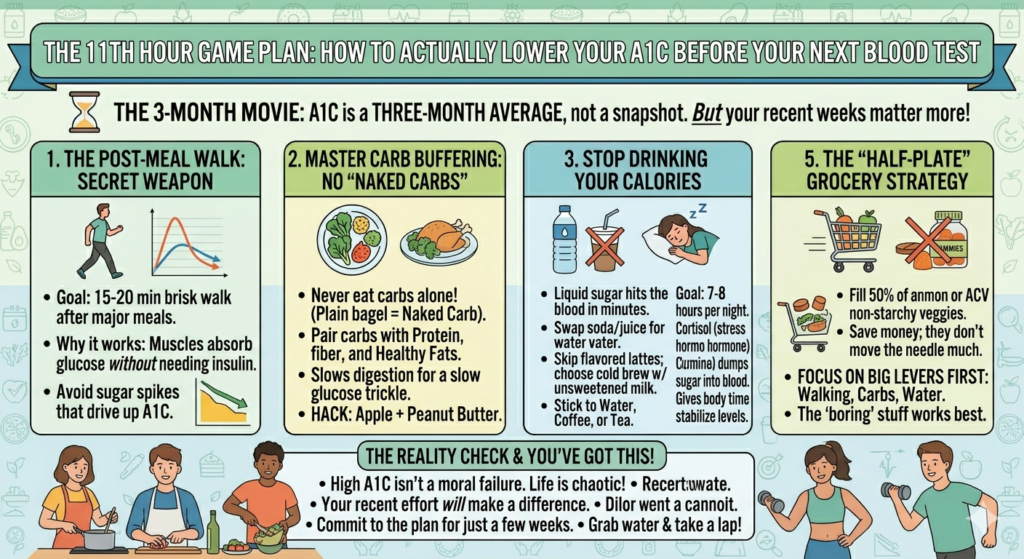
First, a tiny bit of science so we’re on the same page: your A1C (hemoglobin A1c) is basically a three-month average of your blood sugar. It’s not a snapshot; it’s a whole movie. Because it measures how much sugar is “stuck” to your red blood cells, and those cells live for about 90 to 120 days, you can’t just fast for one day and expect a miracle.
However, here is the secret: the most recent weeks of that three-month window actually carry more weight in the final percentage. This means if you go “beast mode” on your habits right now, you can absolutely drag that average down before the needle hits your arm. Here is the fully human, no-BS guide to lowering your A1C as fast as biologically possible.
1. The Post-Meal Walk is Your Secret Weapon
If you do nothing else from this list, do this. Every time you eat, your blood sugar rises. Usually, your body releases insulin to handle it. But if you have prediabetes, that system is lagging.
By taking a 15-to-20-minute brisk walk within 30 minutes of finishing a meal, you are basically bypass-coding the system. Your muscles need fuel to move, so they start vacuuming up the glucose in your blood for energy without needing as much insulin to do the job. Research shows that three short walks after meals are way more effective for A1C than one long gym session in the morning. It’s the single fastest way to “blunt” those sugar spikes that drive your A1C up.
2. Master the Art of “Carb Buffering“
Carbs aren’t the devil, but “naked carbs” are. A naked carb is something like a plain bagel, a bowl of white pasta, or a sugary soda. These hit your system like a freight train and send your sugar levels into orbit.
To lower your A1C quickly, you need to “buffer” every single carb you eat with protein, fiber, and healthy fats. This slows down the digestion process so the sugar trickles into your blood instead of flooding it.
- The Hack: If you want an apple (carb), eat it with peanut butter (fat/protein).
- The Hack: If you’re having rice (carb), pile on double the broccoli (fiber) and chicken (protein).
- The Order Matters: Try eating your veggies first, then your protein, and save the carbs for the very last bites of your meal. Studies show this “food sequencing” can significantly lower post-meal glucose spikes.
3. Stop Drinking Your Calories (For Now)
I know, the iced coffees and the sodas are life-sustainers. But when you’re in a “emergency A1C lowering” phase, liquid sugar is your biggest enemy. Why? Because your body doesn’t have to work to break it down. It goes straight from your throat to your bloodstream in minutes.
Swap the soda for sparkling water with lime. Swap the flavored lattes for cold brew with a splash of heavy cream or unsweetened almond milk. Even “healthy” fruit juices are basically just sugar water without the fiber of the actual fruit. Stick to water, black coffee, and unsweetened tea for the next few weeks. Your numbers will plummet.
4. Prioritize “Deep Sleep” (The Insulin Reset)
This sounds like “wellness” fluff, but it’s actually pure biology. When you don’t sleep enough—which, let’s be honest, is most of us at 22—your body produces cortisol, the stress hormone. Cortisol tells your liver to dump more sugar into your blood for “energy” to keep you awake.
One night of bad sleep can make you as insulin-resistant as someone with full-blown type 2 diabetes the next morning. If you’re trying to lower that A1C, you need to aim for 7 to 8 hours. It gives your body a chance to stabilize and reset your insulin sensitivity. Put the phone away, turn on night mode, and actually rest.
5. The “Half-Plate” Grocery Strategy
When you’re at the store, don’t look for “diet food.” Look for volume. The goal is to fill 50% of your plate with non-starchy vegetables at every single meal. We’re talking:
- Spinach and kale
- Bell peppers and onions
- Zucchini and cucumbers
- Brussels sprouts and cauliflower
These foods are basically “free” because they have so much fiber and water that they barely impact your blood sugar. They fill you up so you don’t feel like you’re starving while you’re cutting back on the heavier stuff.
6. Don’t Fall for the “Quick Fix” Supplements
You’re going to see ads for “Cinnamon pills” or “Apple Cider Vinegar gummies” that promise to melt away your prediabetes. Save your money. While some things like ACV might help a tiny bit with insulin sensitivity, they are like a drop of water in an ocean compared to walking and carb management. Focus on the big levers first. The “boring” stuff is what actually moves the needle (literally).
The Reality Check
Here is the most important part: don’t beat yourself up. Having a high A1C at 22 isn’t a moral failure. It’s usually a mix of genetics, stress, and just trying to survive in a world where cheap, sugary food is everywhere.
You have a few weeks to make a change. If you commit to walking after meals, drinking more water, and buffering your carbs, you are going to see an improvement. Even a 0.2% or 0.3% drop in your A1C can be the difference between a “we need to start medication” talk and a “keep doing what you’re doing” talk from your doctor.
You’ve got the plan. Now go grab a water bottle and take a lap around the block. You’ve totally got this.