We need to have a serious talk about one of life’s most devastating betrayals.
It is the kind of heartbreak that doesn’t come from a text message or a ghosting situation.
It is the physical, burning sensation in your chest that happens right after you enjoy a beautiful, velvety piece of chocolate.
If you have ever been vibing on the couch with a bag of Reese’s or a fancy dark chocolate bar, only to feel like you swallowed a literal torch ten minutes later, you are not alone.
It feels personal. It feels like the universe is gatekeeping joy.
But as much as I hate to be the bearer of bad news, there is a very real, scientific reason why chocolate is one of the biggest “villains” in the world of acid reflux and heartburn.
Being 22 means realizing that your stomach is no longer the indestructible iron pit it was when you were fifteen.
Back then, we could eat pizza and chocolate bars at midnight and wake up feeling like Olympic athletes.
Now? One “fun size” Snickers might be enough to ruin my entire sleep schedule.
Let’s dive into why this happens and if there is any way to keep chocolate in our lives without the spicy chest pain.
The Science of the “Trap Door”
To understand why chocolate is such a menace, we have to talk about the anatomy of your digestive system in a way that doesn’t feel like a boring biology lecture.
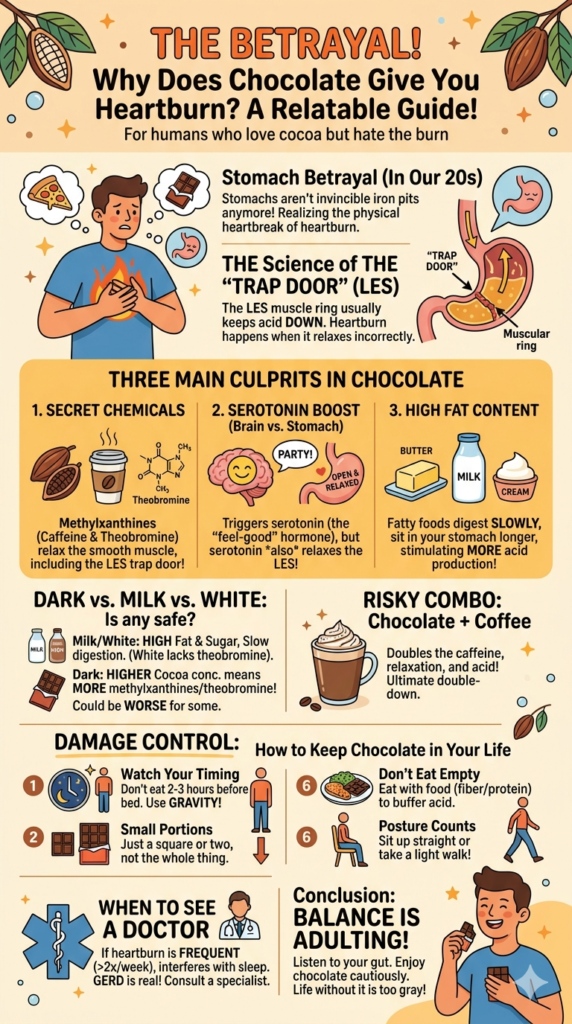
You have a little muscular ring at the bottom of your esophagus called the Lower Esophageal Sphincter, or the LES for short.
Think of the LES as a tiny, very important trap door.
Its only job is to open when you swallow food and then shut tight to keep all that stomach acid where it belongs: down in the pit.
Heartburn happens when that trap door gets lazy.
When the LES doesn’t close all the way, or when it relaxes at the wrong time, stomach acid splashes back up into your throat.
Because your esophagus isn’t built to handle acid like your stomach is, it burns.
Now, here is the tragic part: chocolate contains a bunch of different things that essentially tell that trap door to “just relax and take a nap.”
The Secret Chemicals in Your Cocoa
Chocolate is a complex little treat. It isn’t just sugar and cocoa; it is packed with naturally occurring chemicals that affect your body in weird ways.
One of the main culprits is something called methylxanthines.
This is a fancy group of compounds that includes caffeine and theobromine.
While these chemicals are great for giving you a little mood boost or a tiny kick of energy, they are also notorious for relaxing smooth muscle tissue.
Guess what your LES is made of? Smooth muscle.
When you eat chocolate, the methylxanthines go straight to work telling that “trap door” muscle to chill out.
The door opens, the acid moves up, and suddenly you are clutching your chest wondering why you didn’t just eat an apple instead.
The Serotonin Connection: Too Much of a Good Thing
We all know that chocolate makes us happy. There is a reason we reach for it when we are stressed or celebrating.
Chocolate actually triggers your brain to release serotonin, the “feel-good” hormone.
Normally, serotonin is our bestie. We want it. We need it.
But here is the plot twist: serotonin also has a relaxing effect on the LES.
So, while your brain is having a party and feeling great because of that chocolate truffle, your stomach is basically leaving the front door wide open for acid to escape.
It is a classic case of your brain and your stomach not being on the same page.
It’s like your brain is the friend who wants to stay out until 3 a.m. and your stomach is the friend who just wants to go home and go to bed.
The Fat Factor: Why Creamy Is Costly
If you prefer milk chocolate or white chocolate, you are dealing with another layer of the problem: fat.
Fatty foods are one of the biggest triggers for heartburn because they take a long time to digest.
When you eat something high in fat, it sits in your stomach longer.
The longer food stays in your stomach, the more acid your body produces to break it down.
Plus, high-fat foods also contribute to that “lazy trap door” issue we talked about earlier.
If you are eating chocolate that is loaded with cocoa butter, milk fats, and oils, you are essentially creating the perfect storm for a reflux flare-up.
It is slow to move, high in acid-stimulating fats, and contains the chemicals that let the acid escape.
It is a triple threat, but not the fun kind.
Dark vs. Milk vs. White: Is There a Safe Choice?
I wish I could tell you that switching to dark chocolate is the magical cure.
In some ways, dark chocolate is “healthier” because it has less sugar and more antioxidants.
But when it comes to heartburn, dark chocolate can actually be worse for some people.
Why? Because it has a higher concentration of cocoa.
More cocoa means more methylxanthines and more theobromine.
So, while you might be avoiding some of the heavy fats found in milk chocolate, you are getting a concentrated dose of the chemicals that relax your LES.
Milk chocolate, on the other hand, has less cocoa but way more fat and sugar.
Sugar itself can also be a trigger because it can cause fermentation in the gut, leading to gas and pressure that pushes acid upward.
White chocolate isn’t really “chocolate” in the traditional sense because it doesn’t have cocoa solids, but it is basically just fat and sugar.
For some, white chocolate might be the “least” triggering because it lacks the theobromine of dark chocolate, but the high fat content can still get you in the end.
It really comes down to your personal “stomach vibe” and what your body reacts to the most.
The Coffee and Chocolate Double Whammy
We have to talk about the ultimate combo: the mocha or the “coffee after dessert” move.
If you are a coffee lover like I am, you probably know that coffee is already on the “high alert” list for heartburn.
It is acidic and high in caffeine.
When you pair coffee with chocolate, you are essentially doubling down on every single trigger.
You are getting double the caffeine, double the muscle relaxation, and double the acid production.
If I have a latte and a brownie at the same time, I might as well just go ahead and sleep sitting up because that heartburn is coming for me.
It is a tragic reality for those of us who live for a good cafe aesthetic.
How to Enjoy Chocolate Without the Burn
Now that I have thoroughly depressed both of us with the science, let’s talk about how to actually deal with this.
You don’t necessarily have to give up chocolate forever unless your doctor tells you to.
It’s all about strategy and damage control.
Watch Your Timing
The absolute worst thing you can do is eat chocolate right before bed.
When you lie down, gravity is no longer helping keep that acid in your stomach.
If you have chocolate within two or three hours of hitting the pillow, you are basically asking for a rough night.
Try to keep your chocolate treats to the afternoon or early evening so your body has time to process them while you are still upright.
Small Portions Are Key
This is the hardest rule to follow, I know.
But instead of eating an entire bar, try having just one or two squares.
Sometimes, the dose makes the poison. A tiny bit of chocolate might not be enough to fully relax your LES, whereas a large amount definitely will.
Don’t Eat It on an Empty Stomach
Eating chocolate when your stomach is empty is like throwing fuel on a fire.
There is nothing else in there to help buffer the acid or slow down the absorption of the chemicals.
Try having a small piece of chocolate after a meal that includes some fiber or protein.
The other food will help “soak up” some of that acid and keep things moving more naturally.
Hydrate (But Not Too Much)
Drinking water can help clear the esophagus, but chugging a gallon of water right after eating can actually make reflux worse by increasing the pressure in your stomach.
Small sips are your friend.
Check Your Posture
If you feel the burn starting, don’t slouch on the couch.
Sit up straight or take a light walk.
Gravity is the only free tool we have to fight heartburn, so use it to your advantage.
When to See a Professional
I am just a 22-year-old on the internet sharing the struggle, not a doctor.
If you are experiencing heartburn more than a couple of times a week, or if it is starting to interfere with your ability to eat or sleep, it might be more than just a “chocolate problem.”
Issues like GERD (Gastroesophageal Reflux Disease) are real and can cause long-term damage if you just ignore them.
Sometimes, it isn’t just the chocolate; it’s an underlying issue that needs a professional look.
Lafayette has some great specialists (shoutout to the GI docs in the area) who can help you figure out if you need actual treatment or just a lifestyle tweak.
The Bottom Line
Does chocolate give you heartburn?
For a huge percentage of people, the answer is a very sad “yes.”
Between the muscle-relaxing chemicals, the high fat content, and the serotonin-induced “trap door” failures, it is basically designed to be a reflux trigger.
But being an adult is all about balance.
It’s about knowing that you can probably still have a little bit of chocolate as long as you aren’t doing it at 11 p.m. while lying flat on your back.
We learn to work around our bodies’ quirks because, honestly, life without chocolate is just a little too gray.
Listen to your gut, literally.
If it says “no more,” give it a break.
If it says “maybe just a little,” proceed with caution.
And always, always keep some antacids in your nightstand, just in case.
Stay sweet, stay upright, and may your chest be forever fire-free!