
So, you’re standing in your kitchen at 8 AM, staring at a toasted bagel. It’s golden brown, it’s smelling incredible, and your favorite tub of cream cheese is right there in the fridge. But then, that familiar little voice in the back of your head (and that annoying burn in your chest) starts acting up.
If you’re living with GERD or chronic acid reflux, every single meal feels like a high-stakes negotiation. You’re constantly asking yourself if that one delicious bite is going to come back to haunt you three hours later when you’re trying to sleep or finish a shift at work.
Cream cheese is one of those “middle ground” foods that leaves people totally confused. It’s dairy, it’s creamy, and it’s undeniably delicious, but is it actually safe for someone with a sensitive esophagus?
Let’s break it down like we’re just chatting over coffee. No overly clinical jargon that sounds like a textbook, just the real facts on how cream cheese interacts with your body and how you can manage your breakfast without the fire.
What is GERD Really Doing to Your Body?
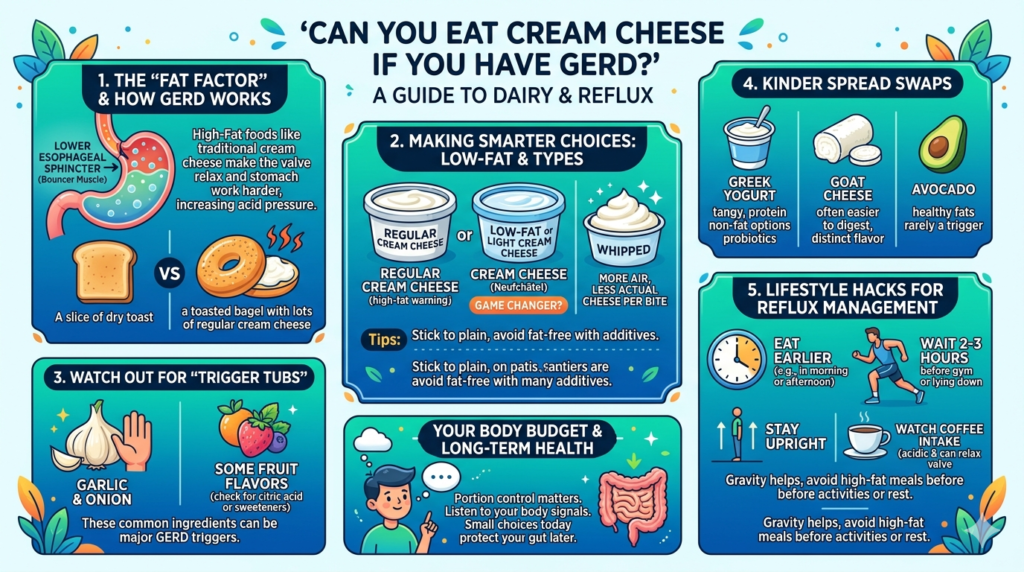
Before we blame the cream cheese, we have to look at the mechanics. GERD, or Gastroesophageal Reflux Disease, is basically a “leaky valve” situation. You have a muscle called the lower esophageal sphincter. Think of it like a bouncer at a club. Its only job is to let food down into the stomach and keep the acid from splashing back up.
When you have GERD, that bouncer is basically taking too many breaks. Certain foods make that muscle relax when it shouldn’t, or they cause your stomach to produce way too much acid. When that happens, the acid climbs up into your throat, and suddenly you feel like you’ve swallowed a literal match.
High-fat foods are notorious for being the worst influence on that “bouncer” muscle. They tell it to chill out and open up, which is exactly what we don’t want.
The Problem with Cream Cheese: The Fat Factor
Here is the honest truth about cream cheese: it is a high-fat dairy product. Most traditional cream cheeses are made from a mix of milk and cream.
Because it’s so rich, it stays in your stomach a lot longer than a piece of fruit or a slice of dry toast. Your stomach has to work overtime, pumping out more acid to break down those fats.
When your stomach is full of acid and food for a long period, the pressure builds up. That pressure is what eventually forces the acid past your esophageal sphincter and up into your chest.
If you’re eating the full-fat, “original” style cream cheese, you’re basically giving your GERD an open invitation to cause trouble. For a lot of 20-somethings who are always on the go, a quick bagel with a thick layer of cream cheese is a staple, but it might be the secret reason you’re feeling sluggish and burny by noon.
Is “Low-Fat” Actually a Better Vibe?
You’ve probably seen the “light” or “low-fat” versions in the dairy aisle and wondered if they’re just a marketing scam. When it comes to reflux, they actually aren’t.
Low-fat cream cheese (often labeled as Neufchâtel cheese) has significantly less fat than the standard stuff. Since fat is the main trigger here, switching to a lighter version can honestly be a game changer for some people.
It still gives you that creamy texture and the tang you’re looking for, but it doesn’t sit in your stomach like a brick for four hours.
However, you have to be careful with “fat-free” versions. Sometimes, when companies take out all the fat, they add in extra thickeners, gums, or even sugars to make it taste better. Some of those additives can actually irritate a sensitive stomach in different ways, so it’s all about finding that middle ground.
The Secret Trigger: Flavored Cream Cheeses
This is where things get tricky. You might think you’re being healthy by picking a “Veggie” cream cheese or a “Garden Herb” mix.
But you have to read the labels. A lot of those savory cream cheeses use garlic powder and onion powder for flavor.
If you have GERD, you probably already know that garlic and onion are the “final bosses” of acid reflux. They are massive triggers that relax the esophageal sphincter almost instantly for a lot of people.
Even a “strawberry” cream cheese might have citric acid or high fructose corn syrup added to keep it fresh and sweet, both of which can kickstart a heartburn episode. If you’re going to do cream cheese, stick to plain or whipped versions where you know exactly what’s in the tub.
Portion Control (The Unpopular Truth)
I know, nobody wants to hear about portion control. We want to slather that bagel until the hole in the middle disappears.
But with GERD, the volume of food in your stomach matters just as much as what the food is. A tiny bit of cream cheese might be totally fine for you, while a “New York Deli” style smear will ruin your entire day.
Try using a tablespoon instead of just winging it with a butter knife. You might find that you get the flavor you want without hitting that “threshold” that triggers the pain.
Better Alternatives for Your Breakfast
If you realize that cream cheese just isn’t working for you no matter what you do, you don’t have to eat dry bread for the rest of your life. There are a few swaps that are much kinder to your esophagus.
Whipped cream cheese is a great hack. Because it’s full of air, you’re naturally eating less actual cheese per bite, but it still feels satisfyingly fluffy.
Greek yogurt is another interesting one. If you get the thick, plain, non-fat version, you can actually use it as a spread. It has that same tang as cream cheese but it’s packed with protein and probiotics which can actually help your digestion in the long run.
Then there’s goat cheese. For some people, goat dairy is much easier to digest than cow’s dairy. It’s naturally a bit lower in certain fats and has a distinct flavor that means you don’t need to use as much to feel satisfied.
And honestly, don’t sleep on avocado. If you need that creamy “mouthfeel” on your toast, avocado provides healthy fats that don’t usually trigger reflux the same way that heavy dairy fats do. Plus, it’s basically a superfood.
Lifestyle Hacks to Keep the Reflux Away
It isn’t just about what you eat, it’s about how you live your life around your meals.
If you’re going to have cream cheese, try to have it earlier in the day. Eating high-fat dairy right before you hit the gym or right before you lie down for a nap is a recipe for disaster. Gravity is your best friend when you have GERD. You want to give your body at least two to three hours to process that cheese while you’re upright.
Also, watch your coffee intake. Most people eat cream cheese on a bagel alongside a massive iced coffee. Coffee is highly acidic and caffeine also relaxes that “bouncer” muscle we talked about.
If you combine the fat from the cream cheese with the acid from the coffee, you’re creating a perfect storm in your stomach. Try switching to a cold brew (which is less acidic) or a herbal tea if you’re having a “cheesy” breakfast.
The Mental Game of Dietary Restrictions
Living with GERD at 22 is honestly annoying. You’re at an age where everyone wants to go out for pizza, grab late-night burgers, or hit up brunch spots. Feeling like the “difficult” one at the table because you have to ask about ingredients sucks.
But it’s all about learning your own “body budget.” If you know you want to have a slice of cheesecake (which is basically just a giant block of cream cheese) at a birthday party later, maybe keep your breakfast and lunch super clean and low-fat.
It’s not about being perfect, it’s about being smart so you don’t end up miserable.
A Quick Summary for the Road
So, can you eat cream cheese with GERD?
Yes, but with some major fine print.
Avoid the full-fat versions if you can and definitely stay away from the onion and garlic flavored tubs.
Go for the low-fat or whipped versions and keep the portion size reasonable.
Pay attention to how your body feels. If you eat it and feel fine, great. If you eat it and feel like your chest is in a vice, it’s time to listen to that signal.
Your gut health is a long-term project. Taking care of it now while you’re young means you won’t be dealing with much scarier complications down the road.
Keep your head up, your meals upright, and maybe give that low-fat spread a chance. Your esophagus will definitely thank you for it.