You did the thing. You had the surgery. You said goodbye to that tiny organ that was causing you so much grief and you expected to walk out of the hospital and straight back into your normal life.
But being 22 and dealing with chronic health stuff is never as simple as the brochures make it sound.
Maybe it has been a few weeks or maybe it has been a few months but you are starting to notice something frustrating.
The pain is back. Or maybe the bloating is even worse than before. Or perhaps you are afraid to leave your apartment because your stomach has become a ticking time bomb.
If you are sitting there feeling like your body is gaslighting you I need you to know that you are not crazy and you are definitely not alone.
There is a real name for this and it is called Post Cholecystectomy Syndrome or PCS for short.
It sounds like a scary medical mystery but it is actually just a way to describe a group of symptoms that persist or even start up for the first time after your gallbladder is long gone.
Let us dive into the reality of living with PCS and how you can actually start feeling like a functional human being again.
What Is Post Cholecystectomy Syndrome Anyway
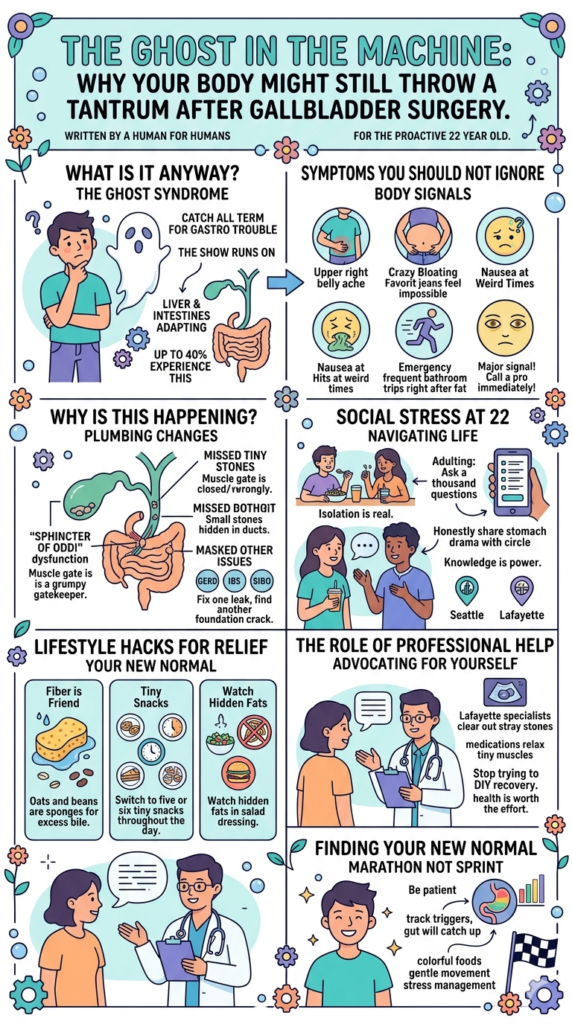
In the simplest terms possible PCS is the catch all term doctors use when the expected relief from surgery does not quite happen.
Think of it like this: your gallbladder was the main character in your digestive drama for a long time.
Now that the main character is gone the rest of the cast members (your liver and your intestines and your bile ducts) are struggling to keep the show running smoothly.
For some people the symptoms are exactly like the gallbladder attacks they had before the operation.
For others it feels like a whole new set of digestive issues.
It is more common than you might think with some studies suggesting that up to 40 percent of people experience some form of PCS at some point.
The most annoying part of being 22 with this condition is that you look fine on the outside.
Your friends see you at a coffee shop in Seattle or out for lunch in Lafayette and they assume everything is back to normal.
But on the inside you are calculating the distance to the nearest bathroom and wondering if that one bite of avocado was a mistake.
The Symptoms You Should Not Ignore
PCS is not just one thing. It is a collection of signals from your body that things are a bit out of sync.
Common symptoms include:
- A dull ache or sharp pain in the upper right side of your belly
- Crazy levels of bloating that make your favorite jeans feel impossible to wear
- Nausea that hits at the weirdest times
- Frequent trips to the bathroom especially right after eating fat
- Yellowish skin or eyes which is a major signal to call a pro immediately
The pain can be especially confusing because it often feels exactly like the stones were still there.
It can radiate to your back or your shoulder and it can make you feel incredibly discouraged.
When you are young you want to be out living your life not curled up on the couch with a heating pad because your digestive system is having a midlife crisis in your early twenties.
Why Is This Happening To Me
The million dollar question is why the symptoms are still hanging around.
The human body is basically a complex web of plumbing and when you remove a major valve like the gallbladder the pressure and the flow of bile change.
One common cause is something called Sphincter of Oddi dysfunction.
This is a tiny muscle that acts like a gatekeeper for the bile entering your small intestine.
If this gatekeeper gets grumpy and stops opening or closing at the right time it causes a backup of pressure that leads to pain and bloating.
Another possibility is that there were tiny stones left behind in the bile ducts that surgery missed.
Or it could even be that the gallbladder was not the only issue in the first place.
Sometimes things like GERD or IBS or even small intestinal bacterial overgrowth (SIBO) get masked by gallbladder pain and once the organ is gone those other issues take center stage.
It is like fixing a leaky roof only to realize the foundation of the house also has some cracks.
Navigating The Social Stress At 22
Let us be real: having digestive issues in your twenties is a massive social buzzkill.
This is the age where life revolves around food and drinks and spontaneously going out.
When you have PCS you have to become the person who asks a thousand questions about the menu.
You have to be the person who passes on the shared fries or the late night pizza run.
It can feel isolating and it can make you feel older than you actually are.
But there is a way to handle this without losing your social life.
It starts with being honest with your circle.
You do not have to give them the graphic details but just saying “my stomach is being a drama queen today” goes a long way.
Most people are way more understanding than we give them credit for.
And if you are in a city like Seattle with a massive food scene or Lafayette with its incredible local eats you can always find options if you look ahead at the menu.
Knowledge is power when it comes to keeping your symptoms under control while still having a life.
Lifestyle Hacks For Immediate Relief
While you wait for your body to adjust there are things you can do right now to make life easier.
First and foremost: fiber is your new best friend.
As we have talked about in other articles soluble fiber is like a sponge for excess bile.
It soaks up the extra liquid and helps slow down your digestion so you do not have those emergency bathroom dashes.
Think oats and beans and peeled fruits.
Second: stop eating three giant meals.
Your body cannot handle a heavy load all at once anymore.
Switching to five or six tiny snacks throughout the day keeps the bile flow manageable.
It prevents that sudden “flood” that causes cramping and pain.
Third: watch the hidden fats.
You might think a salad is safe but if it is covered in a heavy oil based dressing your system is going to revolt.
Stick to lean proteins like chicken and turkey and white fish.
And finally: stay hydrated but try not to chug water during your meals.
Drinking too much liquid while you eat can wash the food through your system even faster which is the opposite of what you want right now.
The Role Of Professional Help
If your symptoms are making it impossible to work or go to school it is time to stop trying to DIY your recovery.
Lafayette has some incredible specialists who deal with the biliary system every single day.
They can run tests like an ERCP or a specialized ultrasound to see exactly what is happening in those ducts.
Sometimes a small procedure to widen a duct or clear out a stray stone can make a world of difference.
There are also medications that can help bind the bile or relax those tiny muscles in your digestive tract.
Do not feel like you have to suffer in silence just because the surgery is technically over.
Advocating for yourself is a major part of adulting and your health is worth the effort of finding the right doctor.
Finding Your New Normal
The journey through Post Cholecystectomy Syndrome is a marathon not a sprint.
Your body has undergone a major change and it is okay if it takes a year or more to fully find its rhythm.
Be patient with yourself.
Some days will be great and you will feel like you have conquered the world.
Other days you will feel like you are back at square one.
The key is to track your triggers and keep moving forward with your healthy habits.
You are 22 years old and you have a huge life ahead of you.
Do not let a grumpy digestive system hold you back from your goals.
Focus on the colorful foods and the gentle movement and the stress management that keeps your whole body happy.
You have got this and your gut will eventually catch up to your spirit.
Take it one meal at a time and do not be afraid to ask for the help you need.
Your future self will be so proud that you took the time to figure this out now.