
So you have finally made it back to your apartment after gallbladder surgery. You are likely parked on your couch, probably staring at the beige carpet of your rental and wondering when you will feel like a functional human again. The first few days after surgery are a total blur of anesthesia dreams and trying to remember which side you can actually roll over on without feeling a sharp pinch.
But then the hunger hits. It starts as a tiny growl and quickly turns into a full-on demand from your stomach. You are tired of the hospital jello and the lukewarm broth. You want something real. You want something that actually feels like a meal.
You look at that bag of rice in your pantry. It is humble. It is cheap. It is the literal foundation of a thousand different meals. But then the post-surgery anxiety kicks in. You have heard the horror stories about what happens when you eat the “wrong” thing after losing your gallbladder. You don’t want to spend your entire evening in the bathroom because you made a tactical error with your dinner.
As a 22-year-old trying to figure out “adulting” while missing an organ, the stakes feel surprisingly high. You just want to know: can I eat rice? Is it safe? Or is it going to trigger a digestive meltdown?
The good news is that rice is basically the gold standard for post-gallbladder recovery. If there was a “hall of fame” for foods that are kind to a gallbladder-less gut, rice would be the undisputed MVP.
Let’s dive into why rice is such a win and how you can make it work for your new digestive reality.
The Science of the “New Management”
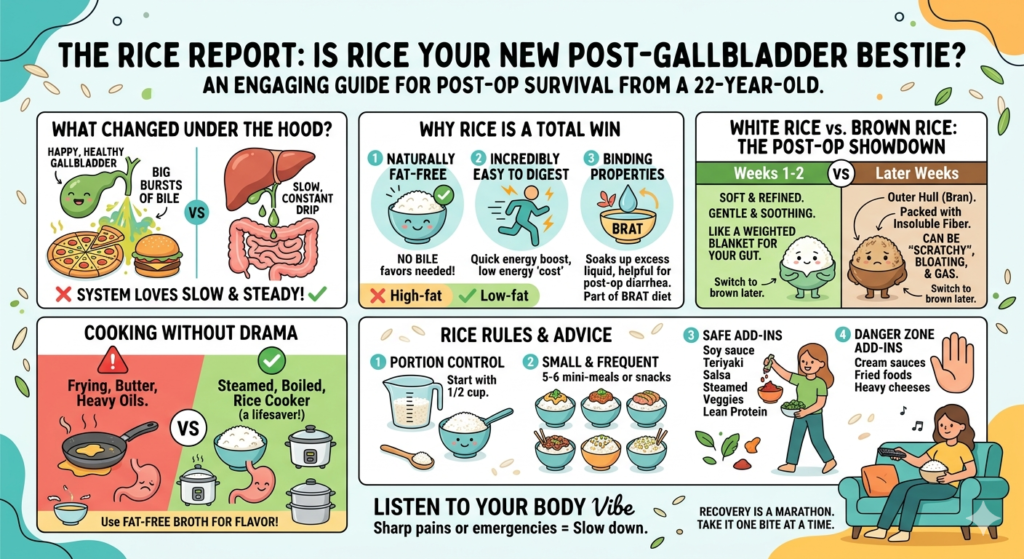
Before we get into the specifics of jasmine vs. basmati, we have to talk about what is happening under the hood. Your gallbladder was essentially a storage unit for bile. When you ate something fatty, it would release a concentrated burst to break things down.
Now that the storage unit is gone, your liver is the one in charge of the delivery. It just drips bile into your small intestine at a slow, constant rate. This means your system is great at handling “slow and steady” foods but gets totally overwhelmed by high-fat “shocks.”
Rice is the ultimate “slow and steady” food. It is naturally fat-free, which means it doesn’t ask your liver for any favors. It just slides through the system, giving you energy without demanding a massive bile response.
Why Rice is the Ultimate Recovery Food
When you are in the early stages of recovery, your digestive tract is a bit sensitive. It has been through a literal trauma. Rice is one of the most non-reactive foods on the planet.
First off, it is incredibly easy to digest. Your body doesn’t have to work hard to break down the simple carbohydrates in white rice. When you are low on energy from healing, having a food that gives you a quick fuel boost without a high energy “cost” is a massive win.
Second, rice has “binding” properties. A common side effect after gallbladder surgery is diarrhea. Because the bile is dripping constantly, it can irritate the lining of your intestines and speed things up a bit too much. Rice is part of the classic BRAT diet for a reason. It helps soak up excess liquid and can help “firm things up” if your digestion is moving at lightning speed.
White Rice vs. Brown Rice: The Post-Op Showdown
This is where things get a little spicy in the nutrition world. Usually, we are told that brown rice is the “healthy” choice because it has more fiber and nutrients. Under normal circumstances, that is totally true.
But right now, you aren’t living under normal circumstances.
In the first week or two after surgery, white rice is actually the better choice. Brown rice still has the outer hull (the bran), which is packed with insoluble fiber. While fiber is great for long-term health, it can be a bit “scratchy” and tough for a sensitive, post-op gut to handle. It can lead to bloating and gas while your system is still inflamed.
White rice has had that hull removed. It is much softer and more “refined,” which in this specific case, is exactly what you want. It is gentle. It is soothing. It is the “weighted blanket” of the food world.
Once you are a few weeks out and feeling more like yourself, you can definitely move back to brown rice or wild rice. But for the “safe zone” of early recovery, stick to the white stuff.
How to Cook It Without the Drama
The way you cook your rice is just as important as the rice itself. If you take a perfectly safe bowl of rice and fry it in oil or douse it in butter, you have just turned a “green light” food into a “red alert” food.
The goal is to keep it “naked” or very lightly seasoned.
If you are living in a small space like I am, a rice cooker is a literal lifesaver. You just dump it in, hit a button, and you have perfectly fluffy rice without any added fats. If you don’t have a rice cooker, steaming or boiling it on the stove works just as well.
Since you can’t use butter or heavy oils right now, you might be worried about it tasting like nothing. Here is a pro tip: cook your rice in fat-free chicken or vegetable broth instead of water. It infuses the grain with flavor without adding a single gram of fat. It makes the meal feel much more satisfying and less like “hospital food.”
Portion Control: The “Don’t Overdo It” Rule
Even though rice is safe, you don’t want to sit down and eat a giant mixing bowl of it. Your stomach capacity might be a little bit smaller right after surgery due to inflammation and the gas used during the procedure.
Start with a small portion: maybe half a cup. Eat it slowly. Give your body time to register the food. If you feel fine an hour later, you can have a bit more.
The key to a successful gallbladder recovery is “small and frequent.” Instead of three big meals, aim for five or six small snacks throughout the day. A small bowl of rice with a little bit of steamed carrot is a perfect “mini-meal.”
The “Add-In” Danger Zone
Rice is rarely eaten completely alone. We usually want to put something on top of it. This is where most people accidentally trip up.
Soy sauce is generally fine, but be careful with the sodium as it can cause some bloating.
Teriyaki sauce is usually low-fat and safe, but check the label for any hidden oils.
Salsa is a great way to add a ton of flavor to rice without any fat.
Steamed veggies like zucchini or squash are perfect companions.
Lean protein like a little bit of boiled chicken breast can turn it into a full meal.
Avoid the “cream” sauces, the “fried” everything, and the heavy cheeses. If it feels “slick” or “oily,” it is probably going to cause a problem.
Listening to Your Body Vibe
At the end of the day, your body is going to give you the best advice. Everyone heals differently. Some people are back to eating regular meals within a week, while others need a month of very careful, bland eating.
If you eat a bowl of rice and you feel sharp pains in your right side or you get that “emergency” feeling, it might be too soon for solid grains. Go back to liquids for a day and try again later.
There is no “race” to recovery. You are literally re-learning how to digest food. It is a process, and it is totally okay to take it one bite at a time.
Final Thoughts
So, can you eat rice after gallbladder surgery? A resounding yes.
It is the perfect, low-fat, easy-to-digest fuel that your body needs to heal. It’s affordable, it’s comforting, and it won’t send your digestive system into a tailspin.
Grab your favorite mug, fill it with some warm broth-cooked jasmine rice, and take a second to breathe. You have been through a lot with this surgery. You deserve a meal that makes you feel good.
Recovery is a marathon, not a sprint. And rice is the perfect fuel to get you across the finish line.
Happy healing, and enjoy that first real bite of comfort!
What is your favorite way to season rice when you are trying to keep things low-fat?