
So you are deep in the trenches of gut health. You have probably spent hours on Reddit or TikTok trying to figure out why your stomach feels like a literal balloon every time you eat.
And then you see it: SIBO. Small Intestinal Bacterial Overgrowth.
It sounds like something out of a sci-fi movie, but for a lot of us in our 20s, it’s a very real, very annoying reality.
When you are trying to navigate the “gut health” world, everything feels like a contradiction. One person says “eat more fiber,” while another says “fiber is the enemy.” One person tells you to live on bone broth, and another says to go vegan.
It is exhausting.
But today, we are talking about the ultimate “healthy” snack: the humble banana.
They are easy. They are cheap. They come in their own biodegradable packaging. But if you have SIBO, that yellow fruit might be the reason you are currently Googling “why do I look six months pregnant” at 2 p.m. on a Tuesday.
Let’s break down the science, the “body vibes,” and the actual truth about bananas and SIBO.
What Is SIBO Anyway?
Before we talk about fruit, we have to talk about what is happening in your “plumbing.”
Normally, most of your gut bacteria should be hanging out in your large intestine (the colon). That is their home. That is where they do their best work.
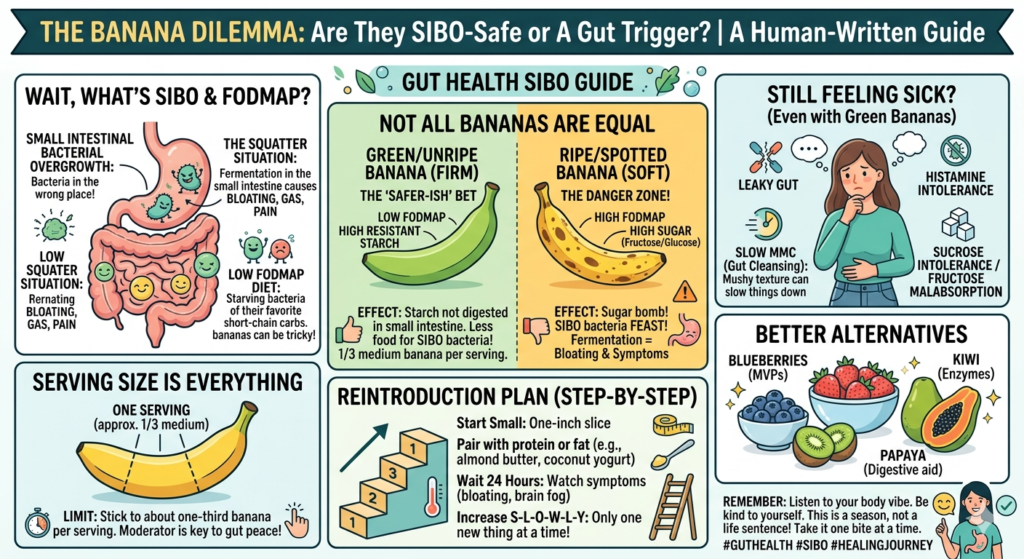
SIBO happens when those bacteria decide to move upstairs into the small intestine. The small intestine is supposed to be mostly about absorbing nutrients, not hosting a giant bacteria party.
When you eat certain things, those “squatter” bacteria in your small intestine ferment the food before you can even digest it.
That fermentation creates gas. That gas creates pressure. That pressure leads to the bloating, the pain, and the “I need to lie down right now” feeling.
The Low FODMAP Factor
If you have heard of SIBO, you have definitely heard of the Low FODMAP diet. It is basically the gold standard for managing symptoms while you work on clearing the overgrowth.
FODMAP stands for Fermentable Oligosaccharides, Disaccharides, Monosaccharides, and Polyols.
Basically, it is a list of short-chain carbohydrates that your gut bacteria absolutely love to eat.
The goal with SIBO is to “starve” those bacteria by not giving them their favorite snacks.
This is where the banana situation gets tricky.
The Banana Paradox: Not All Bananas Are Created Equal
If you look up a list of Low FODMAP foods, you will see bananas. But if you look up a list of High FODMAP foods, you might also see bananas.
It is enough to make you want to throw your blender out the window.
The truth is that the “SIBO-friendliness” of a banana depends entirely on how ripe it is.
The Green Banana (The Safe-ish Bet)
When a banana is firm and slightly green, it is high in something called “resistant starch.”
Resistant starch is interesting because your body doesn’t digest it in the small intestine. It travels all the way down to the large intestine.
For someone with SIBO, this is usually a good thing. Since the starch doesn’t break down in the small intestine, it doesn’t “feed” the bacteria that are hanging out where they shouldn’t be.
A firm, unripe banana is generally considered Low FODMAP. If you are going to have one, this is the version your gut will likely tolerate best.
The Spotted Banana (The Danger Zone)
As a banana ripes, that starch turns into sugar. Specifically, it turns into fructose and glucose.
A yellow banana with brown spots is basically a sugar bomb.
While those sugars are “natural,” they are also exactly what SIBO bacteria crave. If you eat a super ripe banana, those bacteria in your small intestine are going to have a literal feast.
Within thirty minutes, you might feel that familiar “SIBO bloat” starting to kick in.
For most people dealing with an active overgrowth, a ripe banana is a high-fructose trigger that is best avoided until things are more under control.
Serving Size Is Everything
Even if you are eating the “safer” green bananas, you can’t just eat five of them and expect to feel great.
The Low FODMAP diet is all about “stacking.”
Even a “safe” food can become a trigger if you eat too much of it at once.
Most experts recommend sticking to about one-third of a medium banana per serving if you are in the thick of SIBO recovery.
I know, I know. Who wants to eat a third of a banana? It feels weird to leave the rest of it sitting on the counter looking sad. But when it comes to SIBO, moderation is literally your only path to peace.
Why Bananas Might Still Make You Feel Sick
Let’s say you ate a tiny piece of a green banana and you still feel like garbage. Why?
SIBO is rarely just about the bacteria. It is often connected to other issues like “leaky gut,” histamine intolerance, or even just a super sensitive nervous system.
Some people with SIBO also struggle with “sucrose intolerance” or “fructose malabsorption.” If your body isn’t great at breaking down sugars in general, even a “low sugar” banana is going to cause issues.
There is also the “texture” factor. Bananas are mushy and can slow down your “migrating motor complex” (MMC).
The MMC is basically the “cleansing wave” that sweeps through your gut to keep things moving. If your MMC is slow, food sits in your small intestine longer, giving bacteria more time to ferment it.
If you feel like bananas “sit heavy” in your stomach, it might be because they are slowing down an already sluggish system.
How to Reintroduce Bananas Safely
If you are currently on a strict SIBO protocol, don’t just dive back into a banana split.
Start with the “One-Inch Rule.”
Cut a one-inch slice of a firm, slightly green banana. Eat it with a bit of protein or fat—maybe a tiny bit of almond butter (if you tolerate nuts) or a few spoonfuls of coconut yogurt.
Adding a fat or protein can help slow down the absorption of the sugars, which makes it less of a “shock” to your system.
Wait 24 hours. See how your “body vibe” is.
Are you gassy? Is your brain foggy? Did your skin break out?
If you feel fine, you can try two inches the next day.
It feels like a slow process, but it is much better than the “eat it and pray” method which usually ends in a night of Netflix and heating pads.
Better Alternatives for the SIBO Life
If bananas are just not working for you right now, don’t stress. There are other ways to get that fruity fix without the bloat.
Blueberries: These are the MVPs of the SIBO world. You can usually have a decent handful without any issues. They are low in sugar and packed with antioxidants.
Strawberries: Similar to blueberries, these are generally very safe and don’t ferment as quickly in the small intestine.
Kiwi: These are great because they actually contain enzymes that help with digestion. They are low FODMAP and can help keep things moving if you are prone to the “constipation” side of SIBO.
Papaya: This is a “digestive powerhouse.” It contains papain, an enzyme that helps break down proteins. It’s very soothing for a sensitive gut.
The Emotional Side of the SIBO Diet
I want to take a second to acknowledge how much it sucks to have to overthink a piece of fruit.
When you are 22 and all your friends are out getting late-night tacos or drinking oat milk lattes, being the person who has to “measure their banana” feels isolating.
It is easy to get obsessive about every bite of food. It is easy to develop a weird relationship with “safe” vs. “unsafe” foods.
Just remember: This is a season, not a life sentence.
The goal of the SIBO diet isn’t to live on three foods forever. The goal is to calm your system down so you can heal the root cause and eventually go back to eating whatever you want.
Be kind to yourself. If you accidentally eat a ripe banana and feel sick, don’t beat yourself up. Just drink some ginger tea, use your heating pad, and start over tomorrow.
The Final Verdict
So, are bananas “good” for SIBO?
The “human” answer: It depends.
The “SEO” answer: Yes, if they are unripe and eaten in small portions. No, if they are ripe and eaten in large quantities.
Listen to your gut—literally. If your body says “no” to bananas, listen to it. Your “body vibe” is a much better guide than any article on the internet.
Take it one bite at a time. You’ve got this.
Which gut-friendly snack should we talk about next?