
So, you are sitting there in a super quiet room. Maybe you are in a lecture, or maybe you are finally on a first date with that person you have been crushing on for weeks. You take a sip of water or swallow your coffee, and then it happens.
Glug. Gurgle. Pop.
Your throat literally sounds like a sink drain that is struggling for its life. It is loud, it is awkward, and it feels like everyone in a five mile radius just heard your esophagus have a mid-life crisis.
If this sounds like your life lately, trust me, you are not alone. I have been there, and honestly, it is one of those things that sounds so small but feels so weirdly embarrassing. You start wondering if you have a frog living in your neck or if your body is just broken.
The good news? Most of the time, that gurgling sound in your throat after swallowing is just your body doing something slightly glitchy that we can totally fix. Let’s dive into why this happens, what is actually going on in there, and how you can get your throat to finally be quiet.
What Is That Sound Anyway?
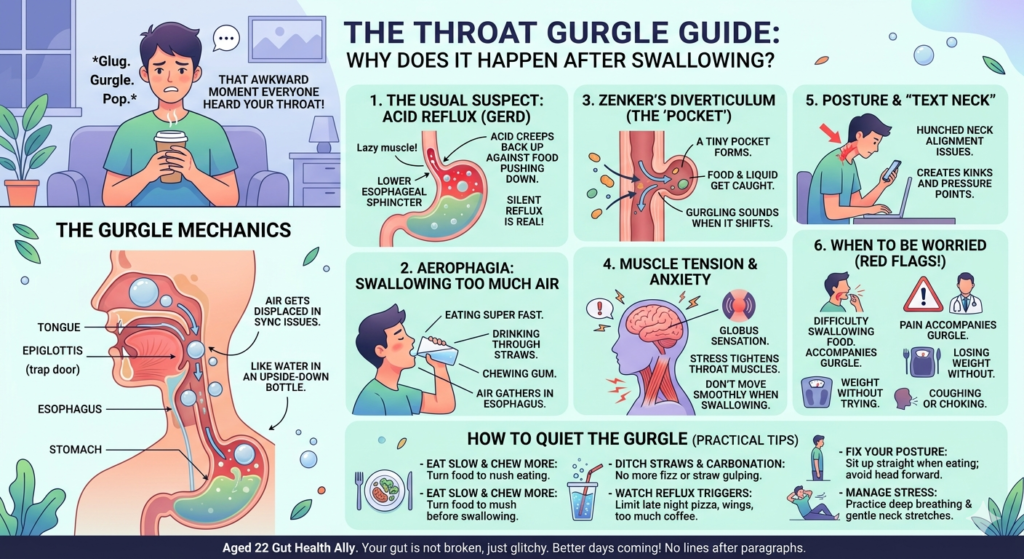
To understand the gurgle, we have to look at the mechanics of swallowing. Swallowing seems like a simple, one step process, but it is actually a super complex “choreography” involving dozens of muscles and nerves.
When you swallow, your tongue pushes the food or liquid to the back of your throat. Your “trap door” (the epiglottis) shuts so food doesn’t go down your windpipe, and your esophagus opens up to let the food pass into your stomach.
The gurgling sound usually happens because of air. If there is air trapped in the esophagus or if the muscles aren’t opening and closing in perfect sync, that air gets displaced. Think of it like a bottle of water. When you flip it upside down, it gurgles because the air and water are fighting for space. Your throat is doing the exact same thing.
The Usual Suspect: Acid Reflux and GERD
If you are dealing with frequent gurgling, the most common culprit is acid reflux or its more annoying cousin, GERD (Gastroesophageal Reflux Disease).
Basically, there is a little ring of muscle at the bottom of your esophagus called the Lower Esophageal Sphincter (LES). Its only job is to stay closed and keep stomach acid down where it belongs. But sometimes, the LES gets a little lazy.
When it doesn’t close all the way, gas and acid can creep back up into your throat. When you swallow, you are pushing things down against that rising gas, and the result is a bubbly, gurgling symphony.
A lot of people think reflux always means “heartburn,” but “silent reflux” is a real thing. You might not feel any burning at all, but you might have a constant need to clear your throat, a weird taste in your mouth, or yes, that annoying gurgle.
Zenker’s Diverticulum (The “Pocket” Situation)
Okay, this one sounds like a character from a fantasy novel, but it is actually a physical thing that can happen in your throat.
Zenker’s Diverticulum is basically a tiny little “pouch” or pocket that forms in the wall of your esophagus. It usually happens right at the top of the throat where the muscles are a bit weaker.
When you eat or drink, a little bit of that food or liquid can get caught in this pocket. Later on, when you swallow again or even just move your neck, the contents of that pocket shift around. This creates a very distinct gurgling or clicking sound.
If you also feel like food is getting stuck in your throat or if you find yourself coughing up undigested food hours after you ate, this is definitely something you want to ask a doctor about. It is more common in older people, but hey, biology doesn’t always follow the rules.
Aerophagia: The Art of Swallowing Air
This sounds fancy, but it literally just means you are swallowing too much air.
Most of us do this without even realizing it. If you eat super fast because you are rushing to class, or if you are a big fan of drinking through straws, you are probably gulping down air with every bite and sip.
That air has to go somewhere. If it doesn’t come back up as a burp immediately, it gets trapped in the esophagus. When you take your next swallow, you are forcing that air to move, which creates that “drainpipe” sound.
Other things that cause you to swallow air? Chewing gum constantly, smoking, or even just being a “mouth breather” because your allergies have your nose totally blocked up.
Muscle Tension and Anxiety
Never underestimate how much your brain can mess with your body. Have you ever felt like you had a “lump” in your throat when you were stressed? That is a real thing called Globus Sensation.
When we are anxious or stressed, the muscles in our neck and throat tend to tighten up. If those muscles are tight, they don’t move as smoothly as they should when you swallow.
This tension can cause air to get trapped more easily, or it can cause the esophagus to vibrate differently, leading to those weird noises. If you find the gurgling gets worse when you are stressed out about finals or work, your nervous system might be the one calling the shots.
Posture and “Text Neck”
I know I sound like a mom right now, but your posture really does matter. Most of us spend hours a day hunched over our phones or laptops. This “forward head posture” actually compresses the structures in your neck.
When your neck is out of alignment, the path from your mouth to your stomach isn’t a straight, easy shot. It creates kinks and pressure points that can make the swallowing process less efficient.
If you are always looking down, you might be creating the perfect environment for air to get trapped and for your throat to make those gurgling protests.
When Should You Actually Be Worried?
I am all for self-care and “googling it,” but sometimes you need to see a professional. If the gurgling is just an annoying sound, it is usually fine. But you should definitely book an appointment with an ENT (Ear, Nose, and Throat doctor) if you notice any of these:
- You are having a hard time actually getting food down.
- The gurgling is accompanied by pain.
- You are losing weight without trying.
- You find yourself choking or coughing every time you drink.
- You feel a physical lump in your neck.
Doctors have cool tools like an “Endoscopy” (where they look down your throat with a tiny camera) or a “Barium Swallow” (where you drink a chalky liquid that shows up on an X-ray) to see exactly what is happening in real time.
How to Quiet the Gurgle (Practical Tips)
If you want to stop the sound right now, here are some human-tested tips that actually help.
Eat Slower and Chew More: I know, I know. But seriously, if you turn your food into mush before you swallow, you are less likely to gulp down air. Try to put your fork down between bites.
Ditch the Straws and Carbonation: If your throat is a gurgly mess, stop adding more air to the fire. Sparkling water and straws are just air delivery systems. Stick to flat water for a week and see if it helps.
Watch the “Reflux Triggers”: Late night pizza, spicy wings, and too much coffee are the holy trinity of reflux. Try to avoid eating at least three hours before you go to bed so that your stomach is empty when you lie down.
Fix Your Posture: When you eat, sit up straight. Keep your chin tucked slightly rather than reaching your neck forward. It sounds simple, but giving your esophagus a clear path makes a huge difference.
Manage the Stress: If your throat is tight because you are stressed, try some gentle neck stretches or diaphragmatic breathing. Relaxing the muscles in your neck can often quiet the “frog” in your throat.
The Bottom Line
A gurgling sound in your throat after swallowing is usually just your body’s way of saying it is dealing with a bit of extra air or some minor reflux. It is rarely something dangerous, but it is almost always annoying.
Listen to what your body is telling you. If you need to slow down, eat better, or just chill out a bit more, your throat might be the first place to let you know.
Don’t let the “glug” get you down. Most of the time, a few small habit changes are all it takes to get back to a silent, normal swallow. You’ve got this!