Being 22 is supposed to be about late night taco runs, spontaneous road trips, and basically having a stomach made of literal steel.
But for those of us dealing with SIBO, or Small Intestinal Bacterial Overgrowth, life looks a little different. Instead of wondering which party to go to, we are usually wondering if that one handful of chips is going to make us look six months pregnant by 9 p.m.
It is exhausting. It is annoying. And honestly, it is lowkey isolating when your friends are passing around a giant bucket of popcorn at the theater and you are sitting there clutching your water bottle like it is a lifesaver.
Popcorn is one of those foods that feels like it should be safe. It is light. It is airy. It is technically a whole grain. Plus, if you look at almost any Low FODMAP list, popcorn is usually sitting there in the “green” section.
But if you have SIBO, you know that “Low FODMAP” and “SIBO Friendly” are not always the same thing. Sometimes, the things that are supposed to be safe turn out to be the absolute worst for our specific gut chaos.
So, let us get into the grainy details. Is popcorn actually bad for SIBO, or are we just overthinking our snacks?
The Science of the “Wrong Zip Code”
Before we talk about the kernels, we have to talk about what is actually happening in your gut.
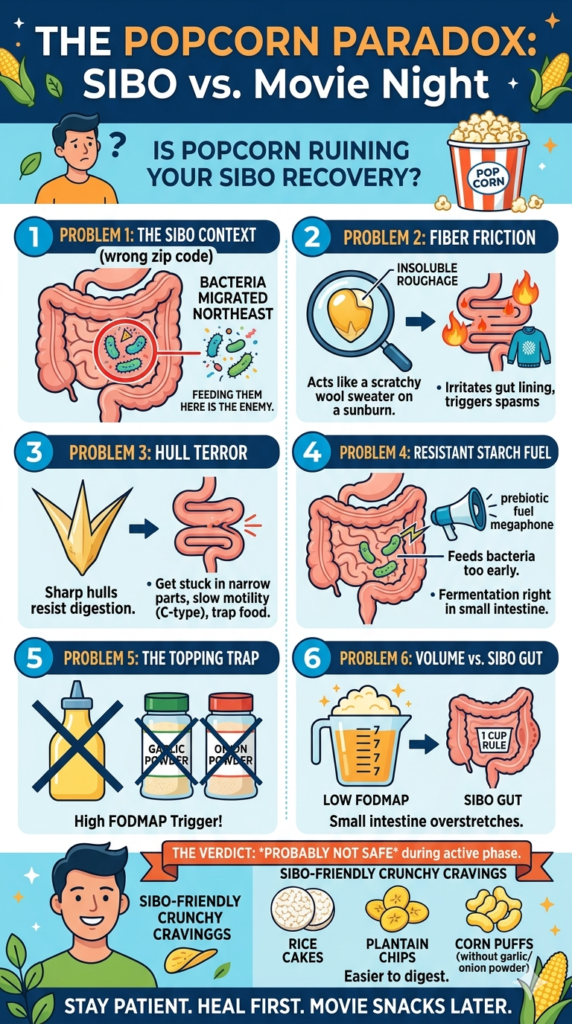
SIBO is basically a case of bacteria living in the wrong zip code. You are supposed to have trillions of bacteria in your large intestine, but in the small intestine, things are supposed to be relatively quiet.
When those bacteria migrate north into the small intestine, they start acting like uninvited houseguests who won’t stop eating your food and then throwing trash everywhere.
The “trash” in this metaphor is gas. When you eat something they like, they ferment it right there in your small intestine. Because the small intestine is narrow and sensitive, that gas causes intense bloating, pain, and either a “fast” or “slow” trip to the bathroom.
This is why the type of fiber you eat matters so much. And popcorn is basically 100 percent fiber and starch.
The Fiber Problem: Insoluble vs. Soluble
Popcorn is famous for being high in fiber. Usually, that is a gold star for health. But in the world of SIBO, fiber is a double-edged sword.
There are two main types of fiber. Soluble fiber dissolves in water and turns into a gel. Insoluble fiber is the “roughage” that stays intact and sweeps through your system.
Popcorn is loaded with insoluble fiber. This is the stuff that gives the kernel its structure.
The problem is that insoluble fiber can be really irritating to a gut that is already inflamed from SIBO. Think of your small intestine like a bad sunburn. Insoluble fiber is like a scratchy wool sweater rubbing against that sunburn. It is not going to feel good.
Even though bacteria do not ferment insoluble fiber as easily as soluble fiber, the mechanical irritation can trigger spasms and discomfort that make your SIBO symptoms feel ten times worse.
Those Annoying Hulls
We have all been there. You are halfway through a bag of popcorn and a tiny, sharp piece of the kernel gets stuck in your teeth or the back of your throat.
Those are the hulls. They are the toughest part of the corn, and they are basically indestructible.
If they are tough enough to survive your teeth and your stomach acid, imagine what they are doing in your small intestine. For someone with a healthy gut, those hulls just pass right through.
But for a SIBO patient, those hulls can slow down motility. If you have “C-type” SIBO (constipation), anything that slows things down is the enemy. When food sits in your small intestine for too long, it gives those bacteria even more time to have a feast and create more gas.
The Resistant Starch Factor
Here is something a lot of people miss. Popcorn contains something called resistant starch.
Resistant starch is called “resistant” because it resists digestion in the small intestine and makes it all the way to the colon to feed your good bacteria.
In a healthy person, this is amazing. It is a prebiotic. It helps you stay healthy.
But remember our “wrong zip code” problem? If you have a massive overgrowth of bacteria in your small intestine, they might get to that resistant starch before it ever reaches the finish line.
If those bacteria ferment that starch in the small intestine, you are going to experience that classic SIBO bloat. It is like giving a megaphone to an already loud crowd.
The Topping Trap
Let us be real for a second. Very few people eat plain, air-popped popcorn. It tastes like cardboard.
We want the butter. We want the salt. We want the seasonings.
This is where popcorn goes from “maybe okay” to “definitely a disaster.”
A lot of pre-packaged popcorn or theater popcorn uses “garlic salt” or “onion powder” for flavor. Garlic and onion are high in fructans, which are like rocket fuel for SIBO bacteria. Even a tiny bit of garlic powder can ruin your entire week.
Then there is the fat. High amounts of butter or poor-quality oils can slow down your digestion. When your digestion slows down, the bacteria have a party.
If you are going to try popcorn, you have to be a stickler for the ingredients. Plain sea salt and maybe a tiny bit of olive oil or coconut oil are your only safe bets.
Portions and the “Low FODMAP” Illusion
The Monash University app, which is basically the Bible for gut health, says that a serving of seven cups of popcorn is low FODMAP.
Seven cups! That sounds like a lot, right? You feel like you can finally eat a normal snack.
But here is the catch. SIBO is not just about the type of sugar; it is about the volume of food in the small intestine.
Eating seven cups of anything puts a huge mechanical load on your small intestine. Even if it is low in fermentable sugars, the sheer volume can cause distension and pain.
If you have SIBO, you are better off sticking to a “one cup” rule. And let’s be honest, who can stop at just one cup of popcorn? It is a snack designed to be eaten by the handful until the bag is empty.
How to Test if Popcorn is Your Enemy
If you are really craving it, you don’t have to banish it forever without a trial. But you have to be smart about the test.
Wait until you are in a “baseline” phase. Do not test popcorn when you are already mid-flare.
Try a half-cup of plain, air-popped popcorn. No butter, no fancy spices. Just a little salt.
Notice how you feel over the next twenty-four hours. Do you feel that specific “tight” bloating in your upper belly? Do you have more brain fog than usual? Does your transit time slow down?
If you pass the half-cup test, you can try a little more next time. But if your stomach starts making weird gurgling noises and you feel like a balloon, you have your answer.
Better Alternatives for the Salty Craving
If popcorn ends up being a “no” for you, do not worry. You aren’t doomed to snack on ice cubes for the rest of your life.
There are other snacks that give you that same salty, crunchy vibe without the hull-induced trauma.
Rice cakes or puffed rice snacks are usually much easier on the SIBO gut. They don’t have those sharp hulls and the rice starch is generally more “absorbable” before the bacteria can get to it.
Plantain chips (the ones made with just salt and oil) are another great option. They are crunchy, satisfying, and usually stay pretty quiet in the digestive tract.
If you really want the corn flavor, sometimes “corn puffs” are safer than popcorn because the corn has been processed into a smooth flour first, removing the irritating hulls and fiber. Just check for those hidden garlic and onion powders!
The Emotional Side of the SIBO Diet
I know how much it sucks to have to think this hard about a snack.
At 22, we should be thinking about our careers or our social lives, not the structural integrity of a corn kernel. It feels unfair.
But the goal of the SIBO diet isn’t to be restrictive forever. It is to calm the inflammation and starve out the “uninvited guests” so that your gut can heal.
Every time you choose a snack that makes you feel good instead of a snack that makes you feel sick, you are one step closer to getting your life back.
Think of it as a temporary sacrifice for a long-term win. Eventually, once your SIBO is treated and your motility is back on track, you might be able to go back to that movie theater bucket.
The Final Verdict
So, is popcorn bad for SIBO?
For most people in the active phase of SIBO, the answer is “probably yes.”
The combination of insoluble fiber, indestructible hulls, and resistant starch makes it a triple threat for a sensitive small intestine. It is not necessarily “toxic,” but it is definitely “high maintenance.”
If you are feeling brave, keep the portions tiny and the toppings simple. But if you want to play it safe and avoid the bloat, stick to the easier-to-digest alternatives for now.
Your gut will thank you, and you will actually be able to focus on the movie instead of wondering where the nearest bathroom is.
Stay patient with your body. You are doing great, and this SIBO journey is just a chapter, not the whole book. Happy snacking!