
Picture this. You are sitting in a dead quiet room. Maybe you are in a lecture, or a super serious meeting, or even just hanging out with someone you really want to impress.
Suddenly, your throat decides to let out this weird, wet, gurgling sound.
It is not a burp. It is not a cough. It sounds like a tiny, caffeinated frog is living in your esophagus and has decided to start a podcast.
Honestly, it is one of the most awkward things your body can do.
You look around hoping no one heard it, but in your head, it sounded like a literal thunderstorm.
If this happens to you all the time, you have probably spent a late night or two on Google trying to figure out if you are turning into a swamp creature.
The good news? You are not alone. Throat gurgling is actually a super common thing, and while it feels weirdly specific to you, there are usually some pretty logical (and totally human) reasons why it is happening.
Let’s get into the “why” behind the noise and see what your body is trying to tell you.
What Is That Sound, Anyway?
Before we dive into the causes, we have to look at what is actually making the noise.
Think of your throat like a very busy hallway. It’s got air going down to your lungs, food and water going down to your stomach, and sometimes stuff (like gas or acid) trying to make its way back up.
Most of the time, this hallway is a one-way street with very strict traffic rules.
But sometimes, things get a little chaotic.
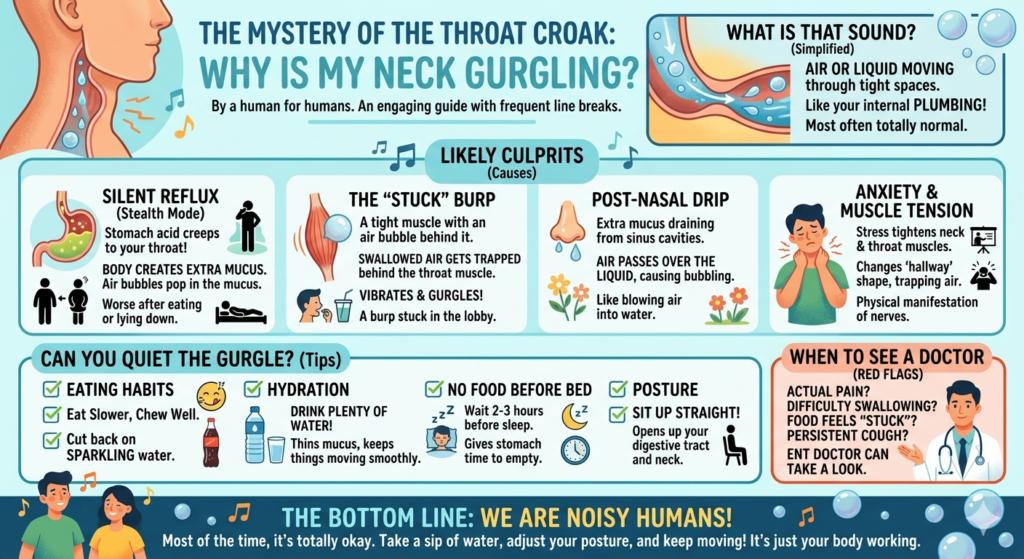
The gurgling you hear is usually just air or liquid moving through a tight space.
It is basically the same concept as when your pipes gurgle after you flush the toilet or run the sink.
It’s physics, just happening inside your neck.
The Most Likely Culprit: Silent Reflux
You have probably heard of acid reflux or GERD. That is the classic “heartburn” feeling where your chest feels like it’s on fire after you eat a giant slice of pizza.
But there is a “stealth” version of this called LPR, or Laryngopharyngeal Reflux.
Most people just call it “Silent Reflux.”
With Silent Reflux, you might not feel any burning at all.
Instead, the stomach acid or gas travels all the way up to your throat and hangs out near your voice box.
When that acid hits the sensitive tissue in your throat, your body tries to protect itself by producing extra mucus.
So now you have a combination of gas bubbles and thick mucus sitting right where you breathe and swallow.
When you move your neck or swallow, those bubbles pop or shift through the mucus.
The result? That classic gurgling or clicking sound.
If you notice the noise is worse after you eat or when you lie down at night, Silent Reflux is a very strong candidate for the “why.”
Air and the “Stuck” Burp
Sometimes the explanation is even simpler: you just have some air trapped in the wrong place.
We swallow air all the time.
If you drink through a straw, eat really fast because you’re running late, or talk while you’re chewing, you are basically pumping air into your system.
Normally, that air either goes down to your stomach and stays there until you burp, or it keeps moving through your digestive tract.
But occasionally, a little pocket of air gets stuck right behind the “trapdoor” of your throat (the upper esophageal sphincter).
Because that muscle is tight, the air can’t quite get out, but it also isn’t going down.
As it vibrates against the walls of your throat or mixes with your saliva, it creates a gurgling or “croaking” sound.
It’s basically a burp that is stuck in the lobby and can’t find the exit.
Post-Nasal Drip: The Seasonal Gurgle
If you have allergies or you’re getting over a cold, your throat gurgling might just be a side effect of “the drip.”
Post-nasal drip is when your sinuses produce extra mucus that drains down the back of your throat.
In a perfect world, this would happen silently and you wouldn’t even notice.
But when that mucus is thick, it can pool in the crevices of your throat.
When you breathe or talk, air passes over that liquid, creating a bubbling or gurgling noise.
Think of it like blowing air through a straw into a glass of water.
If there is enough “liquid” back there, you’re going to hear those bubbles.
If you feel like you’re constantly clearing your throat or if you have a “lump” feeling, the gurgling is likely just air moving through that extra drainage.
The Role of Anxiety and Muscle Tension
This is one that people usually don’t think about, but your mental state can actually change the way your throat sounds.
When you are stressed or anxious, your body goes into a “fight or flight” mode.
One of the first places many of us hold tension is in our neck and throat muscles.
There is even a medical term for it called “Globus Pharyngeus,” which is that feeling of having a lump in your throat when nothing is actually there.
When those muscles are super tight, the shape of your “hallway” changes.
Saliva and air might not move as smoothly as they usually do.
The tension can create little pockets where air gets trapped, leading to those weird noises.
If you notice the gurgling mostly happens when you are stressed out or during a big presentation, it might be a physical manifestation of your nerves.
Can You Fix the Gurgle?
If the sound is driving you crazy (or making you feel self-conscious), there are a few things you can try to quiet the “throat frog.”
Watch your eating habits: Try to eat slower and chew your food thoroughly. If you are a fan of sparkling water or soda, try cutting back for a few days. Those bubbles have to go somewhere, and often, they choose to hang out in your throat.
Hydrate like it’s your job: If your saliva is thick and “sticky” because you’re dehydrated, it is much more likely to create those gurgling bubbles. Drinking plenty of water keeps everything thin and moving smoothly.
The “No Food Before Bed” Rule: If Silent Reflux is the issue, try not to eat anything for at least two or three hours before you go to sleep. This gives your stomach time to empty so that acid doesn’t have a chance to creep up your throat while you’re lying flat.
Check your posture: If you’re constantly hunched over a laptop (like most of us are), you’re putting extra pressure on your digestive system and your neck muscles. Sitting up straight can actually open up that “hallway” and help gas move where it’s supposed to go.
When Is It Time to See a Doctor?
Most of the time, a gurgling throat is just a weird quirk of being a human.
But, there are a few “red flags” that mean you should probably get it checked out by a professional.
If the gurgling is accompanied by actual pain, difficulty swallowing, or a persistent cough that won’t go away, it is worth a visit to an ENT (Ear, Nose, and Throat) doctor.
They can take a quick look down there with a tiny camera to make sure everything looks healthy.
Also, if you feel like food is actually getting “stuck” on the way down, that is something you definitely shouldn’t ignore.
But for the vast majority of us? It’s just air, mucus, or a little bit of reflux doing its thing.
Final Thoughts
At the end of the day, our bodies are noisy.
Between stomach growls, joint cracks, and throat gurgles, we are basically walking orchestras of weird sounds.
If your throat is making noises, try not to stress too much about it.
Usually, a little more water, a little less coffee, and a bit of a slower pace at lunch are all you need to quiet things down.
It’s just one of those “human things” that reminds us our internal systems are constantly working, even when we are just trying to sit quietly and mind our own business.
Next time your throat decided to “talk,” just take a sip of water, adjust your posture, and keep moving.
You’re not a swamp creature; you’re just a person with a very active esophagus.
And honestly? That is totally okay.