Let’s be real for a second. Being in your early twenties is supposed to be the prime of your life. You are supposed to have a stomach made of steel that can handle 2 AM pizza runs and questionable street tacos without blinking.
But for a lot of us, the reality is a little more… spicy. And not the good kind of spicy. I am talking about that slow, burning sensation that climbs up your throat the second you finish anything delicious.
If you have ever stared at a beautiful charcuterie board and felt a genuine sense of fear, you know exactly what I am talking about.
The biggest heartbreak of all? Cheese.
Cheese is basically the main character of every good meal. It’s on the pizza, it’s in the pasta, it’s the best part of a sandwich. But when you have acid reflux or GERD, cheese starts to look like a tiny, delicious villain.
So, can you actually eat cheese when your stomach is acting like it’s eighty years old? Or are we doomed to a life of dry crackers and sadness?
I did the digging, talked to the experts, and tested the waters with my own sensitive stomach to give you the ultimate guide to navigating the cheese aisle without the burn.
The Science of Why Cheese Betrays Us
Before we get to the “safe” list, we have to talk about why cheese is such a problem in the first place.
It mostly comes down to your LES. That stands for Lower Esophageal Sphincter, but let’s just call it the “Stomach Bouncer.”
The Bouncer’s only job is to let food into your stomach and then slam the door shut so acid can’t get out.
Fat is the ultimate sedative for your Stomach Bouncer. When you eat high-fat foods, your body releases hormones that tell the Bouncer it is time to take a nap.
When the Bouncer falls asleep on the job, the door stays cracked open. Since cheese is naturally high in fat, it is one of the biggest reasons that “door” stays open, allowing acid to splash back up into your esophagus.
To make matters worse, fat takes a long time to digest. This means the cheese sits in your stomach for hours, keeping the pressure high and giving the acid plenty of chances to escape.
It is basically a perfect storm for heartburn.
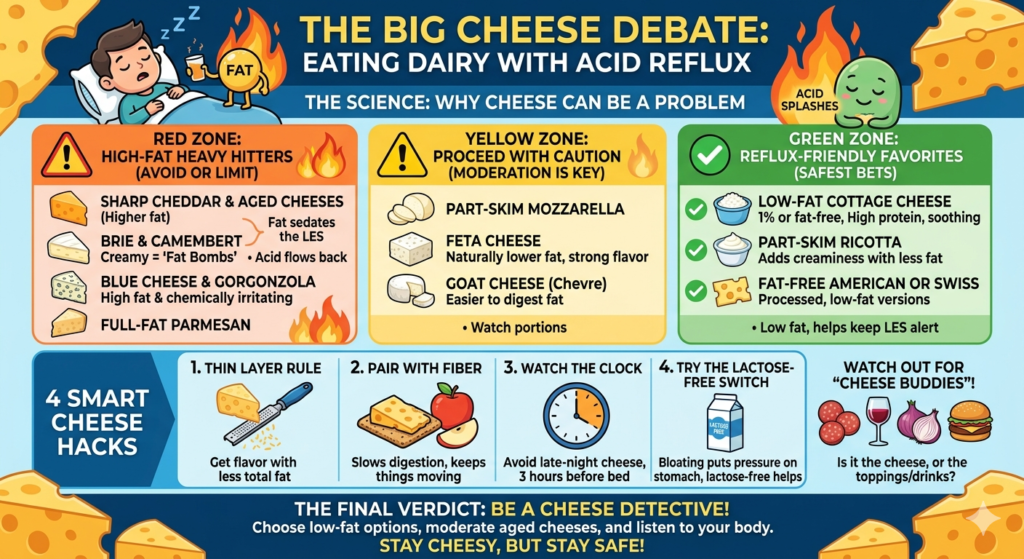
The Red Zone: Cheeses That Are “Not the Move”
If you are currently experiencing a flare-up or you know your reflux is sensitive, these are the ones you probably want to avoid.
These are the high-fat heavy hitters that are almost guaranteed to make your chest feel like it is hosting a bonfire.
1. Sharp Cheddar and Aged Cheeses
The older and sharper the cheese, the higher the fat content usually is. I know, a sharp white cheddar is elite, but it is also a massive trigger for most people with GERD.
2. Brie and Camembert
Anything “creamy” and “spreadable” in the fancy cheese section is usually packed with butterfat. These are basically fat bombs. They taste like heaven but feel like lava twenty minutes later.
3. Blue Cheese and Gorgonzola
These are double trouble. Not only are they high in fat, but they are also very strong and can be chemically irritating to your stomach lining.
4. Full-Fat Parmesan
While a little sprinkle might be okay, a pasta dish that is basically held together by melted parmesan is going to be a nightmare for your LES.
The Yellow Zone: Proceed with Caution
These are the cheeses that might be okay in small amounts, or if you are having a “good stomach day.”
The key here is portion control. You can’t eat a whole block, but a little bit might not ruin your night.
1. Part-Skim Mozzarella
This is a decent middle ground. Since it is “part-skim,” a lot of the heavy fat has been removed. It still melts well, making it a better choice for a homemade pizza or a sandwich.
2. Feta Cheese
Feta is naturally a bit lower in fat than aged cheeses, and because it has a very strong, salty flavor, you usually don’t need to eat a lot of it to get the vibe.
3. Goat Cheese (Chevre)
Many people find goat cheese easier to digest than cow’s milk cheese. It is still creamy, but the fat molecules are smaller, and it is often a bit lighter on the system.
The Green Zone: Reflux-Friendly Favorites
If you are craving cheese but don’t want to suffer, these are your best bets.
These options are lower in fat and higher in protein, which can actually help keep your Stomach Bouncer stay awake and alert.
1. Low-Fat Cottage Cheese
This is the absolute king of reflux-friendly dairy. If you get the 1% or fat-free version, you are getting a massive protein boost without the fat. It’s cooling, soothing, and very safe for most people.
2. Part-Skim Ricotta
Ricotta is naturally pretty light. If you go for the part-skim version, it’s a great way to add creaminess to a dish without the heavy oiliness of other cheeses.
3. Fat-Free American or Swiss
I know, it’s not as “fancy,” but sometimes the processed, low-fat versions are the safest way to get that cheese flavor on a burger or sandwich without the consequences.
4 Hacks to Eat Cheese Without the Consequences
You don’t always have to choose the “healthy” cheese if you follow a few simple rules of engagement.
If you are going to indulge in a little cheddar or mozzarella, here is how to do it smartly.
1. The “Thin Layer” Rule
Instead of thick slices of cheese, try using a microplane or a fine grater. You get the flavor across every bite, but you are actually consuming way less total fat.
2. Pair it with Fiber
Don’t eat cheese on its own. Pair it with high-fiber foods like whole-grain crackers, apples, or cucumbers. Fiber helps slow down the absorption and keeps things moving through your digestive tract so the cheese doesn’t just sit there.
3. Watch the Clock
The 22-year-old in me hates this, but you cannot eat cheese late at night. If you lay down while that high-fat cheese is still digesting, gravity is going to work against you. Try to make your cheese-heavy meals a lunch thing, or at least three hours before bed.
4. The Lactose-Free Switch
Sometimes, what we think is acid reflux is actually a mild lactose intolerance causing gas and bloating. That bloating puts pressure on your stomach and pushes acid up. Switching to a lactose-free cheese might suddenly solve your “reflux” issues.
When It’s Not Just the Cheese
We have to be honest with ourselves. Sometimes we blame the cheese when it was actually the “buddies” the cheese brought along to the party.
Are you eating cheese on a spicy pepperoni pizza?
Are you having it with a giant glass of red wine?
Is it melted onto a greasy beef patty with onions?
In these cases, the cheese is just one part of a trigger-heavy meal. If you want to see if you can handle cheese, try testing it in a “vacuum.” Have a little bit of low-fat cheese with some plain crackers and see how you feel.
If you feel fine, the cheese isn’t the problem—the spicy toppings and the alcohol are.
The Emotional Side of the “No Cheese” Life
It sounds silly to anyone who hasn’t been through it, but having to restrict your diet at a young age is isolating.
It’s hard to be the person at the party asking what kind of cheese is in the dip. It’s annoying to have to turn down a grilled cheese at a late-night diner.
But here is the thing: the more you learn about your triggers, the more control you have. You start to realize that you don’t have to say “no” to everything, you just have to say “yes” to the right things.
Choosing cottage cheese over brie isn’t a “diet” choice; it’s a choice to not be in pain for the next five hours. That is a form of self-care that is actually worth it.
The Final Verdict
So, can you eat cheese with acid reflux?
Yes, but you have to be a bit of a cheese detective. Stick to the low-fat, high-protein options like cottage cheese and ricotta when you are feeling sensitive. Save the sharper, aged cheeses for small, infrequent treats when your stomach is feeling strong.
Listen to your body. If it tells you that the extra-cheesy nachos are a bad idea, believe it the first time. Your esophagus will thank you, and you won’t have to spend your night propped up on three pillows regretting your life choices.
Stay cheesy, but stay safe.