Let’s talk about the absolute betrayal that is a delicious piece of buttery toast.
One minute you’re enjoying the golden, melted goodness of a fresh bagel or a stack of pancakes, and the next minute, your chest feels like it’s hosting a tiny, angry bonfire.
If you’ve ever wondered why that delicious pat of butter seems to turn into liquid lava the second it hits your stomach, you are definitely not alone.
It’s one of those things no one warns you about when you start “adulting.” You think you can just eat whatever you want like you did at eighteen, and suddenly your body starts filing formal complaints.
Today we are diving deep into the relationship between butter and acid reflux. We’re going to figure out if butter is actually the villain in your story or just an innocent bystander in a much bigger digestive drama.
The Short Answer (The “Ouch” Factor)
If you’re looking for a quick “yes” or “no,” the answer is a solid: Yes, butter can absolutely cause heartburn.
But it’s not because butter is “evil” or toxic. It’s mostly because of how your body handles fat. Butter is basically pure fat, and fat is like the ultimate test for your digestive system.
When you eat high-fat foods, your body has to work overtime to break them down. Sometimes, that extra work comes with some pretty spicy side effects in your esophagus.
The Science of the “Sleepy Bouncer”
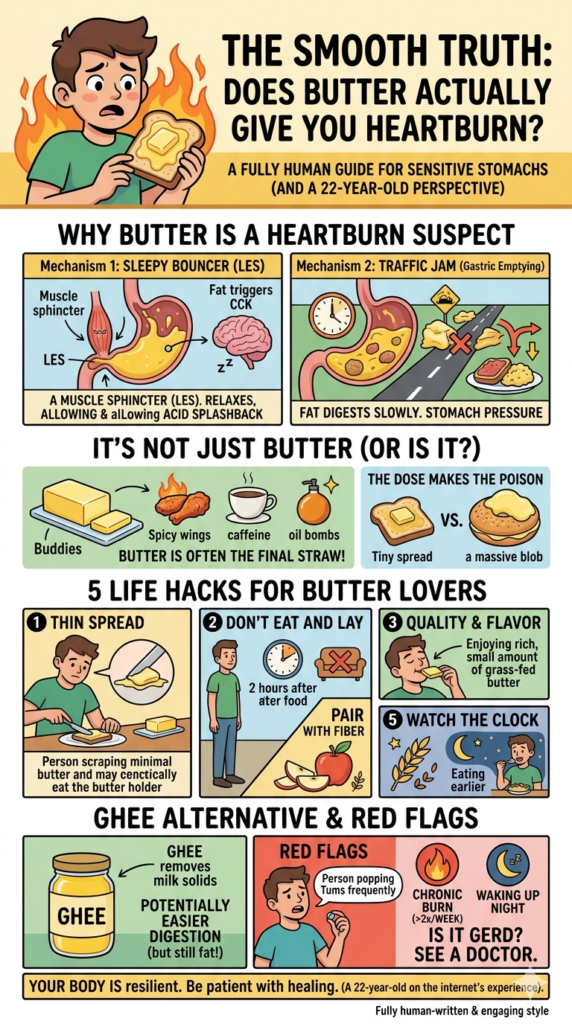
To understand why butter causes that burning sensation, we have to talk about the LES.
The LES, or Lower Esophageal Sphincter, is basically the bouncer at the door of your stomach. Its only job is to open up to let food in and then shut tight so that stomach acid doesn’t splash back up into your throat.
When you eat something super high in fat, like a big serving of butter, your body releases a hormone called cholecystokinin (try saying that five times fast).
This hormone tells your “bouncer” to relax. It basically tells the LES to take a nap.
When that door stays cracked open, even just a little bit, the acid in your stomach sees its chance to escape. It creeps up into your esophagus, and that is exactly where that “heartburn” feeling comes from.
Your esophagus isn’t built to handle acid, so it burns. Literal betrayal from your own anatomy.
The “Traffic Jam” in Your Gut
There is another reason butter is a prime suspect for heartburn: Gastric Emptying.
Fat takes way longer to digest than carbs or protein. When you eat a meal that is heavy on the butter, it sits in your stomach for a much longer time.
Think of it like a traffic jam on the highway. If the food is just sitting there because your body is struggling to process all that fat, the pressure inside your stomach starts to build up.
That pressure pushes against the (already sleepy) LES bouncer. Eventually, something has to give, and usually, it’s the acid splashing upward.
The longer food sits in your stomach, the more acid your body produces to try and melt it down. It’s a vicious cycle of “too much fat” leading to “too much acid” leading to “my chest is on fire.”
Is It the Butter or the Buddy?
Here is the thing though: We rarely eat butter by itself.
Most people aren’t out here biting into a stick of Kerrygold like it’s a Snickers bar. Usually, butter is hanging out with other stuff.
Are you having butter on a spicy bagel? Are you having it with a giant cup of acidic coffee? Are you putting it on top of a heavy, greasy steak?
Sometimes the butter is just the “final straw.” If you already have a sensitive stomach, adding a high-fat trigger like butter to other triggers (like caffeine, spicy food, or chocolate) is basically a recipe for disaster.
You have to look at the whole “food squad” you’re putting into your system. If the whole meal is a fat-bomb, you can’t really blame the butter alone.
Quantity Over Everything
At 22, I’ve realized that “moderation” is a word people use to ruin your life, but unfortunately, it’s actually true when it comes to heartburn.
A tiny bit of butter on a piece of whole-grain toast might not trigger anything. Your body can handle a little bit of fat without the bouncer falling asleep at the post.
But when you’re at a restaurant and they’ve basically used half a tub of butter to sauté your veggies, that’s when the trouble starts.
The dose makes the poison. If you’re struggling with reflux, you might not have to quit butter forever. You might just need to stop treating it like a main course.
Butter vs. Margarine vs. Oil
You might think switching to a “fake” butter or a vegetable oil will save you.
The truth is that your stomach doesn’t really care if the fat is “natural” or “processed” when it comes to acid reflux. Fat is fat.
Whether it’s butter, margarine, or even healthy olive oil, if you eat too much of it at once, it’s going to relax that LES and slow down your digestion.
However, some people find that highly processed oils (like the ones in cheap margarine) irritate their stomach lining even more than real butter. Real butter is a “simple” food, which some people’s bodies actually prefer over the chemical-heavy alternatives.
But if heartburn is the main issue, the total fat grams are what really matter.
How to Keep Butter in Your Life (Without the Burn)
If you aren’t ready to live a butter-free life (and honestly, who is?), here are some lowkey ways to keep the flavor without the fire.
1. The “Thin Spread” Method
Instead of a giant dollop, try to use just enough to get the taste. Using a butter knife to scrape a thin layer across your toast rather than letting it soak in can make a huge difference.
2. Don’t Eat and Lay
This is the golden rule of heartburn. If you eat something buttery, do not go lay on the couch to watch Netflix immediately after. Gravity is your friend. You want that food to stay down. Stand up, walk around, or at least sit upright for two hours after eating.
3. Quality Over Quantity
Go for the high-quality, grass-fed butter. It has a much stronger flavor, which means you might find you need less of it to feel satisfied.
4. Pair it With Fiber
Fiber is like the “clean-up crew” for your digestive tract. If you’re having butter, try to have it with something high-fiber like oats or veggies. Fiber can help absorb some of that excess and keep things moving so the “traffic jam” doesn’t happen.
5. Watch the Clock
Eating a buttery meal at 10 PM is a one-way ticket to Heartburn City. Your digestion slows down at night anyway. Try to keep your heavier, buttery treats for lunch or early dinner.
The Ghee Alternative
If you haven’t tried Ghee (clarified butter), it might be worth a shot.
Ghee is butter that has been simmered until the water and milk solids are removed. What’s left is pure fat, but many people with sensitive stomachs find it easier to digest because the lactose and casein are gone.
While it’s still fat and can still relax your LES, some people find they don’t get that same “heavy” feeling in their gut. It’s a bit of a “your mileage may vary” situation, but it’s a solid hack to try.
When Heartburn Becomes a Real Problem
We all get a little reflux now and then, especially after a holiday meal or a late-night diner run.
But if you are popping Tums like they’re Skittles every time you eat a piece of toast, you might be dealing with GERD (Gastroesophageal Reflux Disease).
GERD is basically when heartburn becomes a chronic jerk. If left alone, that constant acid splash can actually damage the lining of your esophagus.
If you’re getting heartburn more than twice a week, or if it’s waking you up in the middle of the night, it’s time to stop Googling and go talk to a professional. There might be an underlying issue that a simple “less butter” rule can’t fix.
The Bottom Line
Butter is delicious. It makes life better. And for most of us, it isn’t the sole cause of our problems, but it is definitely a “trigger food.”
If your chest is on fire, the butter is likely the one telling your stomach bouncer to take a break while the acid runs wild.
You don’t have to live a bland, butter-less existence. You just have to be a little smarter about how, when, and how much you use.
Listen to your body. If it tells you that the extra-buttery popcorn is a bad idea, believe it. Your future, non-burning self will thank you.
Stay golden, keep it moderate, and maybe keep some ginger tea nearby just in case.
Disclaimer: I’m a human writer, not a medical professional. If your chest pain feels weird, or if you’re concerned about your heart or chronic reflux, please go see a real doctor. Don’t take medical advice from a 22-year-old on the internet!