Talking about your colon isn’t exactly the most aesthetic vibe. It’s not something that usually comes up over brunch or while scrolling through TikTok. But honestly? It’s time we start talking about it.
I’m 22, and if there is one thing I’ve realized lately, it’s that being “healthy” isn’t just about how you look in a gym selfie. It’s about making sure the internal machinery is actually working.
Colon cancer used to be thought of as something that only “older people” had to worry about. But the stats are changing, and more young people are being diagnosed. That’s a bit of a wake-up call, right?
The good news is that our lifestyle—and specifically our diet—is one of the biggest tools we have to protect ourselves. You don’t need a medical degree to eat in a way that loves your gut back. You just need a plan that doesn’t feel like a chore.
Here is the low-down on the colon cancer diet: what to eat, what to skip, and how to make it a lifestyle rather than a restriction.
The Big Picture: Why Your Gut Cares What You Eat
Think of your colon as the final processing plant of your body. Everything you eat eventually passes through there. If you’re sending down nothing but processed junk, it’s like trying to run a high-end machine on low-grade fuel. Eventually, things are going to get gunked up.
A colon-friendly diet is essentially a diet that reduces inflammation and keeps things moving. When waste sits in your colon for too long, it can lead to issues. We want a “fast transit time,” which is a fancy way of saying we want to keep the pipes clear.
There’s also the whole world of the gut microbiome. We have trillions of bacteria living in us. When we eat the right foods, we feed the “good” bacteria, which then produce short-chain fatty acids that actually protect the lining of the colon.
It’s literally a tiny ecosystem inside you. You’re the park ranger. It’s your job to keep it balanced.
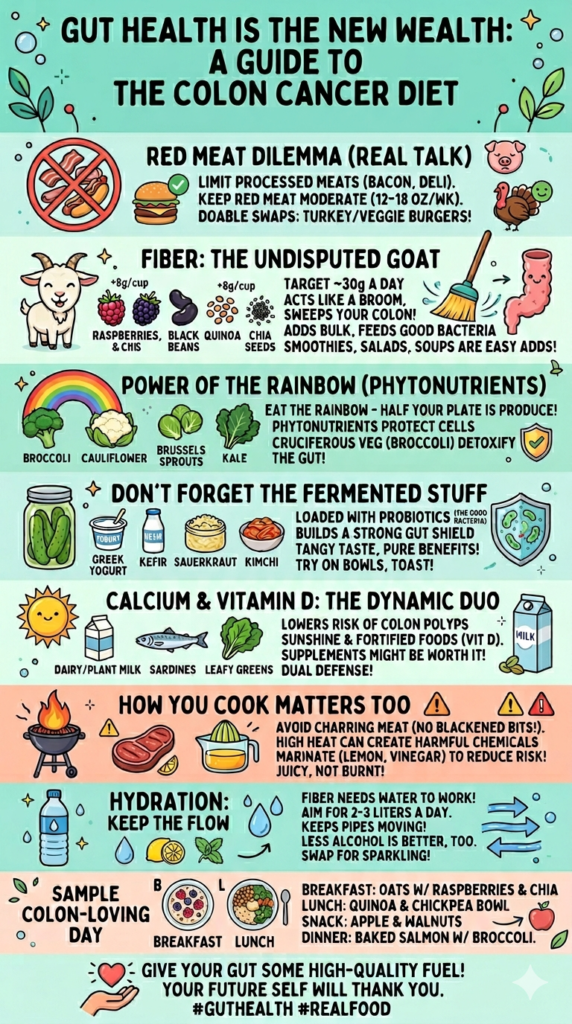
The Red Meat Dilemma (Real Talk)
This is the part that usually makes people defensive. I love a good burger as much as anyone, but the science is pretty clear here.
Large amounts of red meat (beef, pork, lamb) and, more importantly, processed meats (bacon, deli meats, hot dogs, pepperoni) are linked to a higher risk of colon cancer.
The World Health Organization even classified processed meats as a Group 1 carcinogen. That’s the same category as smoking.
Does that mean you can never have a slice of pepperoni pizza again? No. I’m 22; I’m not going to tell you to live a life without pizza. But it does mean it shouldn’t be a daily habit.
Try to limit red meat to about 12-18 ounces a week. And for the processed stuff? Treat it like a rare guest, not a roommate. When you do have a burger, try to go for grass-fed, or swap it for a turkey or veggie burger every once in a while. Your gut will thank you.
Fiber: The Undisputed GOAT
If there is a “superpower” in the colon cancer diet, it’s fiber.
Fiber does two main things. First, it acts like a literal broom, sweeping out the colon and keeping things regular. Second, it dilutes any potential carcinogens that might be hanging out in your digestive tract.
The goal is around 30 grams a day. Most people get maybe half of that.
Here’s how to hit that number without feeling like you’re eating a bale of hay:
Raspberries and Blackberries: These are fiber bombs. Throw them in your smoothies or yogurt.
Beans and Lentils: These are the MVPs of budget-friendly health. Black beans, chickpeas, lentils—put them in salads, soups, or tacos.
Whole Grains: Swap your white rice for quinoa or farro. Swap white bread for a seedy, whole-grain version.
Chia and Flax Seeds: You can’t even taste them, but a tablespoon of these adds a massive boost of fiber to your morning.
The Power of the Rainbow (Phytonutrients)
You’ve probably heard “eat the rainbow” a million times, but for colon health, it’s legit.
The colors in fruits and vegetables come from phytonutrients. These are natural compounds that help protect plants from germs and bugs, and when we eat them, they help protect our cells from damage.
Cruciferous vegetables are the heavy hitters here. Broccoli, cauliflower, Brussels sprouts, and kale contain something called sulforaphane. It sounds like a character from a sci-fi movie, but it’s actually a compound that helps detoxify the gut and might even stop cancer cells from growing.
Try to get at least five servings of fruits and veggies a day. If that sounds like a lot, just try to make half of your plate produce at every meal. It’s an easy rule to live by.
Don’t Forget the Fermented Stuff
Gut health is a huge trend right now, and for once, the trend is actually backed by solid science.
Fermented foods are loaded with probiotics. These are the “good” bacteria I mentioned earlier. A healthy, diverse microbiome is like a shield for your colon.
Start incorporating things like: Greek yogurt (check for “live and active cultures”) Kefir (it’s like a drinkable yogurt) Sauerkraut or Kimchi (amazing on bowls or avocado toast) Kombucha (just watch the sugar content) Miso
It might take a second for your taste buds to get used to the tanginess, but eventually, you’ll crave it.
Calcium and Vitamin D: The Dynamic Duo
Interestingly, research shows that getting enough calcium and Vitamin D can actually lower your risk of colon polyps (which can eventually turn into cancer).
Dairy is an easy source of calcium, but if you’re plant-based, look for fortified almond or soy milks, sardines, or leafy greens.
Vitamin D is a bit trickier because we mostly get it from the sun. If you live somewhere where it’s cloudy half the year (hello, fellow office workers), it’s definitely worth getting your levels checked and maybe taking a supplement. It’s one of the few supplements that most doctors actually agree is worth it.
How to Cook Matters Too
This is a weird one that people often overlook. How you prepare your food is almost as important as what you’re eating.
When you char meat at very high temperatures (like on a grill until it’s blackened), it creates chemicals called heterocyclic amines (HCAs) and polycyclic aromatic hydrocarbons (PAHs). These are known to be carcinogenic.
I’m not saying don’t grill. Just don’t burn it to a crisp. Marinating your meat in things like lemon juice, vinegar, or herbs can actually reduce the formation of these chemicals. So, keep it juicy, not charred.
Hydration: Keep the Flow
You can eat all the fiber in the world, but if you’re dehydrated, it’s just going to sit there. Fiber needs water to do its job.
If you’re aiming for 30 grams of fiber, you should be aiming for at least 2-3 liters of water. If you’re bored of plain water, add some lemon, cucumber, or mint. Just keep the fluids moving.
Also, keep an eye on the alcohol. High alcohol consumption is linked to a higher risk of several cancers, including colon cancer. If you’re going to drink, keep it moderate. Maybe swap that third drink for a sparkling water with lime. Your head (and your colon) will feel better the next morning.
A Sample “Colon-Loving” Day
What does this actually look like in real life? It’s easier than you think.
Breakfast: Steel-cut oats topped with a handful of raspberries, a sprinkle of chia seeds, and a drizzle of almond butter.
Lunch: A Mediterranean-style bowl with quinoa, roasted chickpeas, cucumber, tomato, feta, and a big scoop of hummus.
Snack: An apple and a small handful of walnuts.
Dinner: Baked salmon with a side of roasted broccoli (tossed in olive oil and garlic) and half a baked sweet potato.
Dessert: A small bowl of Greek yogurt with a little honey or a square of dark chocolate.
See? No cardboard in sight.
The Bottom Line
Taking care of your colon doesn’t have to be scary or boring. It’s really just about leaning into real, whole foods and pulling back on the ultra-processed stuff.
As a 22-year-old, I know it feels like we’re invincible. But the habits we build now are the ones that carry us through the next few decades.
Eating for your gut isn’t just about avoiding a disease; it’s about having more energy, clearer skin, and just feeling better day-to-day.
So, next time you’re at the grocery store, grab the broccoli, pick up the beans, and maybe leave the hot dogs on the shelf. Your gut is doing a lot of work for you—the least you can do is give it some high-quality fuel.
Stay healthy, stay hydrated, and keep that gut happy!
What’s one small change you think you can make this week? For me, it’s definitely swapping my afternoon chips for some carrot sticks and hummus. Small wins for the win!