
Let’s be real for a second. Most “healthy” diet advice is basically just someone yelling at you to eat more kale and quinoa until you start looking like a salad yourself. We have been told since we were toddlers that fiber is the golden child of nutrition. You want to be healthy? Eat fiber. You want to feel full? Fiber.
But then, life happens.
Maybe your stomach is throwing a literal tantrum (shoutout to my Crohn’s and UC warriors), or maybe your doctor told you that you need a “low-residue diet” to prep for a procedure.
Suddenly, everything you thought was “good” for you is now on the “absolutely not” list. It feels completely backwards. It is confusing, it is a little bit annoying, and honestly, it is kind of a vibe shift to be told that white bread is your new best friend.
But do not panic. I have done the deep dive so you do not have to. Here is the ultimate, human-to-human low-residue diet food list that will not make you feel like you are eating cardboard.
First Off, What Even is Residue?
Before we get to the grocery list, let’s clear up the mystery.
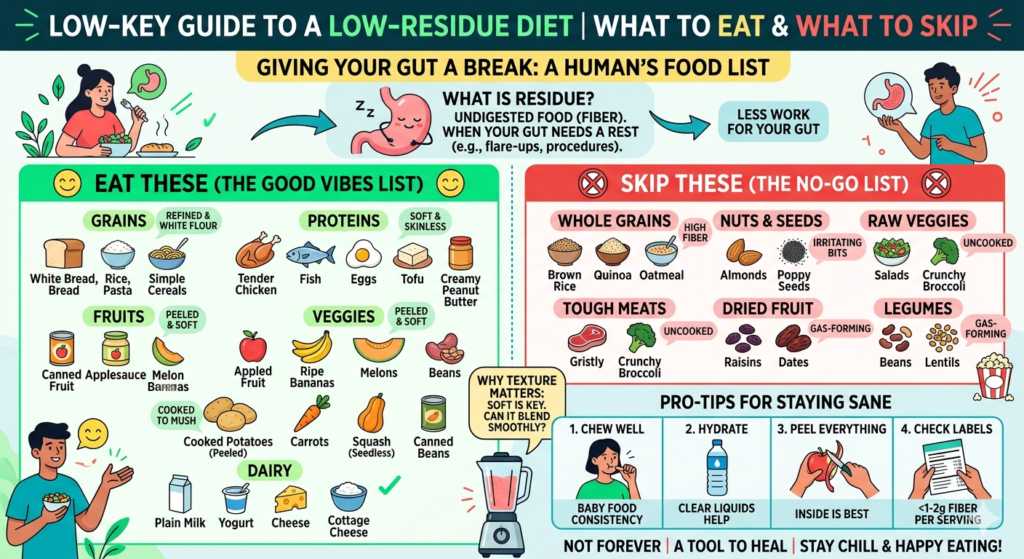
“Residue” is basically just a fancy medical word for the stuff your body cannot digest. Most of the time, that is fiber.
In a normal world, fiber is the hero. It keeps things moving. But when your digestive tract is inflamed, healing from surgery, or needing to be crystal clear for a scan, fiber becomes the villain. It is like trying to send a boulder down a waterslide. It is going to cause some friction and probably a lot of pain.
Low residue means low fiber. That equals less work for your gut. Think of it as giving your digestive system a much-needed spa day. We are keeping things smooth, easy, and low-stress.
The Green Light List: What is for Dinner?
This is the part where you get to embrace your inner child. All those refined carbs your fitness influencer cousin told you to avoid? They are the MVPs here.
1. Grains: The Refined Era
This is the one time in your life where “white” is better than “whole wheat.” Put down the brown rice and step away from the bran.
White bread, buns, and rolls: No seeds, no nuts, no grains on top. Just plain, soft, squishy bread. If it looks like it belongs in a school lunch from 2005, you are on the right track.
White rice: The ultimate safe bet. It is easy to digest and goes with literally everything.
White pasta: Butter and a little salt? Perfection. Just keep it plain and avoid any whole-grain varieties.
Crackers: Think saltines or Ritz. They are easy on the stomach and great for snacking when you feel a bit bleh.
Cereals: Cornflakes, Rice Krispies, or puffed rice. Basically, if it turns to mush in milk, you are usually golden. Avoid anything with the word “fiber” or “bran” in the title.
Pancakes and Waffles: As long as they are made with refined white flour and you do not add blueberries or chocolate chips with husks, you are good to go.
2. Proteins: Keep it Tender
You need your protein to stay strong, but the way you cook it is everything. We are going for “tender and juicy,” not “tough and chewy.”
Chicken and Turkey: Skinless is the move here. Poached, baked, or roasted until it is soft. Avoid the crispy skin because that can be hard to break down.
Fish: Flaky white fish like cod, tilapia, or salmon (without the skin). Fish is naturally very easy for the body to process.
Eggs: The GOAT of the low-residue diet. Scrambled, poached, or hard-boiled. They are easy to digest and packed with the good stuff. If you are struggling with what to eat, just make an egg.
Tofu: If you are plant-based, plain silken tofu is a great shout. It is soft and has almost zero residue.
Smooth Peanut Butter: This is a crucial distinction. It must be creamy. One stray peanut chunk can ruin the whole low-residue vibe.
3. Fruits: The Peeling Game
This is where people usually trip up. You can have fruit, but you have to be picky about it. No skins, no seeds, no membranes.
Canned fruits: Peaches, pears, and apricots are great. Just make sure they do not have the skin on them. Canned fruit is usually softer and easier to digest than fresh fruit anyway.
Applesauce: A total staple. It is basically the mascot of this diet.
Ripe bananas: The yellower (and softer) they are, the better. Avoid green bananas as they have more resistant starch.
Melons: Cantaloupe or honeydew are usually fine, just skip the seeds and the rind.
Fruit Juice: Clear juices like apple or white grape are fine. Just make sure there is zero pulp. If it looks cloudy, skip it.
4. Vegetables: Cooked to Death
If it is crunchy, do not eat it. We are looking for vegetables that have been cooked until they basically melt in your mouth.
Potatoes: Peeled and mashed or boiled. No skins allowed! The skin is where all the fiber lives.
Carrots: Cooked until they are super soft. You should be able to mash them with a fork easily.
Yellow Squash: Peeled and seeded, then cooked well.
Canned Veggies: Canned green beans (without the tough ends) or canned asparagus tips are usually safe bets.
5. Dairy: If You Are Down With It
As long as you are not lactose intolerant, dairy is usually okay on a low-residue diet.
Milk and Yogurt: Stick to plain or vanilla. No yogurt with fruit chunks or seeds.
Cheese: Hard or soft cheeses are fine, as long as they do not have added nuts or veggies.
Cottage Cheese: Low-key a great protein snack that fits the rules perfectly.
The Blacklist: Foods to Ghost
This is the part that hurts a little bit. To keep your gut happy, you have to say “thank you, next” to these for a while.
Whole Grains: Brown rice, wild rice, quinoa, oatmeal, and anything “multi-grain.” These are fiber heavyweights.
Nuts and Seeds: This includes everything from almonds to those tiny poppy seeds on a bagel. Even small seeds can get stuck and cause irritation.
Raw Veggies: No salads, no raw carrots, no crunchy broccoli. If it hasn’t been cooked to mush, stay away.
Tough Meats: Steaks with a lot of gristle or deli meats with tough casings.
Dried Fruit: Raisins, prunes, and dates are fiber bombs. They are the opposite of what we want right now.
Legumes: Beans, lentils, and chickpeas are a no-go for now. They are legendary for causing gas and having high fiber content.
Popcorn: I know, it is heartbreaking. But those hulls are the definition of residue. They are literally the enemies of a smooth digestive tract.
Why Texture Matters More Than You Think
When you are 22, you usually do not think about the texture of your food unless it’s a weird mushroom or something. But on a low-residue diet, texture is the whole game.
You want everything to be “soft.” If you have to chew it twenty times just to get it down, it is probably too high in residue.
Think about it like this. If you put the food in a blender, would it become a smooth liquid or a chunky mess? We want things that lean toward the smooth side.
A Day in the Life: A Sample Menu
What does this actually look like in practice? It is not as boring as you think.
Breakfast: Two scrambled eggs, a slice of white toast with a little butter, and a glass of apple juice. Simple, classic, safe.
Lunch: A turkey sandwich on a white roll (no lettuce or tomato) with a side of smooth applesauce.
Snack: A container of vanilla Greek yogurt or a few saltine crackers with creamy peanut butter.
Dinner: Baked chicken breast (skinless), a pile of mashed potatoes (peeled), and some very well-cooked carrots.
Dessert: A bowl of vanilla ice cream or a plain sugar cookie. See? Not all bad.
Pro-Tips for Staying Sane
Doing a low-residue diet can feel a bit restrictive, but these tips help it feel less like a chore.
1. Chew Like It is Your Job
Seriously. Digestion starts in the mouth. The more you break down your food before it hits your stomach, the easier time your gut is going to have. Aim for “baby food” consistency before you swallow.
2. Hydrate, Hydrate, Hydrate
When you lower your fiber intake, things can sometimes get a little… backed up. Drink plenty of water and clear liquids to keep things moving smoothly.
3. Peel Everything
If it has a skin, it has fiber. If you are dying for an apple, peel it completely. If you want a potato, peel it. The “good stuff” is on the inside for now.
4. Check Your Labels
You would be surprised where fiber hides. Check the “Dietary Fiber” section on the back of packs. You are generally aiming for less than 1 or 2 grams of fiber per serving.
When Will This End?
The good news is that for most people, a low-residue diet is not a “forever” thing.
It is a tool. Whether you are managing a flare-up or getting ready for a colonoscopy, it is just a phase to help your body heal or stay clear.
Once your doctor gives you the thumbs up, you can slowly start reintroducing the “good” fiber. Pro tip: do it slowly. Do not go from white rice to a giant bowl of beans overnight, or your gut will definitely let you know it is mad.
The Bottom Line
Living on a low-residue diet does not mean your food has to be sad. It just means you are being a little more intentional about texture.
Focus on the “soft, smooth, and peeled” rule, and you will be just fine.
You have got this. Your gut will thank you for the break, and honestly, sometimes a plate of buttery white pasta is exactly what the soul needs anyway.
Stay hydrated, stay chill, and happy eating!